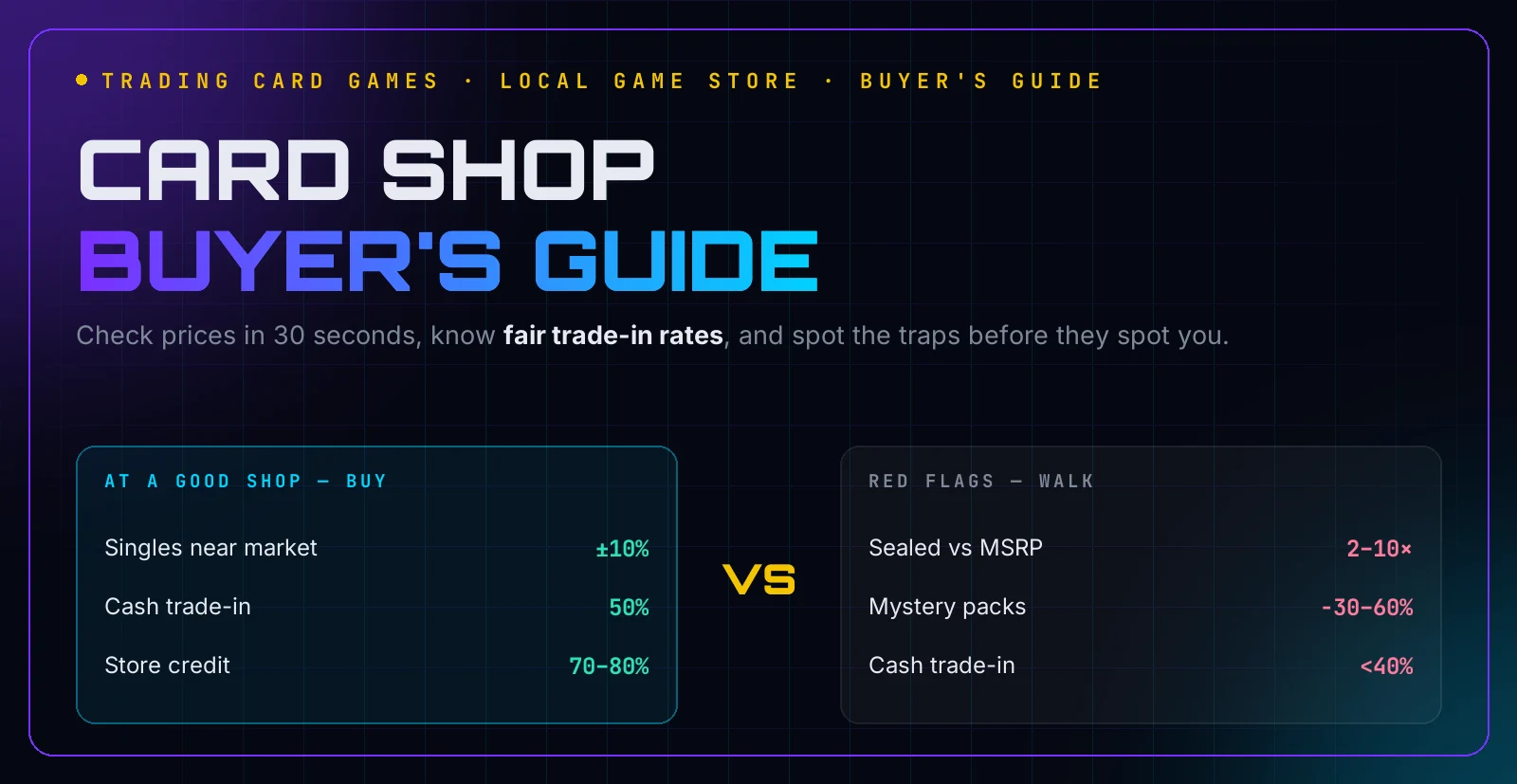
- Check every price on your phone before you pay: singles against TCGplayer market, sealed against MSRP (pack $4.49, ETB $49.99). The check takes 30 seconds.
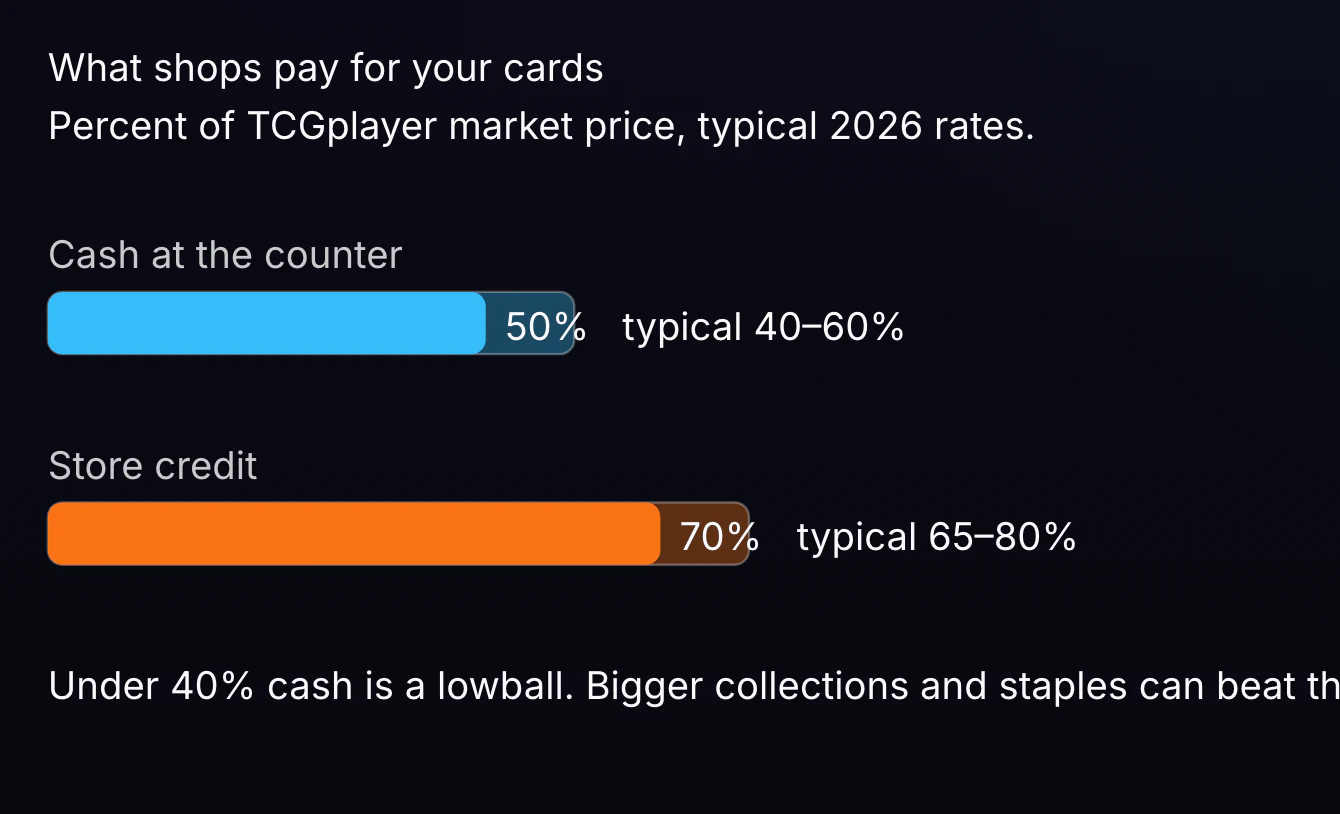
- Fair trade-in rates are 40–60% of market in cash (50% is standard) or 65–80% in store credit. Under 40% cash is a lowball — walk away or sell online.
- Skip mystery packs and repacks: they typically hold 30–60% less value than their price. The surprise is the product, not the cards.
- Good shops earn your money: sealed at MSRP, singles near market, fair buylists, and a play space. Reward them; leave the bad ones.
- Shop with a wishlist, pre-checked prices, and a hard cap. Decide all three at home, not at the counter.
Your local game store is the best place in the hobby and sometimes the most expensive. Same counter, same glass case — the difference is whether you walked in with numbers or with vibes. Public shop reviews repeat the same four complaints: sealed product at multiples of MSRP, mystery packs pushed at the register, trade-ins at half of half, and staff who bank on you not checking.
This guide fixes that. Three rules, each checkable on your phone in under a minute, plus when the shop genuinely deserves your money. It covers all TCGs — the examples use Pokémon prices because they’re the best documented, but the math works for Magic, Yu-Gi-Oh, Lorcana, and One Piece alike.
Quick Answer: The Three Rules of Card Shop Shopping
- Check the price before you pay. Singles against TCGplayer market, sealed against MSRP. If the shop’s price beats or matches, buy happily. If it’s far above, say thanks and buy it elsewhere.
- Know the trade math cold. Cash offers run 40–60% of market (50% is standard); store credit runs 65–80%. Anything under 40% cash is a lowball.
- Skip the traps. Mystery packs, loose packs from strangers, and “investment-grade” pitches at the counter. Every one of them is priced for the seller, not you.
That’s the whole system. The rest of this guide is the detail that makes each rule automatic.
Rule 1: Check the Price on Your Phone Before You Pay
Nobody memorizes card prices. The shop knows that. Your phone fixes it.
For singles: open TCGplayer (app or site) and compare the sticker to market price — the average of recent completed sales — not the lowest listing, which may be a damaged copy or a seller who never ships. Within ~10% of market is a fair shop price; you’re paying a small premium for instant possession and zero shipping. At 30%+ over market, the premium buys you nothing — order it online.
For sealed: memorize two anchors. A Pokémon booster pack’s MSRP is $4.49, and an Elite Trainer Box is $49.99 for 9 packs (Phantom Checkout MSRP guide, updated November 9, 2026). A Booster Bundle at $26.94 is the same $4.49 a pack. If the shelf price is near those numbers, it’s fair. At double MSRP or more, you’re paying a hype tax — check the live market price and decide if the set is worth it at all. The price-per-pack calculator compares every product side by side, and how to price cards to sell covers the singles side in depth.
Before any purchase over $10: search the card or product on TCGplayer, read the market price, and compare. Do it openly — good shops respect it, and the shops that glare at phones are telling you everything about their pricing.
One exception: prices below market deserve suspicion, not celebration. The Pokémon Company itself flags packs priced dramatically below retail as a near-certain sign of fakes (via Rorz Cards’ fake-pack guide). A $2 booster pack isn’t a deal; it’s either fake, searched, or weighed.
Rule 2: Know What Your Cards Are Worth Before You Trade
Selling to a shop means accepting less than market — that’s the deal, and it’s fair. The shop resells your cards, pays rent, and takes the risk that prices drop. What’s not fair is not knowing the standard rates:
| Method | Typical rate (% of TCGplayer market) | Source |
|---|---|---|
| Cash at the counter | 40–60% (50% is the standard) | Keystone Games, TCGS shows guide |
| Store credit | 65–80% | Same; e.g. Cardtropolis TCG posts 70% credit / 50% cash |
| Generous shops / hot staples | Up to 70% cash, 80% credit | TickerMint (Nov 2026) |
Three things move your offer within (or outside) those bands:
- Condition. Near-mint gets full rate; played copies get less or get rejected. Sleeve anything you might sell.
- Demand. Meta staples and liquid cards (Charizard-tax cards, fetch lands) get the best rates because the shop resells them this week. Bulk gets bulk pricing no matter what the market screen says.
- Size. A $500 stack negotiates better than a $15 single. Ask “what’s your best on the lot?” — the posted rate is often the floor, not the ceiling.
When does the shop beat selling online? When the card is worth under ~$20 (fees and shipping eat online sales), when you want credit toward tonight’s event, and when you value an hour of your life over the extra 15%. For bigger sales, how to price cards to sell walks through fees and net math, and when to sell your cards covers timing.
Rule 3: Skip the Traps
Three products exist to separate hopeful buyers from money:
Mystery packs and repacks. Third-party bundles — the blisters by the register, the “mystery slabs,” the creator-branded boxes — are priced against the fantasy of what’s inside and filled against the seller’s margin. Openings routinely show 30–60% less market value than the price paid (mystery-pack opening analysis, Nov 2026), and the honest guides call them the worst value in the store (Nine Pocket). The one fair way to buy them: as pure entertainment, with money you’d otherwise spend on a movie ticket. If the seller won’t publish odds and contents, that tells you the expected value.
Loose packs from strangers. Packs from opened boxes at flea markets, marketplace meetups, or that guy outside the event can be weighed, searched with a metal detector for the foil, or resealed. Buy loose packs only from shops you trust, and prefer sealed boxes and bundles where the packaging is intact.
Counter-side investment pitches. “This will double,” “graded copies only go up,” “last one at this price.” Sealed product as an investment is a speculation model with a bad track record for modern sets — the sealed-investment reality check has the full case. A shop pitching ROI instead of fun is selling you their margin.
Kids get the worst of every trap above: the highest markups, the most mystery-pack pressure, the lowest trade offers. If you shop with a young collector, run the 30-second check for them and teach them the trade math. It takes one trip to learn.
When the Local Shop IS the Right Place to Buy
This guide isn’t anti-shop. Good local stores are the reason paper TCGs survive, and they earn your money in ways no website can:
- Sealed at MSRP during calm periods. Between hype cycles, many shops sell at or near retail — with no shipping and no wait.
- Singles you need today. Tonight’s locals, tomorrow’s prerelease, the last two cards for a deck. The 10% premium over market is a convenience fee, and it’s worth it.
- A place to play. Entry fees rarely cover the tables, the judging, and the Friday-night lights. Buying product where you play keeps the lights on — the real cost of locals breaks down where event money goes.
- Community and expertise. A good owner talks you out of bad buys. That’s worth more than any discount code.
Reward shops that do this. Leave reviews naming what they do right. And leave shops that don’t — quietly, with your wallet.
The 5-Minute Pre-Shop Checklist
Do this at home, before every shop trip:
- Write the wishlist. Specific cards or products, nothing vague. “A booster box” becomes “one Surging Sparks booster box OR the three singles I actually want.”
- Pre-check prices. Note TCGplayer market for each single and MSRP for each sealed item. Screenshot them — shop wifi is never reliable.
- Set the cap. One number for the trip. When it’s gone, you’re done browsing the case.
- Bring the trade binder sorted. Pull trade candidates in advance, check their market prices, and know your walk-away number (50% cash, 70% credit).
- Log it the same day. Every purchase goes into your TCG budget as real money. How to budget for trading card games fits the trip into a monthly system, and how to stop impulse-buying booster packs is the emergency brake when the case starts whispering.
A TCG budget in Hunter Vault shows what’s left this month, and Safe-to-Spend shows what’s free after bills and savings — so you know whether that display case is calling with your hobby money or someone else’s.
Related guides:
- How to Budget for Trading Card Games Without Going Broke — the full monthly framework
- How to Price Trading Cards to Sell — online selling fees and net math
- Sealed vs. Singles: Which Is Cheaper for TCG Players? — the full comparison
- The Real Cost of Playing TCG at Locals and Tournaments — entry, travel, and deck costs
- When to Sell Your Cards (and When to Hold) — timing your sales
- How to Stop Impulse-Buying Booster Packs — tactical impulse control
Frequently Asked Questions
Are local card shops overpriced?
Some are, some aren't — that's exactly why you check. A fair shop sells singles near TCGplayer market price and sealed product near MSRP. An overpriced one charges double MSRP or more on sealed and above-market on singles. The 30-second phone check in this guide tells you which kind you're standing in before you pay.
What percentage do card shops pay for trade-ins?
Most shops pay 40–60% of TCGplayer market value in cash (50% is the common standard) or 65–80% in store credit. A shop offering under 40% in cash is lowballing. Bigger collections and high-demand staples sometimes get better rates, so it pays to ask.
Are card shop mystery packs worth it?
Almost never, if you care about card value. Mystery packs and repacks typically contain 30–60% less market value than their price, because the price includes the seller's margin. Buy one only if you're deliberately paying for the surprise-opening experience with entertainment money.
Should I buy singles online or at my card shop?
Buy time-sensitive singles (tonight's locals, a deck you need this weekend) at the shop, and patient singles online. Online wins on price for most cards once you factor in selection, but the shop wins on zero shipping wait and no minimums. Check both prices — the gap is often smaller than players assume.
How do I know a booster pack hasn't been searched or weighed?
Buy sealed product from sealed boxes or reputable shops, not loose packs from unknown sellers. Avoid packs priced far below retail — The Pokémon Company itself flags dramatically-below-retail pricing as a near-certain sign of fakes. If a deal looks too good, the packs are the reason.