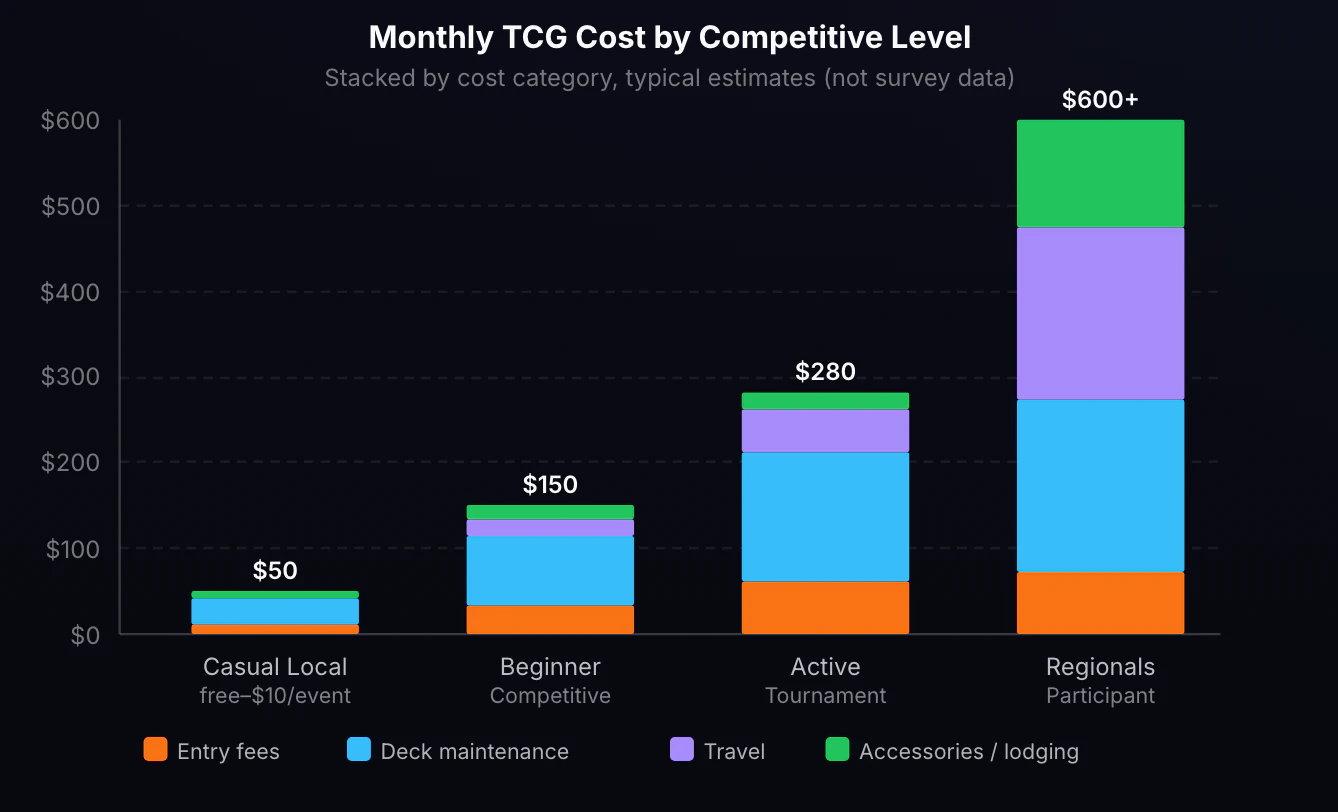
- Competitive TCG costs far more than casual play — the deck itself is often the smallest recurring expense once travel and maintenance are included
- Regional and nationals attendance costs $250–$600+ per event once entry, travel, and lodging are added up
- Deck maintenance — buying new singles as the meta shifts — typically runs $50–$150/month for active tournament players
- Calculate your 'cost per round' to compare events honestly and find the best value for your competitive spending
- The single biggest budget lever: focus on one format in one game, rather than splitting time and money across multiple
The $10 locals entry fee is not the real cost of competitive TCG. It’s the visible part — the number on the event flyer that makes competitive play feel accessible. The actual cost structure includes deck maintenance as the meta shifts, travel and lodging for higher-level events, accessories, side events, and the ongoing pressure to keep your list current.
Understanding the full cost picture doesn’t mean you shouldn’t play competitively. It means you can plan for it accurately instead of being surprised by the monthly total. The figures below are typical estimates, not survey data, and your game, store, and region will change them.
The Cost Breakdown by Competitive Level
Entry Fees: The Visible Cost
Locals entry fees are low by design — they’re what gets you in the door.
Casual weekly locals: Free to $10. Many LGS-run casual nights charge nothing or a nominal $5 that goes toward prize support. These events are typically informal, run 3–4 rounds, and offer a promo or pack as participation prize.
Structured competitive locals: $10–$20. Pokémon League Challenges, Magic Game Day events, and similar organized play carry higher entry that funds better prize support (store credit, booster boxes for top cut) and structured pairings.
Regionals and larger events: roughly $30–$75. Main-event entry at regional championships in major TCGs (Pokémon, Magic, One Piece) often lands somewhere around $30–$60, but fees vary by event and organizer, so check the event page. Nationals and larger international qualifiers can cost more.
Entry fees are the least variable part of tournament costs. The bigger variables are below.
Deck Maintenance: The Real Ongoing Expense
This is the cost most competitive players underestimate. Competitive metas are not static — they shift with new set releases, new tournament results, and community-driven discoveries about card synergies.
An active tournament player doesn’t just maintain the same deck month after month. They adjust it:
- New set releases introduce cards that replace or upgrade existing pieces
- Meta shifts make some cards less relevant and others essential
- Archetype pivots happen when a deck stops placing and a player switches entirely
A realistic maintenance budget for an active tournament player in Pokémon, Magic, or One Piece TCG: $50–$150/month. That covers buying singles to upgrade the list, adding new tech cards, or partially rebuilding after a meta shift.
Budget players who avoid deck maintenance tend to fall behind in competitive events — their list becomes a known quantity that opponents can play around. Staying competitive requires ongoing investment.
Before spending money on deck changes, proxy the new cards and test them in casual play or against a friend. Many “must-have” upgrades prove less impactful in practice than they appear on paper. Test for two weeks before buying. This alone can noticeably cut what you spend on upgrades.
Travel: The Cost That Scales Fast
Locals: Zero to modest. If you drive to your LGS, the gas cost is minimal. Some players bike or use transit.
Regionals: This is where travel becomes a real budget line. Regional championships are held in cities, and players often drive 2–4 hours or fly. Real costs:
- Gas: $15–$60 round trip depending on distance
- Flights: $150–$400+ if the regional is in another city
- Hotel: $120–$200/night for 1–2 nights near the venue
- Food: $40–$80 for the day (venues are notorious for expensive on-site food)
- Parking: $15–$30/day at convention centers
A regional weekend for a player who flies: easily $400–$600 before a single card is purchased. Even driving to a regional a few hours away with a hotel stay totals $200–$350.
Nationals/World Championships: These are travel events. Players budget $800–$2,000+ for flights, hotels, and expenses. Most competitive players save for these separately from their monthly TCG budget.
Accessories: Sleeves, Binders, Deck Boxes
The recurring accessories cost is small individually but consistent:
- Sleeves: Quality sleeves (KMC, Dragon Shield) run $8–$15 per pack of 100. Competitive players often resleeve their decks every 1–3 months. That’s $10–$30/quarter.
- Deck boxes: $10–$40 per box. Most competitive players own several.
- Playmats: $20–$80 for a quality mat. Not replaced often, but notable upfront.
- Binders and pages: For collection storage and transport. $15–$30 for quality options.
The monthly accessories amortization is modest — roughly $10–$25/month for an active player — but it’s money that never shows up in estimates of “how much does it cost to play competitively.”
Side Events and Collector’s Side
Most larger tournaments run side events: sealed rounds, drafts, collector’s events. Entry is $10–$40 per side event. Players attending a regional often spend $40–$100 on side events beyond their main event entry.
Side events are optional, but they’re specifically designed to extend your time at the event and capture additional spend. Budget for them explicitly rather than deciding in the moment.
Calculating Your Cost Per Round
Cost per round (CPR) is a useful metric for comparing events and evaluating whether competitive play is delivering value for the spend.
Formula: Total event cost ÷ number of rounds played
| Event | Total Cost | Rounds | CPR |
|---|---|---|---|
| Free casual local (4 rounds) | $0 | 4 | $0 |
| $15 competitive local (4 rounds) | $15 | 4 | $3.75 |
| $50 regional (9 rounds) with $200 travel | $250 | 9 | $27.78 |
| $50 regional (9 rounds) with $400 travel | $450 | 9 | $50.00 |
CPR makes the cost of competitive escalation visible. A player spending $27 per round of competitive TCG is doing so because they enjoy it — which is a valid reason — but they should know that’s what they’re paying.
Budget Tips for Competitive Players
Focus on one format in one game. Format switching means rebuilding your deck — new cards, new accessories, new meta knowledge. Players who split time between Modern and Standard in Magic, or between multiple TCGs, usually spend noticeably more than those who commit to one.
Calculate your ‘tournament travel radius.’ Decide in advance how far you’ll travel for each event tier. If you’ll only drive to regionals within 2 hours, you eliminate a major cost category for most events.
Plan for set releases in your deck maintenance budget. New set releases will require deck updates. Setting aside a fixed monthly amount specifically for deck maintenance (separate from casual pack purchases) prevents the “I need to buy 8 singles before the regional” panic spend.
Budget the trip, not just the entry. Before registering for a regional, calculate the full trip cost: entry + travel + hotel + food + estimated side events. That’s your actual number.
For a framework that puts tournament costs in the context of your complete TCG budget — including singles, sealed, and accessories — How to Budget for Trading Card Games covers all five spending categories.
For how to choose between sealed product and singles when maintaining your competitive deck, Sealed vs. Singles: Which Is Cheaper runs the full cost comparison.
This is general educational content, not financial advice. Entry fees, travel, and card prices vary widely by game and region, so build your tournament budget from your own receipts rather than these estimates.
Hunter Vault’s budget planner lets you set a monthly TCG budget, and you can log entry fees, deck upgrades, and travel as separate expense categories when you record them. For a bigger event, a savings goal tracks the money you’re setting aside for the trip, so you can see the full picture in one place.
Frequently Asked Questions
How much does it cost to play at a TCG locals event?
Casual locals are typically free or $5–$10 entry. More structured weekly competitive events charge $10–$20. Entry usually includes a pack or promo card as a participation prize. The bigger cost for competitive locals isn't the entry fee — it's deck maintenance, as the meta shifts and specific cards need to be replaced or upgraded.
What does a regional TCG tournament cost to attend?
Regional entry fees are typically $30–$75. Add travel costs (gas or flights, depending on distance), lodging for a multi-day event ($100–$200/night), food, and any last-minute deck upgrades before the event. A regional weekend for an active competitive player often totals $250–$600 all-in, depending on how far you travel.
How much does deck maintenance cost in competitive TCG?
Competitive decks rotate as the meta evolves — cards that were core pieces two months ago may now be tech cuts or full removes. As a typical estimate, active tournament players spend $50–$150/month on deck adjustments: buying new singles, upgrading versions of cards, or pivoting to a new archetype when their deck stops placing. This is one of the hidden costs that casual estimates miss.
What is 'cost per round' and how do I calculate it?
Cost per round is your total tournament spending divided by the number of rounds you played. For a $15 entry (4-round local), your floor is $3.75/round before travel. Add in your share of deck maintenance and accessories amortized over the month and the real cost per round is typically $8–$25 depending on your competitive level. It's a useful metric for comparing events — a $50 regional with 9 rounds has lower CPR than a $20 local with 3 rounds.
Can I play competitive TCG on a tight budget?
Yes, with deliberate focus. The key strategies: pick one format and stick with it (format switching means rebuilding the deck), use proxies for testing before buying new cards, watch meta reports before purchasing singles for deck changes, and concentrate your spending on one game rather than spreading across two or three. Budget local players who focus on a single format can often keep it to roughly $50–$100/month all-in.