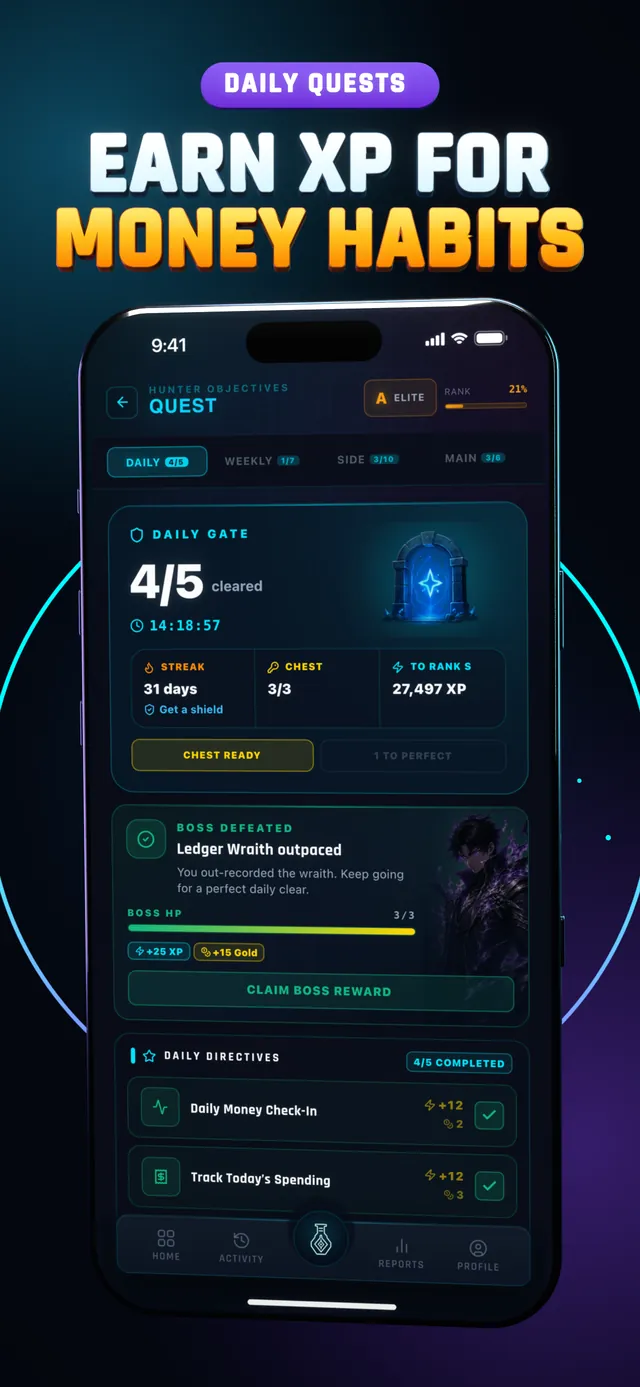
Pick a matchup.
 Hunter Vault
Zero-based budgeting vs gamified momentum
YNAB charges $14.99/month and requires assigning every dollar before you spend it. See how Hunter Vault differs on price, approach, bank sync, and what each app is actually built for.
See full comparison → Hunter Vault Premium bank-sync dashboard vs free gamified habits
Monarch is a polished, subscription-priced app built around bank syncing and net-worth tracking. See how Hunter Vault compares on price, privacy, approach, and who each app is for.
See full comparison → Hunter Vault Bill-cutting + bank sync vs private gamified budgeting
Rocket Money links your accounts to track bills and cancel subscriptions, behind its own paid tiers. See how Hunter Vault compares on bank sync, privacy, price, and approach.
See full comparison → Hunter Vault City-builder logging vs RPG money habits
Fortune City is great for building the expense-tracking habit. See how Hunter Vault compares on savings goals, debt payoff, bills, and what happens after logging alone isn't enough.
See full comparison → Hunter Vault Gamified life vs gamified money
Habitica turns any habit into an RPG but has no money features. See how Hunter Vault compares on budgeting, penalties, privacy and pricing, and when to use both.
See full comparison → Hunter Vault Envelope method vs gamified momentum
Goodbudget and Hunter Vault are both manual, no-bank apps. See how they differ on method, household sharing, pricing, and what actually keeps you logging.
See full comparison → Hunter Vault Minimal logger vs gamified momentum
Monefy nails fast tap-to-log tracking, but moved Pro to a subscription and has data-loss complaints. See how Hunter Vault compares on price, backup, budgeting depth, and motivation.
See full comparison → Hunter Vault Bank-synced dashboard vs reliable manual tracking
Spendee leans on bank sync and shared wallets, and recent updates frustrated many users. See how Hunter Vault compares on reliability, data ownership, pricing, and approach.
See full comparison → Hunter Vault Freemium wallet manager vs free gamified habits
Money Lover is a capable wallet-based tracker, but moved Premium to a subscription, runs ads, and needs an account. See how Hunter Vault compares on price, ads, and approach.
See full comparison → Hunter Vault Bank-sync dashboard vs manual-first reliability
Wallet by BudgetBakers is built around bank sync — and dropped connections are its top complaint, even on Premium. See how Hunter Vault's manual-first approach compares.
See full comparison → Hunter Vault Detailed ad-supported ledger vs simple gamified tracking
Money Manager (Realbyte) is powerful but ad-supported — with reports of ads after paying — and heavier than many need. See how Hunter Vault compares on ads, price, and simplicity.
See full comparison → Hunter Vault Ramsey zero-based method vs flexible gamified budgeting
EveryDollar brings Ramsey's zero-based method to a clean app, but bank sync is paywalled and it leans on a paid ecosystem. See how Hunter Vault compares on price, flexibility, and motivation.
See full comparison → Hunter Vault Apple-only subscription vs free, cross-platform
Copilot is a polished Apple-only tracker — subscription-only, iPhone/Mac exclusive, and bank-sync dependent. See how Hunter Vault compares on price, platforms, and reliability.
See full comparison → Hunter Vault Business expense reports vs personal budgeting
Expensify is built for business expense reports and reimbursement, with reports of surprise charges. See how Hunter Vault compares as a simple, free, private personal budget app.
See full comparison → Hunter Vault Shared group bills vs budgeting your own money
Splitwise runs shared group bills; Hunter Vault budgets your own money and can split an expense to track what friends owe you. See how they compare on purpose, price, and the ads and paywalls Splitwise users report.
See full comparison → Hunter Vault AI spending roast vs positive-reinforcement quests
Cleo uses AI feedback and bank sync to show spending patterns. Hunter Vault uses quests and XP with no bank link required. Compare on approach, privacy, pricing, and what each is actually for.
See full comparison → Hunter Vault Quicken spending plan vs free gamified manual tracking
Simplifi is a clean bank-sync spending plan from Quicken at $47.88/yr — US bank-focused, no gamification. See how Hunter Vault compares on price, bank sync, motivation, and fit.
See full comparison → Hunter Vault Bank-sync 'In My Pocket' vs manual Safe-to-Spend with gamification
PocketGuard shows 'In My Pocket' from live bank data. Hunter Vault shows Safe-to-Spend from manual entries — with quests and XP to build the habit. Compare on approach, privacy, and price.
See full comparison →