This article is for informational and educational purposes only. Sealed TCG products are speculative collectibles — not savings vehicles or reliable investment assets. Past price appreciation for specific sets does not predict future returns for any product. Nothing here constitutes financial advice. Consult a licensed financial professional before making significant financial decisions.
- Vintage sealed product (1st edition Pokémon, early Magic) has produced real long-term appreciation — but those are exceptions, not the rule
- Most sealed product released after 2020 has corrected downward from launch highs as large print runs kept supply available
- Storage costs $5–$20/month; over 5 years at $10/month that's $600 added to your cost basis before any return is earned
- The S&P 500 has historically returned ~10% annually without storage costs, illiquidity risk, or platform fees — a meaningful comparison point
- Frame sealed buying as a hobby choice with speculative upside, not as an investment strategy; only use capital you can afford to lose
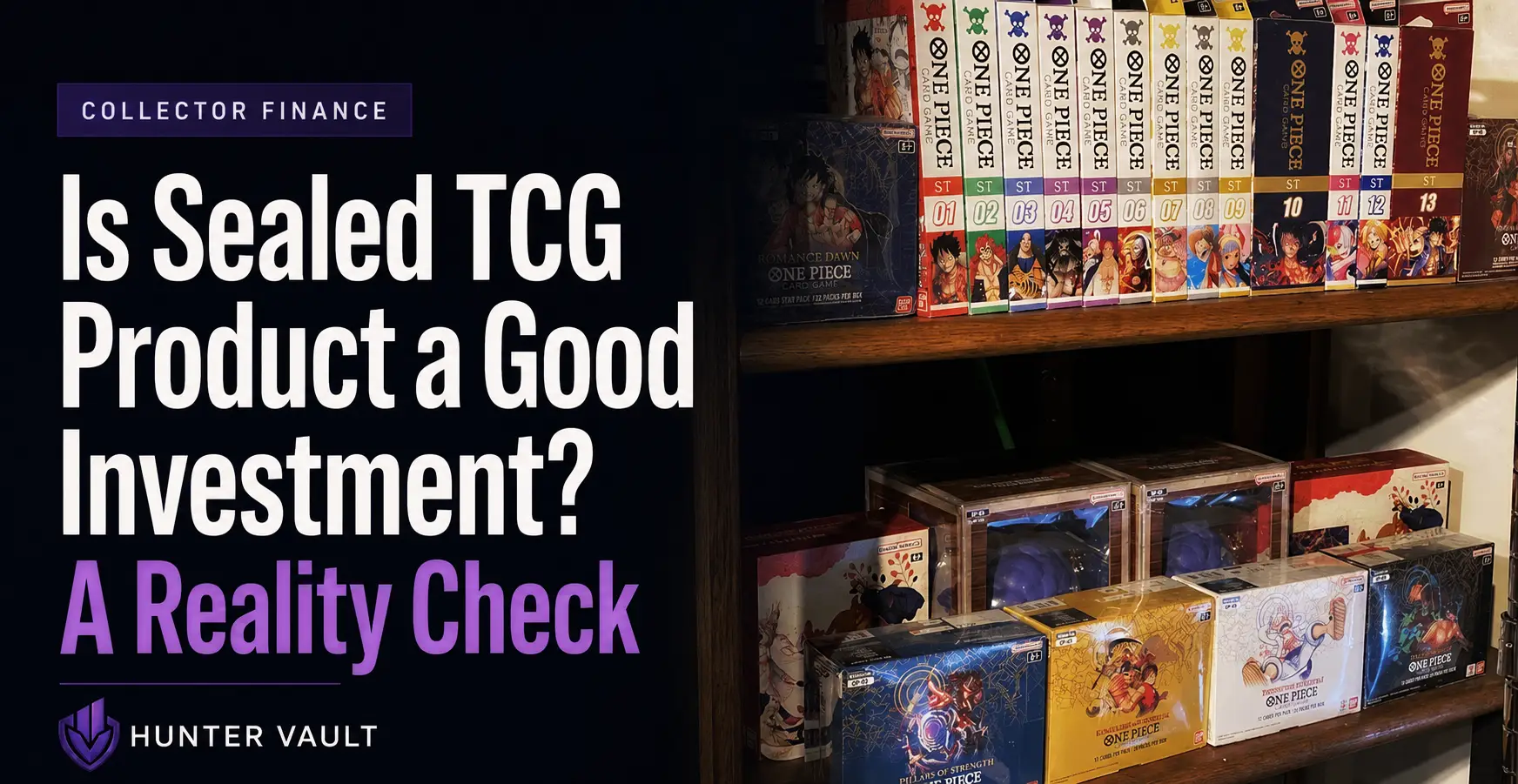
In October 2021, a sealed 1st Edition Pokémon Base Set booster box sold at Heritage Auctions for $408,000. Stories like that one — and the broader pandemic-era surge in card prices — created a narrative that sealed TCG product is a smart investment.
That narrative needs scrutiny. The 1st Edition Base Set box is genuinely exceptional: a product with a real print run that ended, cultural staying power spanning two decades, and collector demand that compounds over time. Most sealed TCG product sold today shares none of those characteristics.
Here’s what the actual data shows — and what it doesn’t.
The Case for Sealed Product
Sealed TCG products have some genuine attributes that other collectibles don’t:
Provenance and authenticity. A factory-sealed box has built-in authenticity verification. You know exactly what’s inside (a known set), and you know it hasn’t been searched, weighted, or tampered with. For grading purposes, sealed product opened in front of witnesses or on camera has a paper trail that raw-purchased singles don’t.
Cultural staying power for iconic sets. Pokémon has maintained cultural relevance for nearly 30 years. Magic: The Gathering has a dedicated tournament and collector base that’s been active since 1993. For sets tied to that kind of cultural bedrock, there’s a plausible long-term appreciation case — particularly for products where the print run genuinely ended.
Scarcity compounds over time for vintage. A sealed box from 1999 becomes harder to find in excellent condition every year. Storage conditions degrade boxes; collectors open them; accidents happen. The pool of high-quality sealed vintage product genuinely shrinks, which supports price appreciation.
The vintage record. 1st Edition Pokémon boxes, Alpha/Beta Magic booster packs, and certain regional-exclusive early prints have produced exceptional long-term returns for holders who have had them for 15+ years. That record is real.
The Indexed Price Reality by Product Era
The chart below shows how sealed product from three different eras has typically performed over holding periods, indexed to 100 at launch.
The chart shows the divergence clearly. The vintage appreciation story is real — but it applies to a specific category of product that no longer comes to market. Modern sealed product released after 2020 generally follows the opposite trajectory.
The Modern Sealed Reality
The 2021 TCG market surge brought a wave of new buyers into sealed product as a speculative play. What followed was predictable in retrospect: publishers responded to elevated demand with elevated print runs, secondary market supply caught up, and prices corrected.
Several Pokémon sets from 2021–2023 that launched at $120–$160 per booster box are now available for $60–$100 on the secondary market. The exception — sets with notable chase cards and strong competitive play — has been partial price recovery, but rarely a return to launch highs for sealed product specifically.
The underlying mechanics work against modern sealed appreciation:
Massive print runs. Publishers learned from the 2021 shortage and scaled print capacity significantly. Sets with large initial print runs have ample secondary market supply available immediately after launch.
No print run scarcity. Modern TCG publishers have no obligation to stop printing a set. If demand persists, supply increases to meet it. The artificial scarcity that made vintage sealed valuable doesn’t exist for current products.
Launch window demand spike. Set launch periods concentrate demand from multiple buyer types simultaneously: players who want to play competitively, collectors chasing specific cards, and investors buying sealed hoping it will appreciate. Once that three-way demand passes, the remaining supply is competing against all the boxes that didn’t sell during the spike.
The 2021 correction. Many investors who bought sealed product at 2021 peak prices are still holding it at significant losses three years later. That lesson has been broadly absorbed in the collecting community.
The Storage Cost Problem
Sealed product holding strategies have a cost that rarely appears in casual ROI calculations: storage.
TCG sealed products are cardboard. Cardboard is sensitive to humidity, temperature fluctuation, pests, sunlight, and physical compression. A sealed box stored improperly for five years could have visible warping, fading, or moisture damage — all of which dramatically reduce its value.
Proper storage requires:
- A stable temperature (ideally 65–70°F) and low humidity (around 45–55% RH)
- Archival-quality boxes or containers that protect from light and compression
- Regular monitoring for humidity and temperature fluctuations
- Insurance coverage for high-value holdings
Estimated monthly storage costs:
| Setup | Monthly cost | 5-year total |
|---|---|---|
| Climate-controlled closet + dehumidifier | $5–$8 | $300–$480 |
| Dedicated storage unit (small, climate-controlled) | $15–$25 | $900–$1,500 |
| Professional storage with insurance | $20–$50+ | $1,200–$3,000+ |
At $10/month for a basic home setup, a five-year hold adds $600 to your cost basis. That $600 needs to be recovered in appreciation before you’ve broken even on storage alone.
Most sealed product ROI calculations omit storage costs entirely. A modern booster box that costs $160 at launch and sells for $130 three years later hasn’t just lost $30 — it’s lost $30 plus the full storage cost over that period. The actual loss is significantly larger than the price decline alone.
Opportunity Cost: The Comparison That Matters
The cleanest measure of whether sealed product speculation makes sense isn’t whether the product went up in value — it’s whether it went up more than the alternative use of that capital.
The S&P 500 index has returned approximately 10% annualized over long periods, before taxes. On a $1,000 investment:
- After 1 year: ~$1,100
- After 3 years: ~$1,331
- After 5 years: ~$1,611
A modern sealed product that declines from $1,000 to $700 over three years — not an unusual outcome for post-2020 sets — has underperformed an S&P 500 index fund by roughly $631 over that same period. The comparison isn’t theoretical: it’s the actual cost of the allocation decision.
For vintage sealed product with real appreciation (e.g., a $1,000 vintage product rising to $3,200 over three years as shown in the chart above), the calculation reverses dramatically — and the vintage case is compelling for holders with access to those products and the capital to hold them.
But few collectors have access to authentic vintage sealed product at reasonable prices, and the transaction costs (platform fees, authentication, insurance) are substantial on both ends.
Who Sealed Speculation Might Make Sense For
There’s a narrow set of criteria where sealed product speculation has historical support:
- Vintage sets with verified authenticity and genuine print run scarcity — where the product can no longer be manufactured
- Capital you can genuinely lock up for 10+ years without needing to access it
- Proper storage infrastructure already in place that doesn’t add significant ongoing cost
- Deep hobby knowledge about which sets have cultural staying power versus which are trend-driven
- Ability to absorb a total loss without affecting financial security — because collectible markets can collapse
If those criteria don’t all apply, sealed product speculation is better understood as a hobby choice with uncertain financial outcome — not an investment strategy.
The Practical Conclusion
The most grounded way to think about sealed TCG purchases:
- Budget them as a hobby expense
- If the product appreciates, that’s a pleasant outcome
- If it depreciates, you enjoyed owning it and it cost you the difference
- Never buy sealed product with money you’d need back within 5 years
- Never buy sealed product instead of funding an emergency fund, retirement account, or other financial priority
For collectors building a TCG budget that accounts for sealed product honestly, see How to Budget for Trading Card Games.
For the broader question of whether card collecting can make financial sense, see Is Collecting Trading Cards a Good Investment?.
For a detailed comparison of sealed versus singles as a spending strategy, see Sealed vs. Singles: Which Is Cheaper for TCG Players?.
If you do hold sealed product as part of your hobby collection, Hunter Vault’s Reports feature lets you track what you paid versus current market estimates — so you always know where your collection stands, not just what you hoped it would be worth.