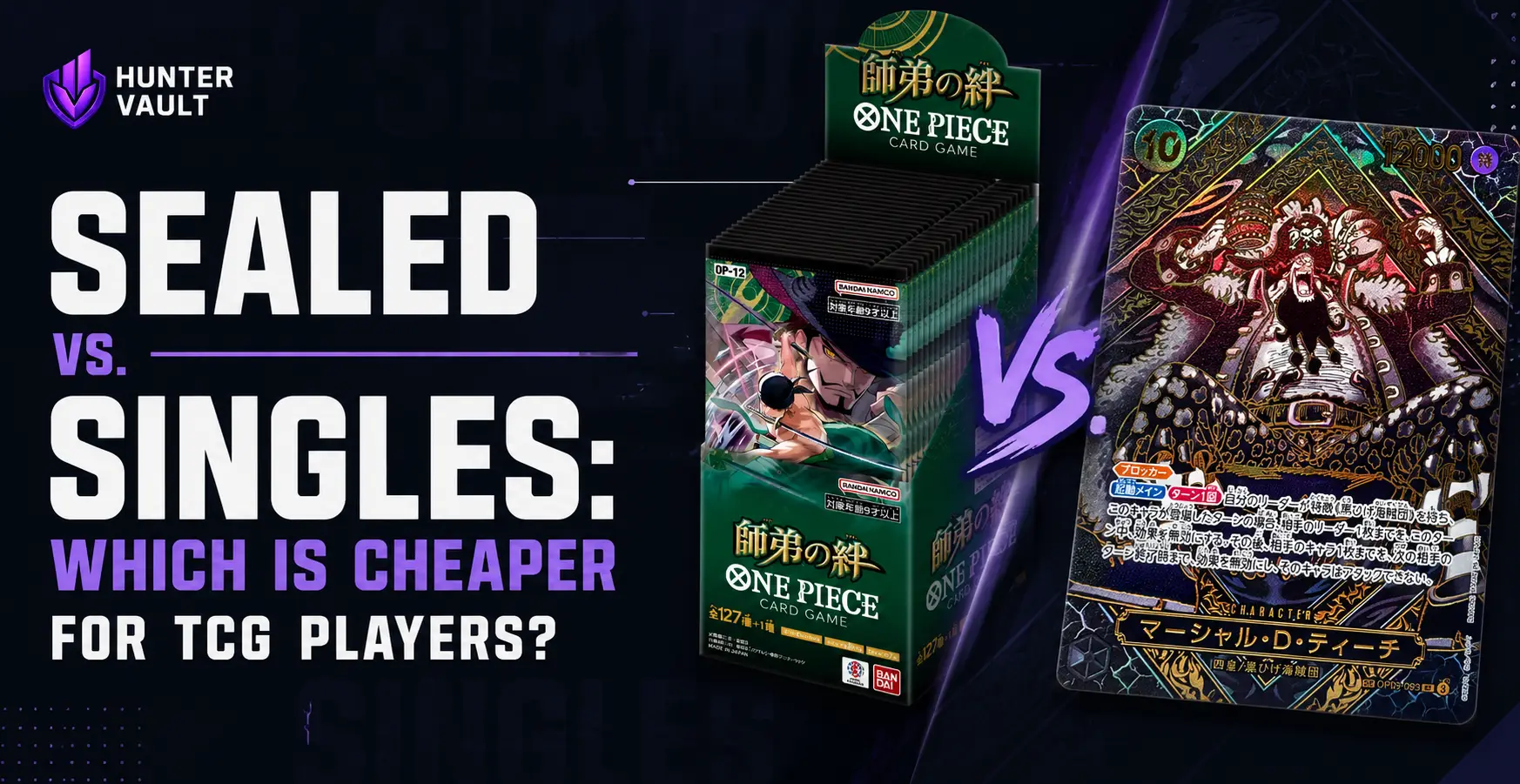
- For every goal except the opening experience itself, singles are cheaper than sealed product — usually by a large margin
- Building a competitive deck via sealed typically costs 3–5× more than buying the singles you need
- Expected pack spend to pull a specific chase card is often 4–10× the card's singles price
- The FOMO premium is real — opening at set launch means paying peak prices before the market settles
- Sealed is justified when entertainment is the explicit goal; budget for it as an experience, not a strategy
Singles win on cost. That’s the short answer. For almost every TCG goal that involves actually owning specific cards, buying singles on the secondary market is cheaper than cracking packs to acquire them. The math is rarely close.
That’s not an argument against sealed product. Opening packs is a distinct hobby experience and a legitimate reason to buy them. But the decision to buy sealed vs. singles should be a deliberate one, not the default path because it feels more exciting.
Here’s the comparison across every common TCG goal.
The Four Goals — and Which Route Is Cheaper
Goal 1: Building a Competitive Deck
Singles win, and it’s not close. A typical competitive deck across major TCGs contains 3–6 cards worth $20 or more, plus a supporting cast of uncommons and commons. Buying those cards directly on TCGplayer or your local game store’s singles case costs $100–$300 depending on the format.
Getting the same cards through sealed product means opening packs until you hit them — and since most valuable rares have pull rates of 1-in-20 to 1-in-72 packs, the expected cost via sealed is 3–5× higher.
Example: Building a Pokémon competitive deck with two specific ex cards
| Route | Cost |
|---|---|
| 2 specific ex cards at $40 each (singles) | $80 |
| Full competitive deck (remaining cards as singles) | +$80 |
| Total via singles | ~$160 |
| Expected packs to pull both ex cards (2× 1-in-40 rate, $5.50/pack) | ~$440 |
| Additional packs to fill out the rest of the deck | +$150 est. |
| Total expected via sealed | ~$590 |
The savings are significant. A player who commits to singles for deck building typically spends 70–80% less than one who cracks packs hoping to hit their list.
The one caveat: some deck components are cheap enough that pulling them from sealed product is fine. Commons and uncommons can be cheaper to acquire through bulk lots or by pulling them incidentally. But the rare, high-value pieces — the ones driving most of the deck cost — should almost always be bought directly.
Goal 2: Hitting a Specific Chase Card
Singles win by an even larger margin. Chase cards — the secret rares, special illustration rares, full-arts that drive set excitement — have low pull rates precisely because they’re rare. The expected pack spend to pull one often exceeds the card’s secondary market price by 3–10×.
The math formula: expected spend = pull rate (packs) × pack price
If a card pulls at 1-in-60 packs at $5.50 each, expected spend is $330. If the same card lists on TCGplayer for $90, buying the single saves $240.
This is why pull rate math is worth knowing before you decide to crack packs for a target. Once you’ve run the numbers for your specific card and set, the singles vs. sealed decision becomes obvious in most cases.
If you’ve opened packs and haven’t hit your target, check the singles price after every five packs. Once your cumulative pack spend has matched or exceeded the singles price, you’re now paying more per attempt than the card costs to buy outright. At that point, stop opening and buy the single.
Goal 3: Completing a Set
Singles win, but the margin is smaller than you might expect. Completing a set means acquiring every card — including the high-rarity pulls, but also hundreds of commons and uncommons. Singles for commons are cheap ($0.10–$0.50 each), so the total cost via singles is manageable even if it takes effort.
Expected sealed cost to complete a set: Opening full boxes until you’ve statistically hit every rare and ultra-rare can cost $600–$1,200+ for a large set. You’ll have extreme duplicates of commons while still missing specific rares.
Expected singles cost to complete a set: Buying commons in bulk ($0.10–$0.25 each), uncommons at $0.50–$1.00, and rares at market price typically totals $200–$400 for a full set. The labor is finding and ordering hundreds of cards, but the cost difference is real.
The exception: some players buy sealed boxes and use the remaining budget to fill gaps with singles. That hybrid approach — cracking a few boxes for the experience, then completing the set via singles — is often the practical middle ground for set completionists.
Goal 4: Opening for Fun (Entertainment)
Sealed wins — because singles don’t offer the same experience. This is the one goal where sealed product isn’t about efficiency. The opening experience itself is the point: the pack texture, the shuffle sound, the moment of flipping a card face-up. Singles can’t replicate that.
If your goal is to open 36 packs and enjoy the ride, you’re paying $180–$200 for the experience. That’s a legitimate use of money. The key is framing it correctly — you’re buying entertainment, not cards. If you’re hoping the pulls will “cover” the cost, you’re likely to be disappointed, because the math doesn’t support that expectation in most sets.
Budget for sealed entertainment the same way you’d budget for a concert or a dinner out: an experience with a known price, not an investment with an expected return.
The FOMO Premium: What It Costs You
Set release timing matters more than most players account for. When a new set drops, secondary market prices are high because supply is low and demand is at its peak. That $90 chase card might be $65 two months later once more product has been distributed and initial excitement has settled.
FOMO premium in action:
- Set launch week: chase card lists at $90 on TCGplayer
- Week 6 after release: same card at $65
- Month 4: card stabilizes around $55
The player who had to have the card during launch week paid $35 more than the one who waited. Multiply that across a few cards and a few set releases, and the annual FOMO premium is meaningful.
The same dynamic applies to sealed product. Box prices at launch reflect peak demand. Waiting 6–8 weeks typically brings box prices down 15–25% as retail inventory catches up.
For any sealed product or singles purchase driven by set release excitement, wait 30 days. In most cases, the price will be lower, you’ll have more information about which cards are actually meta-relevant, and the urgency will have faded. The cards will still be there.
When Sealed Product Makes Sense Beyond Entertainment
There are a few legitimate reasons to buy sealed beyond the opening experience:
Limited format play. Draft events, sealed events, and prereleases require product. That’s a functional use case where sealed is the right product.
Sealed as a long-term hold. Some sealed product appreciates over years, particularly first-edition or short-print sets. This is a speculative investment — treat it as such, with money you can afford to have illiquid for years.
Gift purchases. A sealed booster bundle is a more intuitive gift than a stack of singles for most recipients.
Bulk-building a new game. When you’re starting a new TCG and want exposure to the whole card pool, a few booster packs or a booster bundle is a reasonable way to learn the set. Once you know what you want, switch to singles.
How to Apply This in Practice
Before any TCG purchase, answer two questions:
- What is my actual goal? Own specific cards? Build a deck? Complete the set? Enjoy the opening experience?
- What is the cheapest way to meet that goal?
For the first three goals, that almost always points to singles. For goal four, it points to sealed.
If you’re buying sealed when your actual goal is cards, you’re paying a FOMO tax. For a complete framework on setting a TCG budget that accounts for both sealed and singles spending, How to Budget for Trading Card Games covers the full picture.
For Pokémon-specific sealed vs. singles math: How to Budget for Pokémon Cards includes set-specific expected value data.