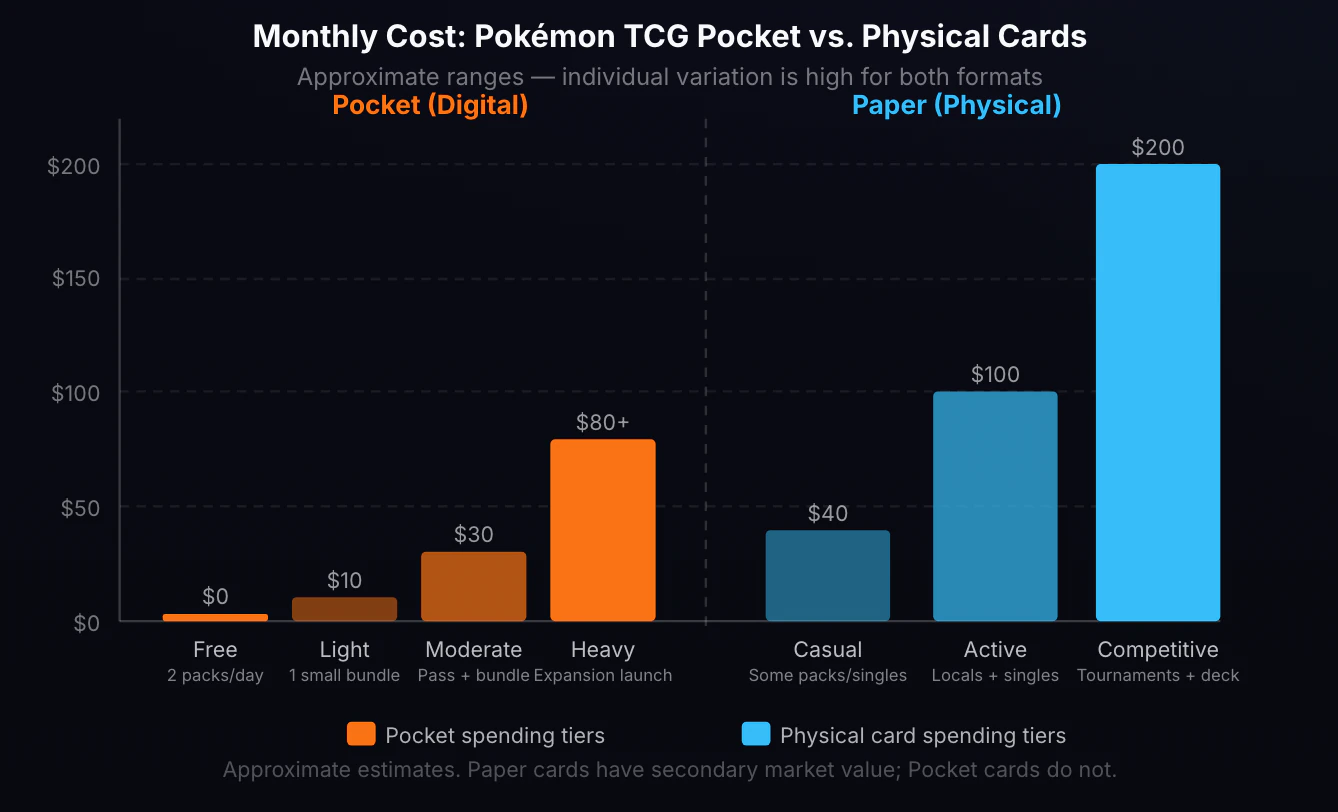
- Pocket is cheaper than paper for free and casual engagement — zero cost versus $30–$50/month for casual paper play
- For moderate and heavy spenders, Pocket costs converge with paper — $30–$80/month in Pocket is comparable to or exceeds casual paper budgets
- Paper cards have secondary market value; Pocket cards have none — this is the key financial difference between the two
- Pokémon TCG Pocket earned an estimated $1.25B in its first year and passed 150M downloads, so the monetization is engineered and effective
- Budget both as one 'Pokémon hobby' line, not two separate categories — the combined total is what matters
Pokémon TCG Pocket launched in October 2024, crossed 150 million downloads (Nintendo Life), and earned an estimated $1.25 billion in player spending in its first year (PokeBeach). It landed among the 10 highest-grossing mobile games of 2025 and passed $1.6 billion by April 2026 (PocketGamer.biz), driven largely by a player base that already loved physical Pokémon cards.
Which is cheaper? The answer depends entirely on how much you spend. And the more interesting question for most players is not “which costs less” but “how do I budget for both without losing track of the total.”
The Side-by-Side Cost Comparison
Free and Casual: Pocket Wins Clearly
Pocket at $0 per month is the most accessible TCG experience available. Two free booster packs per day provides a complete daily game loop: open packs, build decks, play matches, participate in Wonder Picks. You get genuine entertainment, genuine deck building, and genuine collection growth — for free.
Compare that to casual paper play at $30–$50/month for a booster bundle or occasional singles purchases. At the free and light-spending tiers, Pocket is unambiguously cheaper.
Pocket at $10/month (a single small Poké Gold bundle) is still well below casual paper spending. This is probably the sweet spot for budget-conscious players who want a bit more than free packs provide.
Moderate Spending: The Convergence Zone
At $30/month — a premium pass plus one bundle — Pocket is approaching casual paper budgets. At $50–$80/month during an expansion launch, Pocket spending is comparable to an active paper player.
This is the zone where many players are surprised when they calculate their actual spending. The individual Pocket transactions feel small — $9.99 for a pass, $4.99 for a bundle, a little more Poké Gold to refill Wonder Stamina. Added together during an expansion launch, they compound quickly.
The Pocket premium pass math: $9.99/month × 12 months = $119.88/year before a single additional bundle purchase. That’s money spent before you’ve opened anything beyond the premium pass content.
Heavy Spending: Pocket Can Exceed Paper
Heavy Pocket spending during expansion launches — multiple bundles, the premium pass, Wonder Stamina refills — can reach $80–$120+ in a month. That exceeds casual paper and approaches active paper spending.
At this level, the critical distinction comes into focus: paper cards have secondary market value; Pocket cards do not.
A paper player who spends $100 on singles retains ownership of cards that can be sold. If they later sell those cards and keep $70 after fees and shipping, their net spend was $30. That recovery isn’t guaranteed, though: marketplace fees and shipping take a cut of every sale, and many cards lose value over time, especially after reprints. A Pocket player who spends $100 on Poké Gold bundles has spent $100 with no recovery path — those digital packs and the cards inside them cannot be converted to cash.
This doesn’t mean Pocket spending is irrational. Entertainment has value. But the financial structure is different: Pocket spending is pure consumption, paper spending involves assets with some resale value.
What Pocket Does Better
Despite the lack of secondary market value, Pocket offers real advantages:
Accessibility. You can play Pocket on your phone during a commute. Paper requires a local game store, a playgroup, or an opponent willing to play remotely. The barrier to playing is much lower.
Entry cost. Starting Pocket from zero costs nothing. Starting paper from zero requires buying a starter deck or singles, at minimum $20–$50.
Space. Physical cards take physical space — binders, boxes, shelves. Pocket is infinitely scalable without occupying a single square foot.
The free daily loop. No paper equivalent matches two free packs per day as a sustainable zero-cost game loop.
What Paper Does Better
Secondary market. Cards you buy can be sold, traded, or graded. Spending $100 on physical singles is an expenditure with a potential recovery. This is the most significant financial difference.
True ownership. Physical cards are yours. A game company can shut down servers, change drop rates, or alter the digital economy. Your binder full of paper cards exists regardless of what the company does.
Resale and trade culture. Trading cards with friends, selling at locals, and building a binder to trade at events are experiences Pocket doesn’t replicate.
Tangible collecting. Binder pages of complete sets, sleeved decks, displayed ultra rares — the physical collecting experience is genuinely different from owning a digital sprite.
The Right Way to Budget Both
The mistake most players make: treating Pocket and paper as two separate hobby budgets with independent limits. The result is two mental accounting categories, each of which feels small and justified on its own, that add up to a combined number that’s larger than either seems individually.
The better approach: one Pokémon hobby budget.
Decide how much you can spend on Pokémon monthly — everything included. That covers:
- Physical booster packs
- Physical singles (TCGplayer, local shop)
- Physical accessories (sleeves, binders, deck boxes)
- Grading fees
- Pokémon TCG Pocket (all in-app purchases)
When you see one number, you make one decision. When you see two separate numbers, you rationalize both.
Example allocation for a $60/month Pokémon budget:
- $15: Pocket premium pass + one small bundle
- $30: Physical singles for deck building
- $15: Reserve for set releases (sinking fund contribution)
Both activities live within the same $60. If you want to spend more on Pocket during an expansion launch, something in the physical budget adjusts. One line, one decision, one limit.
This is general educational content, not financial advice. In-app prices and card values change, so treat these monthly figures as rough estimates and don’t count on resale to cover what you spend.
Both Pocket and physical TCG see spending spikes during new set releases. Set your combined monthly Pokémon budget before the next expansion’s spoiler season starts — when you’re not mid-excitement about specific new cards. That’s the moment to decide the number. Not during launch week.
For the complete guide to budgeting Pocket specifically — including how the monetization model works and how to set a per-expansion limit — How to Budget for Pokémon TCG Pocket covers every element.
For physical Pokémon card budgeting including sealed vs. singles and set release planning, How to Budget for Pokémon Cards is the companion guide.
The full TCG budget framework covering all spending categories is at How to Budget for Trading Card Games.
In Hunter Vault, set one Pokémon budget for digital and physical spending, log both kinds of purchases, and check what’s left — plus your Safe-to-Spend number — before you open the Pocket shop or the TCGplayer cart.
Frequently Asked Questions
Is Pokémon TCG Pocket free to play?
Yes — you get two free booster packs every day, and the core gameplay loop costs nothing. Paid elements are Poké Gold bundles for additional packs, a premium pass subscription (~$9.99/month), and Wonder Stamina refills bought with Poké Gold. You can play Pocket indefinitely at zero cost, though the monetization is designed to make spending feel natural and incremental.
Is Pokémon TCG Pocket cheaper than physical cards?
For free and casual engagement, yes — Pocket is cheaper. You can play daily for $0, while paper casual play costs $30–$50/month for booster packs. However, for moderate to heavy spenders, the costs converge: spending $30–$80/month on Pocket is comparable to or exceeds a casual paper hobby budget. The difference is that paper cards can have some resale value and Pocket cards don't.
Can you sell Pokémon TCG Pocket cards?
No. Pokémon TCG Pocket cards are digital-only and have no secondary market. You cannot sell, trade for cash, or transfer Pocket cards outside of in-game trading. Physical Pokémon cards can be sold on TCGplayer, eBay, or locally. This is the key financial difference: paper card spending can be partially recovered through resale, while Pocket spending is pure consumption once made.
How much does Pokémon TCG Pocket typically earn per user?
Pokémon TCG Pocket earned an estimated $1.25 billion in player spending in its first year (PokeBeach, October 2025), when it had also passed 150 million downloads (Nintendo Life, October 2025). That works out to roughly $8 per download on average, but spending is heavily skewed: many players spend nothing, while a smaller segment spends heavily. By April 2026 the total had passed $1.6 billion, and the app landed among the 10 highest-grossing mobile games of 2025 (PocketGamer.biz).
Should I budget Pokémon TCG Pocket and physical cards separately?
No — budget them together as one Pokémon hobby line. Treating them as separate spending categories creates two mental accounting buckets, each of which feels small on its own, but adds up to a combined total that many players find surprising. Both come from the same money. One unified Pokémon hobby budget that covers both is more accurate and easier to control.