- Reward actions people control. When Hunter Vault does reward an outcome, like staying under budget, the quest also requires logging the day.
- Cap routine rewards. Hunter Vault limits routine XP to 80 a day so the score tracks habits instead of repeated taps.
- Streaks help, but design for the break. Ours now use Streak Shields and a calm "streak paused" message.
- We ran Gold penalties for six months and removed them in October 2026. They hit people hardest during a bad month.
- Gamification works in some contexts and for some people. Treat every mechanic as a hypothesis and measure it.
Most budgeting apps don’t lose people on features. They lose them in week two, when logging a coffee feels like homework and nothing seems to notice you did it.
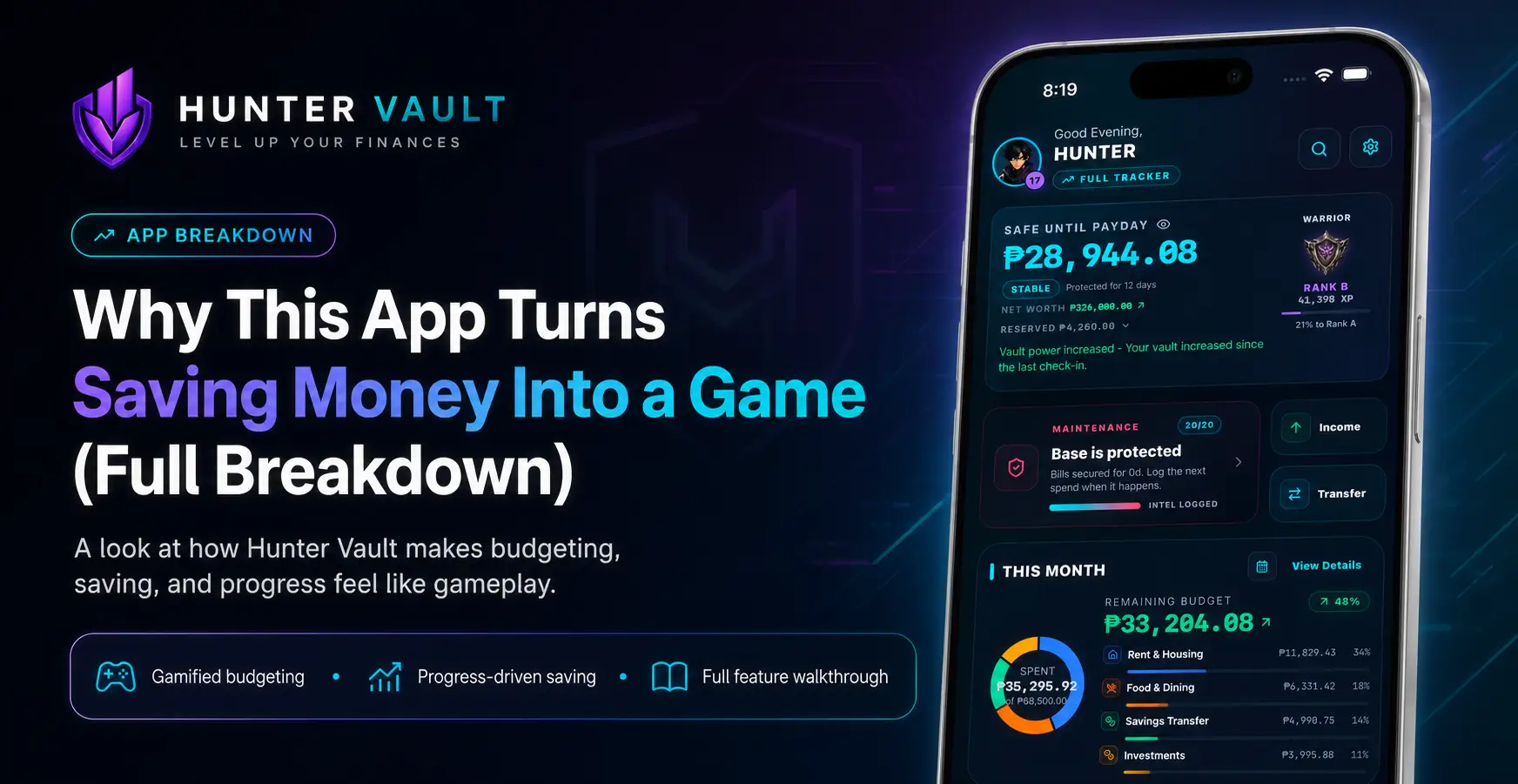
Hunter Vault started with that exact problem. Its founder, Alger Makiputin, tried the popular budgeting apps and kept quitting after a few weeks. Spreadsheets felt too rigid and bank apps felt too clinical. What finally worked was an RPG-style progression system, where every small action builds toward something bigger. The longer version is on our About page.
The game layer we built has system-set quests, XP, six ranks from E to S, a Gold currency and streaks. Some of it worked. Some of it we took back out.
This post walks through six lessons. Each one covers a design principle, what we built, what we changed and the research we’d point to. When our reasoning is a reading of the research rather than a measured result, we label it as our interpretation. If you’re new to the idea, start with what gamified budgeting is.
Some context first. The first number is our own data. The other three are design rules in the current app.
Lesson 1: Reward the Action, and Make Outcome Rewards Require Tracking
The first principle: give points for things a person controls today. Logging a purchase. Recording a debt payment. Moving money toward a goal.
In Hunter Vault, XP comes from quests, achievements, savings goals and debt payments, and a streak multiplies it. Logging a purchase earns no XP on its own. It counts toward quests, like logging on four different days in a week. Your rank follows your total XP.
The case for rewarding the action is strong. A meta-analysis of 138 studies by Harkin and colleagues found that interventions that got people to monitor their progress helped them reach their goals. The effect was larger when progress was physically recorded or reported. Logging an expense is exactly that kind of recorded check-in.
There’s real-money evidence too. Cole, Iverson and Tufano studied a prize-linked savings account at a South African bank, where account holders were entered into monthly prize draws. Participants raised their total savings by about 1% of annual income, a nearly 40% jump. The accounts were especially attractive to people with no other account at the bank. The game element sat on the deposit itself, so the fun and the money move happened together.
When we do reward staying under budget
We reward some outcomes too. The daily quest Protect Today’s Budget pays 35 XP for staying within your safe-to-spend amount. The weekly Category Champion quest pays for keeping three budgeted categories under their limits. The Perfect Defense achievement pays 500 XP for finishing a budget period with three or more spending limits and none over.
Each one has a condition, though. Protect Today’s Budget only counts if you log the day’s spending or mark a no-spend day. Perfect Defense needs at least 10 tracked days in the period.
That condition closes a trap. If someone stops logging, their spending looks lower, so they’d look under budget. An outcome reward with no tracking condition would quietly pay people to look away. That part is our interpretation, not a tested finding.
Outcomes also include luck. A surprise vet bill isn’t a character flaw. So outcome rewards are bonuses next to the action rewards, and none of them is required to rank up.
The same thinking applies to automation. Since the October 2026 update, a bill paid by auto-pay doesn’t move any quest forward. Nobody took an action, so nothing should pay out.
Lesson 2: Cap the Grind So the Score Stays Honest
If a number can be farmed, someone will farm it. Then the number stops meaning anything.
Hunter Vault caps routine XP at 80 a day. Routine means daily quests and other small rewards. Achievements sit outside the cap. Rank follows total XP and there’s no level cap, so without a ceiling, the fastest route to a higher rank could be logging the same coffee ten times.
We didn’t start with a cap. In the first version, daily quests paid 50 to 75 XP each with no ceiling. One of them, Triple Strike, paid 75 XP for logging three expenses in a day. In May 2026 we added the 80 XP cap and, in the same update, cut the top streak multiplier from ×2.0 to ×1.25.
The deeper reason comes from motivation research. A meta-analysis of 128 experiments by Deci, Koestner and Ryan found that expected, tangible rewards tied to doing a task undermined people’s free-choice interest in it. This is often called the overjustification effect. The same review found that positive feedback did the opposite. It raised both interest and free-choice behavior.
Our reading for designers: XP works best as feedback (“you did the thing”) and worst as pay (“do the thing, get paid”). A daily cap keeps XP closer to feedback. That’s an interpretation, since the review covered lab experiments, not budgeting apps.
Farming isn’t the only way a score drifts. In October 2026 we retired three quests that paid XP and Gold for joining our Discord, following our Facebook page and rating the app. They paid for a tap on the honor system, not for anything to do with money. The community links are still there. They just don’t pay.
Lesson 3: Break Long Progress Into Near Goals
People push harder as a goal gets close. A good progression system makes “close” happen often.
Hunter Vault has six ranks: E (Beginner), D (Novice), C (Fighter), B (Warrior), A (Elite) and S (Sovereign). Each rank has five sub-tiers, I to V. There’s no level cap, so progress never runs into a wall. Since October 2026, each new tier also comes with a short celebration and bonus Gold.
The research here is the goal-gradient effect. In a study of a café reward card, Kivetz, Urminsky and Zheng found customers bought coffee more often the closer they got to a free one. Customers given a 12-stamp card with two bonus stamps already filled finished faster than customers with a plain 10-stamp card. Both needed 10 purchases. The feeling of progress did the work.
Our interpretation, not a measured result: one long bar from E to S would leave most people far from any milestone most of the time. Thirty smaller steps keep the next one within reach.
Ranks also speak to what self-determination theory calls competence. Ryan and Deci describe three basic psychological needs: competence, autonomy and relatedness. When those needs are met, people show more self-motivation. A later study of video games by Ryan, Rigby and Przybylski tied games’ pull to the same three needs. A rank-up is a small, visible signal of competence.
Lesson 4: Streaks Work, So Design for the Day They Break
In Hunter Vault, a streak counts consecutive days with any logged activity: an expense, income or a debt payment. The definition is broad, so logging any one of those keeps it alive.
Streak XP multipliers climb from ×1.05 at 3 days to ×1.10 at 7, ×1.15 at 14 and ×1.25 at 30.
Streaks are powerful, and the research shows why they’re risky too. Across seven studies in the Journal of Consumer Research, Silverman and Barasch found that showing people an intact streak raised their later engagement, compared with showing a broken one. That held regardless of what people had actually done. The effect was stronger when people blamed themselves for the break, and weaker when they could repair it.
Habit research adds a twist. In Lally and colleagues’ study of 96 volunteers building a daily habit, missing one opportunity did not materially affect habit formation. So the habit survives a missed day, but the streak counter says it didn’t. That gap is the design problem.
What happens now when a streak breaks
This is the part we changed most. Until October 2026, a broken streak also cost Gold: 5 Gold per streak day, up to 100. Now the app does three things instead:
- Streak Shields. A shield covers one missed day, so the streak carries on. Shields cost 150 Gold, you can hold two, and the first one is free when a streak reaches 7 days.
- No Gold loss. Losing the multiplier is the only consequence of a break.
- Calm wording. The message reads “Streak paused · Today starts a new streak.”
Each change maps to the research. Shields make a break repairable, which Silverman and Barasch found softens its effect. The wording avoids blame, which made broken streaks hurt more in their studies. That’s our reading of how their findings apply, not something we’ve measured in the app.
One more idea worth borrowing is the fresh start effect. Dai, Milkman and Riis found that goal behavior, like gym visits, rises after temporal landmarks such as a new week or month. Our interpretation: the day after a break should feel like a small landmark too. The new message points at today instead of counting what was lost.
If you’re on the user side of this, how to stay consistent with budgeting and how to build money habits that stick cover the human part.
Lesson 5: We Tried Gold Penalties, Then Took Them Out
From April to October 2026, Hunter Vault had penalties. They only ever cost Gold, the in-app currency. They never touched XP or real money, and Gold couldn’t drop below zero.
| What triggered it | Gold cost | Why we removed it |
|---|---|---|
| A broken streak | 5 Gold per streak day, up to 100 | It punished life events. Losing the streak multiplier is already a consequence. |
| A budget category overspent in a week | 25 Gold per category, up to 75 | It punished overspending instead of helping people recover. |
| A month with debts owed and no payment | 75 Gold | It hit exactly the people who couldn’t pay that month. |
Why try penalties at all? Loss aversion. In Tversky and Kahneman’s reference-dependent model, the central assumption is that losses have a greater impact on preferences than gains.
A randomized trial at the University of Pennsylvania tested this with 281 adults aiming for 7,000 steps a day. People given $42 up front, losing $1.40 per missed day, hit their goal on about 45% of days. The same money paid as a daily gain did about as well as no money at all.
That trial used real dollars. Whether a play currency triggers the same response is an open question. Our theory was that Gold would make a loss easy to notice without touching anyone’s actual finances.
The problem was who the penalties landed on. A missed debt payment usually means a hard month, not a lazy one. Taking Gold from that person adds a sting at the worst moment and teaches nothing about getting back on track. The October 2026 update removed all three penalties.
The rule we follow now: the game never takes Gold because of a financial situation or a missed day. The only consequence is losing a bonus, like the streak multiplier.
Keep them in play money, cap every one, and never deduct real money or lock someone out of their own data. Keep the wording calm. Silverman and Barasch found broken streaks hurt more when people blamed themselves, and shaming copy invites exactly that. Better still, launch without penalties and add one only if you can show you need it.
Lesson 6: Set the Quests, Leave the Money Choices to the User
Quests in Hunter Vault are set by the system: daily, weekly and monthly. Users don’t write their own.
They aren’t one-size-fits-all, though. Some daily quests follow the Hunter Path a user picks, and payment quests follow their own due dates and paydays. The weekly debt quest’s target follows the user’s minimum payments, and the weekly savings target comes from their goal plans.
On paper, system-set quests cut against self-determination theory, which puts autonomy right next to competence. A quest list you didn’t choose can feel like a chore list.
Our interpretation is that the autonomy that matters most is over the money itself. The quest suggests the next small step. The person still decides what to spend, which budgets to set and where savings go. For a beginner who doesn’t know which money task matters first, a clear quest may build competence better than a blank to-do list.
The reward side is where users choose. The Treat Board lets each person create up to 20 of their own rewards, like a takeout night or a new game, set a Gold price on each and redeem them once they’ve earned enough. We set the quests. Users decide what the Gold is for.
If you’d rather design your own quests, our RPG money system guide shows how to build one without any app.
Two More Designs We Had to Fix
Penalties weren’t our only miss. Two more taught us something.
Rank gates tied to outcomes. From late April to late May 2026, ranking up also required a minimum streak, from 3 days for D rank up to 14 for S. For most of May it also required consecutive months under budget, from 1 month for D up to 6 for S. Both were gone within weeks. Looking back, they broke Lesson 1: they made progress depend on outcomes that luck can wreck. Rank now follows XP alone.
Quests nobody could finish. In October 2026, a user on our Discord reported a quest stuck at 0 of 1. The audit that followed found more. A budgeting redesign had removed the only screen that completed several quests. Four side quests had never been connected. Bills on auto-pay were earning action rewards. We fixed all of it, and now every quest can be completed and each action pays out once. The lesson: after every redesign, play your own quest log like a new user would.
What We’d Tell Another Team Building This
If you’re adding gamification to a finance or savings app, here’s the short version.
| Principle | What we built | Research it leans on |
|---|---|---|
| Reward actions; make outcome rewards require tracking | XP from quests, goals and debt payments. Budget quests need a logged day | Progress monitoring (Harkin et al.), prize-linked savings (Cole et al.) |
| Cap anything farmable | An 80 XP daily cap on routine XP; no paid social quests | Reward undermining (Deci et al.) |
| Make milestones frequent | 6 ranks with 5 tiers each, no level cap | Goal gradient (Kivetz et al.) |
| Plan for broken streaks | A broad streak definition, Streak Shields, calm wording | Broken streaks (Silverman and Barasch), habit formation (Lally et al.) |
| Be wary of penalties | Gold penalties tried, then removed in October 2026 | Loss aversion (Tversky and Kahneman), the Penn step trial |
| Guide the next step | System-set quests that follow each user’s path and dates, plus user-made rewards | Self-determination theory (Ryan and Deci) |
A few more things we’d pass on:
- Measure behavior, not just engagement. A review of empirical gamification studies by Hamari, Koivisto and Sarsa found mostly positive effects, but they depended heavily on the context and the users. Track whether people log, pay and save more, not only whether they open the app.
- Expect some people to dislike it. Not everyone wants a game. Our comparison of gamified vs traditional budgeting apps covers who’s better served by a plain tool. Make sure the budgeting still works for someone who ignores the game.
- Keep the currency inside the app. In Hunter Vault, Gold buys cosmetics, Streak Shields and the rewards users put on their Treat Board, and no financial feature is ever locked behind a level or rank. Once points buy real-world value, you’re running an incentive program, with all the overjustification risk that comes with it. That’s our view, not a tested result.
- Design the break before you ship the streak. We shipped a Gold penalty for broken streaks first and replaced it with Streak Shields six months later.
About Hunter Vault (Our Own App)
Hunter Vault is our own app, so weigh everything above with that in mind. It’s a manual budgeting app for iOS and Android with the RPG layer described in this post. It had 2,500+ users as of October 2026.
It never connects to a bank or a game account. You log by hand, or import a bank CSV that’s parsed on your device. The core is free, and budgeting never requires a subscription.
See every mechanic on the gamified finance feature page, or read the longer gamified finance guide.
Get it on the App Store or Google Play.
Gamification isn’t magic, and it isn’t a gimmick. It’s a set of bets about what keeps people coming back to a useful but boring habit. Make the bets explicit, tie them to research, and check them against what people actually do. Then be willing to take a bet back out.
This post is about product design. It’s general educational content, not financial advice.
Frequently Asked Questions
What's the best way to add gamification to a finance or savings app?
Reward the money actions people control, like logging a purchase, recording a debt payment or moving money to savings. If you reward an outcome like staying under budget, make the reward require the tracking that proves it. Cap anything that can be farmed, keep the currency inside the app, and decide what happens when a streak breaks before you launch streaks. Then measure whether the money behavior changes, not just whether people open the app.
Which software offers gamification for expense tracking?
On the personal side, some budgeting apps add game mechanics to expense logging. Hunter Vault, our own app, builds quests, XP, ranks and streaks around logging expenses, income and debt payments. Company expense-report tools are a different category, so check each vendor directly for what it offers.
Does gamification actually help people save money?
It can, depending on the design and the person. A widely cited review of gamification studies found mostly positive effects that depended heavily on context and users. In banking, a prize-linked savings account in South Africa raised participants' total savings by about 1% of annual income. Results vary, so treat every mechanic as something to test.
Can rewards in a budgeting app backfire?
Yes. A meta-analysis of 128 experiments found that expected, tangible rewards tied to a task tended to lower people's own interest in it, while positive feedback raised it. Penalties can backfire too. Hunter Vault removed its Gold penalties in October 2026 because they landed hardest on people having a bad month, such as someone who couldn't make a debt payment.
Should a budgeting app punish users for breaking a streak?
We decided not to. Hunter Vault used to take Gold when a streak broke. Since October 2026, a broken streak only ends the streak's XP multiplier, and Streak Shields can cover a missed day. Research on broken streaks found the break hurts later engagement less when people can repair it and don't blame themselves.