- Saving feels hard because spending rewards you instantly while saving only pays off far in the future.
- Turning saving into a game adds an immediate reward today, making the habit far easier to repeat.
- A Bayes Business School study found a gamified group saved almost 20% more than a control group.
- Hunter Vault maps each game mechanic to a psychological lever: goals, quests, XP, streaks, ranks, and vaults.
- The game adds motivation, not money, so keep the goal real and use it to help build the habit.
Saving money is one of those tasks that gives you nothing back in the moment. You set some cash aside, a number changes slightly, and nothing about it feels like a win. Spending, meanwhile, hands you a reward instantly. No wonder saving loses.
Turning saving into a game fixes that imbalance by adding an immediate reward to an action that normally has none. When saving earns you points, fills a progress bar, or extends a streak, you get a small payoff today instead of waiting months, which makes the habit far easier to repeat. Below is the psychology behind why this works, and a full breakdown of how one app, Hunter Vault, actually does it.
Amounts below are in USD as examples — use whatever currency you actually budget in.
Quick Answer: How Does Turning Saving Into a Game Work?
Turning saving into a game works by giving you instant psychological rewards for an activity that usually only pays off far in the future. Apps do this with progress bars, points, levels, and streaks, so each small contribution feels like a win. Research backs this up: people using gamified saving tools have been shown to hit their savings goals more often than people using plain ones. (This is the “does it actually work?” piece behind the complete gamified finance system.) The game part doesn’t add money; it adds motivation.
Why Turning Saving Into a Game Actually Works
The core problem with saving is timing. People struggle to save because the pleasure of spending is immediate, while the benefit of saving is only felt in the future. Your “present self” wins that argument almost every time.
Gamification flips the timing. The idea is that adding immediate psychological rewards to an otherwise unpleasant behavior like saving can increase how much people save. Instead of waiting for the far-off reward, you get a small hit of satisfaction now, every time you act.
This isn’t just a nice theory. In one study from Bayes Business School, participants who used a gamified savings app saved almost 20% more than a control group, and were more likely to hit the goal they’d set for the following month. The four-week study split 331 people into a gamified group and a plain group, and the gamified version had a measurable effect on whether people met their goal. It’s one study, not a guarantee, but the direction is clear.
The same approach already works elsewhere. According to the researchers, apps like Duolingo (language learning) and Zombie Run (exercise) use progress trackers and rewards to keep people coming back. Saving is just another behavior that’s easier to stick with when it gives feedback.
Gamified saving isn’t magic, and it has a real downside worth naming. Because games reward short-term wins, gamification can nudge people toward instant gratification over long-term planning, and it can create unrealistic expectations about financial progress.
In plain terms: the points and streaks should serve the saving, not replace real thinking about your money. A progress bar feels great, but it doesn’t change your income or your bills. Used well, the game keeps you showing up. Used badly, it becomes a dopamine loop disconnected from your actual finances. Keep the goal real and the game stays useful.
The Full Breakdown: How Hunter Vault Turns Saving Into a Game
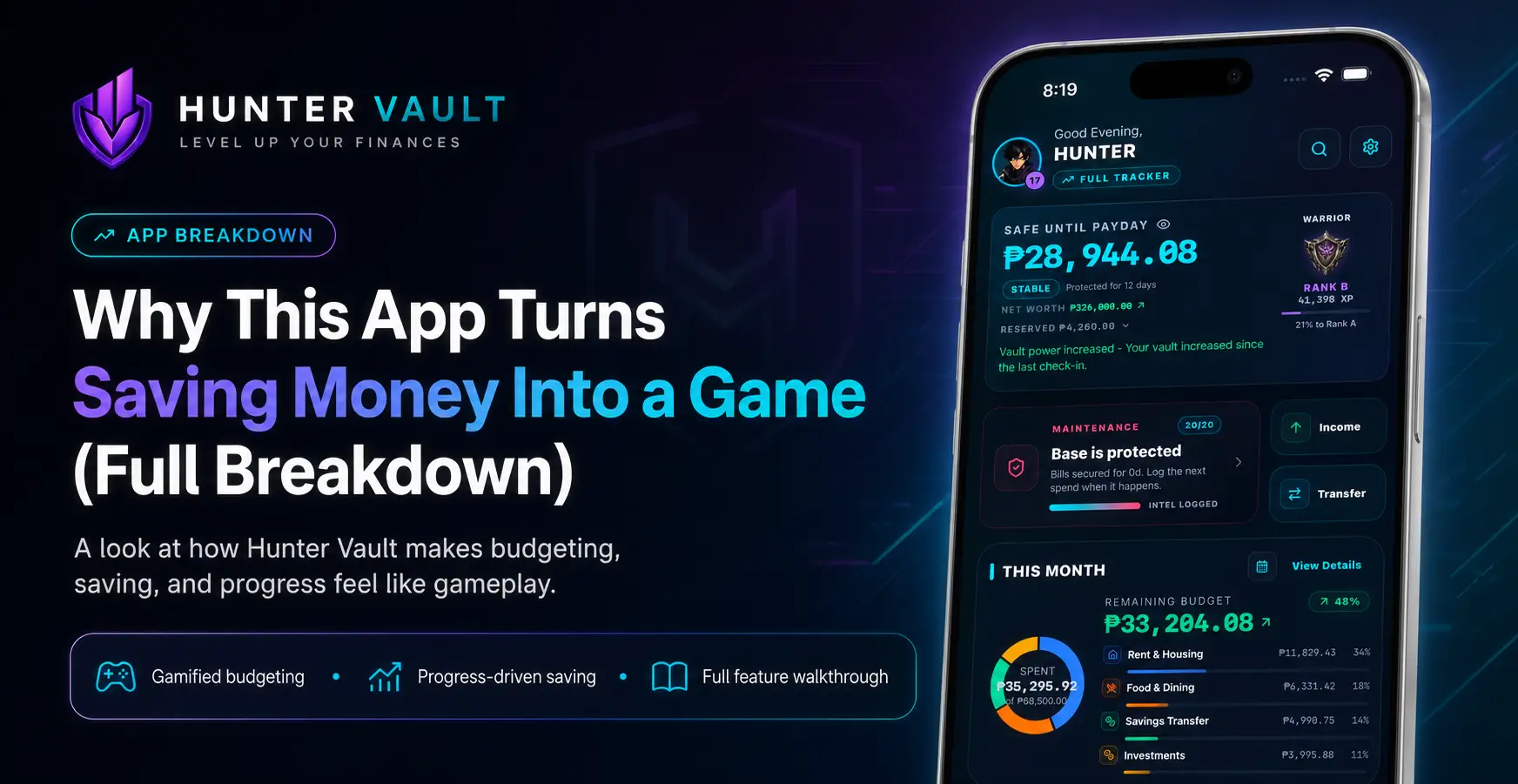
Hunter Vault is a gamified personal finance tracker that turns budgeting, expense tracking, saving, and debt payoff into RPG-style progress using quests, XP, ranks, streaks, vaults, and goals. What makes a saving money game work isn’t the theme; it’s that each mechanic targets a specific psychological lever. Here’s the map.
| Game Mechanic | Psychology It Triggers | Hunter Vault Feature |
|---|---|---|
| Progress bar | Visible progress feels rewarding | Savings goals |
| Small clear task | Easy to start, easy to repeat | Quests |
| Instant points | Immediate reward beats a delayed one | XP |
| Don’t-break-the-chain | Momentum and consistency | Streaks |
| Long-term leveling | Identity and “look how far I’ve come” | Ranks and profile |
| Sorting by purpose | Clarity, goals feel real | Vaults |
The rest of this section breaks each one down.
Goals = The Progress Bar
A savings goal in Hunter Vault is a progress bar you fill. This is the single most important mechanic, because the research points to progress visibility as a core reason gamified saving works. Watching the bar move from 10 percent to 40 percent gives you the immediate “I’m getting somewhere” feeling that a flat bank balance never does.
Quests = The Small Repeatable Action
Quests turn saving into a specific, tiny action you can complete, like “add to your savings goal” or “log today’s spending.” A clear small task is far easier to do than a vague intention to “save more,” and finishing it gives you something to check off.
XP = The Instant Reward
Every completed money action earns XP. This is the immediate reward the research describes, delivered the moment you act, instead of months later when the savings finally matter. It’s deliberately small, because a reward you get now does more for the habit than a bigger one you have to wait for.
Streaks = Momentum
Streaks track how many days in a row you’ve shown up. They turn a one-time effort into something you want to protect, which builds consistency. A streak you don’t want to break is often what carries you through the days you don’t feel like it.
Ranks and Profile = Long-Term Progression
Ranks and a character-style profile give you a sense of growing over time, like leveling a character across a long campaign rather than a single fight. This is where the game does something the other mechanics can’t: over months, your rising rank becomes proof of identity. You stop thinking “I’m trying to save” and start thinking “I’m the kind of person who shows up for their money.” That shift is what makes a habit outlast motivation, because you’re no longer chasing a goal, you’re defending who you’ve become.
Vaults = Organizing Money by Purpose
Vaults let you separate money by job, like savings, bills, or a fun fund, so your goals aren’t competing in one blurry pile. It’s less of a game mechanic and more of a clarity tool, but it makes the goals you’re filling feel real.
A Quick Walkthrough
Say you want to build a $500 emergency buffer.
- You create a goal: $500, with a progress bar starting at zero.
- You set a quest: add a small amount each payday, plus log spending daily.
- Each contribution moves the bar and earns XP. Each day you log builds your streak.
- Three weeks in, the bar is climbing, your streak is alive, and your rank has nudged up.
- The buffer grows not because you found extra discipline, but because every small action paid you back a little.
The money math is ordinary. The experience around it is what keeps you doing it.
If that loop sounds like what’s been missing for you, it costs nothing to test: create one goal in Hunter Vault and complete your first quest today. You’ll feel the mechanic within a minute, which is faster than reading another paragraph about it.
Who This Is For (and Who It Isn’t)
Turning saving into a game works best if:
- You start saving and lose interest fast.
- You like progress systems, games, or anything with visible levels.
- Plain finance apps bore you into quitting.
It’s probably not the right fit if:
- You want an app that automatically moves or holds your money. Hunter Vault tracks and motivates; it doesn’t transfer cash for you, so an automation app would suit you better.
- You already save consistently and don’t need the extra motivation layer.
Being honest about that second list matters more than the first. A game can make saving enjoyable, but it can’t do the saving for you. If you landed in the first list, though, you’re exactly who this is built for, and it’s worth a try.
If you’d rather build and run the XP system yourself without an app, a leveling system for saving money gives you the full mechanic — XP table, level thresholds, and daily quests — to copy by hand.
This is general educational content, not professional financial advice. A game-like app can help you build the habit, but it won’t change your income or guarantee results. Choose an approach that fits your situation, and if you’re facing serious financial hardship, consider speaking with a qualified professional.
Final Takeaway
Saving feels hard because it pays off later while spending pays off now. Turning saving into a game closes that gap by handing you a small reward today, and the research suggests that nudge genuinely helps people reach their goals more often. The mechanics aren’t complicated: a progress bar to fill, a small action to repeat, and a reward for showing up.
If you want to feel that loop instead of just read about it, set one savings goal in Hunter Vault, turn your first contribution into a quest, and watch the bar move. It’s free to start on iOS and Android, so you can see whether the game feel clicks for you before anything else.