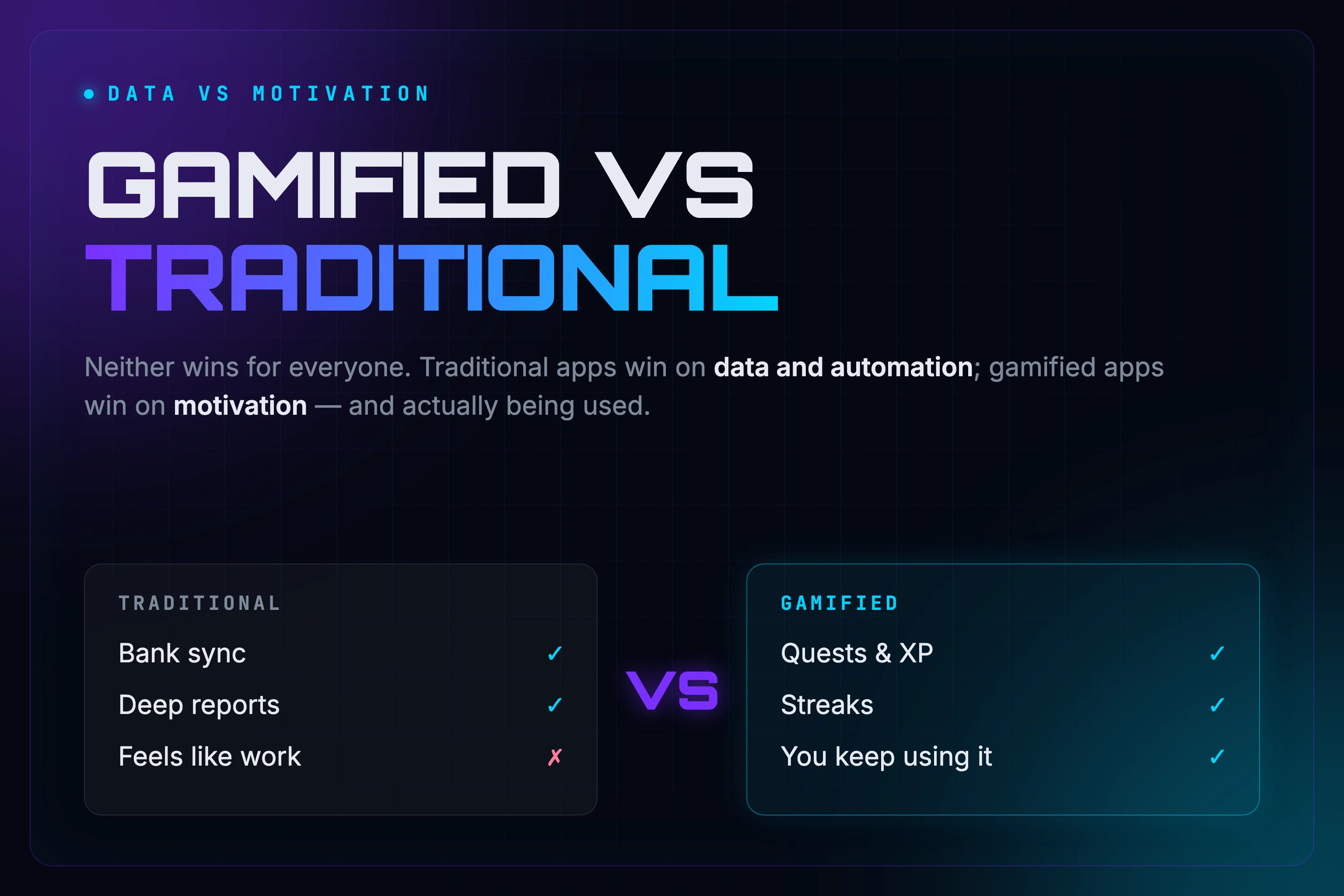
- Neither type wins for everyone, match the tool to your actual weak spot.
- Traditional apps win on automation, detail, and reports, but feel like work.
- Gamified apps win on motivation and consistency, but track less detail.
- Pick traditional if your problem is information, gamified if it's staying consistent.
- You can switch later or use both, you don't have to choose forever.
You’ve decided to get a budgeting app, and now you’re stuck on a different question: the serious, number-crunching kind, or the fun, game-like kind? Pick wrong and you risk repeating the usual cycle of downloading something, using it twice, and quietly giving up.
Here’s the honest answer up front. Neither type wins for everyone. Traditional budgeting apps win on automation, detail, and data, while gamified apps win on motivation, consistency, and not boring you into quitting. The right choice depends on whether your real problem is information (you don’t know where your money goes) or motivation (you know, but you can’t stay consistent). This guide breaks down both fairly so you can pick.
This is Hunter Vault’s blog, and Hunter Vault is a gamified app, so we’ll be clear about exactly where each type wins and where the gamified side falls short.
Quick Answer: Which Is Better, Gamified or Traditional?
Traditional budgeting apps are better if you want deep tracking, automatic bank syncing, and detailed reports, and you’re willing to put in regular effort. Gamified budgeting apps are better if your main struggle is staying motivated and consistent, especially as a beginner. There’s no universal winner. Match the tool to your actual weak spot: traditional for information and depth, gamified for motivation and habit-building.
What We Compared
To judge “which wins,” we weighed five things that actually matter day to day: how motivating each type is, how beginner-friendly it is, how much it automates (bank syncing, reports, data depth), what it costs, and how well it helps you stay consistent. The winner genuinely flips depending on which of these matters most to you, which is the whole point of this comparison.
The Side-by-Side
| Factor | Traditional Apps | Gamified Apps |
|---|---|---|
| Core strength | Detailed tracking and data | Motivation and consistency |
| Best for | People who’ll do the work | People who quit out of boredom |
| Automation | Often syncs bank accounts | Often manual or lighter |
| Learning curve | Can be steep | Usually gentle |
| Effort needed | Regular, hands-on | Small, repeatable actions |
| Risk | You stop using it | You enjoy it but track less detail |
What Traditional Budgeting Apps Do Well
Traditional budgeting apps focus on information. They typically link to your bank, credit card, and other accounts, track your purchases automatically, and show you detailed reports and progress toward goals. The well-known example is YNAB, which uses a zero-based system where you assign every dollar a job before you spend it. (If you’re weighing YNAB against a gamified alternative, see Hunter Vault vs YNAB.)
Strengths:
- Deep, accurate tracking, often with automatic bank syncing.
- Powerful for people with complex finances or specific goals like debt payoff.
- Detailed reports and category control.
Weaknesses:
- The learning curve can be steep. Zero-based budgeting, for instance, asks you to assign every dollar, which takes regular effort.
- They can feel like work, which is the number one reason people abandon them.
- Some carry a real cost; serious budgeting apps often run around a hundred dollars a year.
One more thing worth knowing: these tools depend on the company staying in business. When the hugely popular app Mint shut down in 2024, millions of users had to migrate elsewhere, a useful reminder that “serious” doesn’t always mean permanent.
Best for: People who genuinely enjoy detail, will spend 15 to 30 minutes a week on it, and want maximum control.
What Gamified Budgeting Apps Do Well
Gamified budgeting apps focus on motivation. Instead of just showing numbers, they turn money actions into progress: points, streaks, levels, quests, and progress bars. The goal is to make the habit rewarding enough that you actually keep doing it.
Strengths:
- Far easier to stick with, because each action gives you a small reward.
- Beginner-friendly, with a gentle learning curve.
- They make budgeting feel like progress instead of punishment, which keeps you showing up.
Weaknesses:
- They often track less financial detail than a heavy traditional app, and many don’t auto-sync your bank.
- If the points start mattering more than the money, the game can distract from real planning.
- Lighter tools may not be enough for very complex finances.
Best for: People who know roughly where their money goes but can’t stay consistent, and anyone who’s quit boring finance apps before.
Which One Should You Pick?
Match the tool to your weak spot:
- You don’t know where your money goes: start with a tracking-focused app, traditional or a gamified tracker, to build visibility.
- You know, but you keep quitting: go gamified. Your problem is motivation, not information.
- You have complex finances or strict goals: a traditional app like YNAB rewards the effort.
- You’re a total beginner: a gamified app lowers the barrier to actually starting.
- You hate the idea of homework: gamified, every time.
And here’s the part most “versus” articles skip: you don’t have to choose forever. Plenty of people start gamified to build the habit, then graduate to a heavier app once budgeting feels normal, or use a detailed tracker for data and a gamified one to stay engaged.
Where Hunter Vault Fits
On this map, Hunter Vault sits firmly on the gamified side. It’s a gamified personal finance tracker that turns budgeting, expense tracking, saving, and debt payoff into RPG-style progress using quests, XP, ranks, streaks, vaults, and goals. Its whole job is the consistency problem: making small money actions rewarding enough that you keep doing them.
To be straight about it: if you want automatic bank syncing and the deepest possible reports, a heavier traditional app will out-detail it. What Hunter Vault offers instead is the motivation layer that data-heavy apps tend to lack, which is exactly what most people are actually missing when budgeting doesn’t stick.
If your honest weak spot is staying consistent rather than gathering data, that’s the case for trying a gamified tool, and Hunter Vault is built around it.
This is general educational content, not professional financial advice. App pricing and features change often, so verify current details before choosing. Pick the type that fits how you actually behave, not the one that sounds most impressive.
Final Verdict
There’s no trophy for “best budgeting app type,” only the best fit for you. If your problem is not knowing where your money goes, lean toward detailed tracking. If your problem is starting strong and fizzling out, lean gamified, because no amount of detail helps an app you’ve stopped opening.
If consistency is your real struggle, the simplest next move is to try the gamified approach and see if it sticks: set one goal in a gamified app like Hunter Vault, complete a single quest, and judge it by whether you come back tomorrow. Budgeting should feel like something you can keep doing, and the best app is the one you’ll still be using next month.