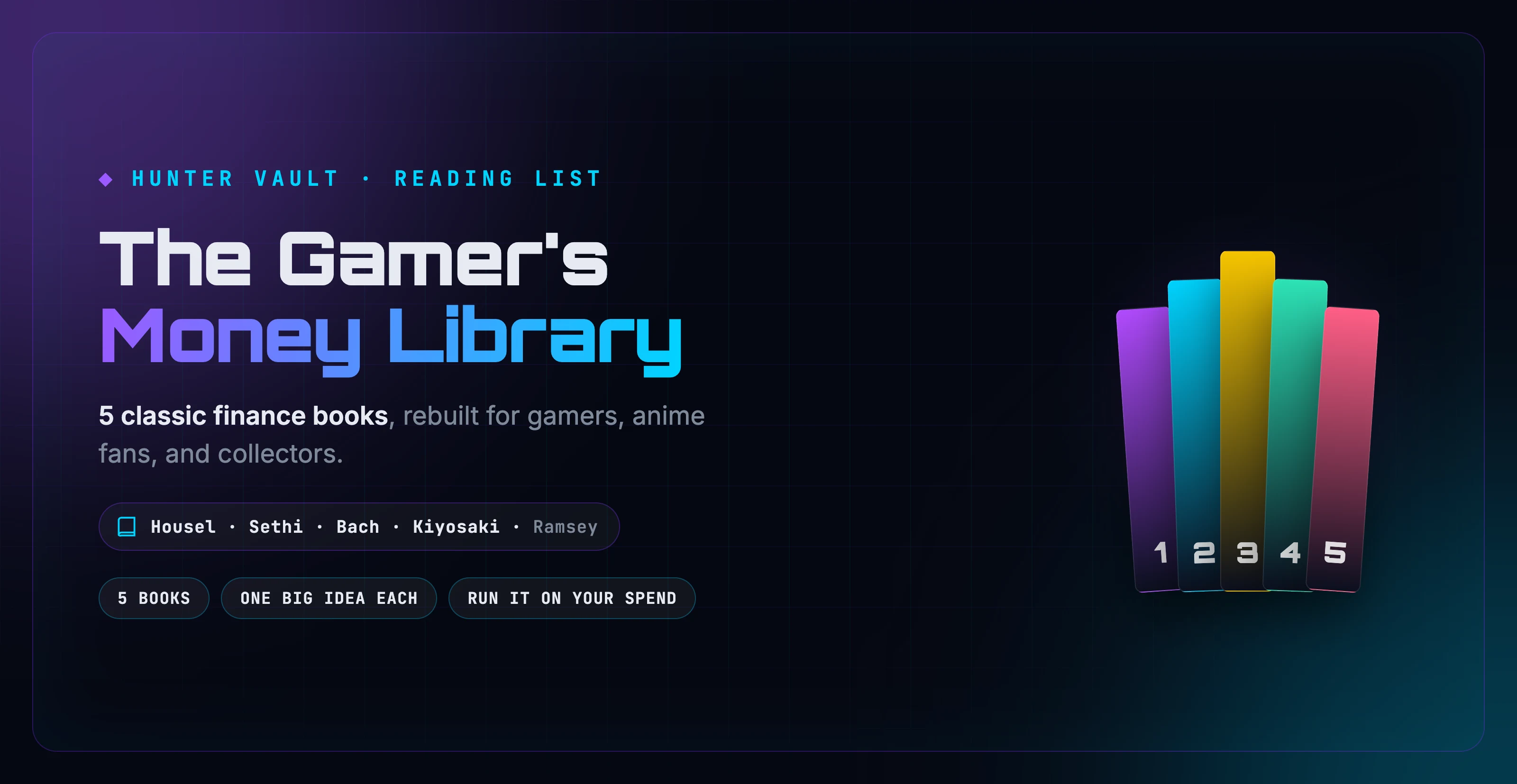
- Five classic money books, each carrying one load-bearing idea — translated for gamers, anime fans, and collectors
- Housel: behavior beats math. Sethi: automate the boring stuff, spend consciously on what you love
- Bach: pay yourself first, and watch the 'Latte Factor' hiding in your microtransactions
- Ramsey: the Baby Steps and the debt snowball give you a clear order of operations
- Kiyosaki: know the difference between assets and liabilities before you try to grow anything
- You don't need to read all five — take the one idea that fits your situation and run it this week
Every RPG worth playing has a skill tree. You don’t unlock everything at once — you pick the branch that fits how you play, invest your points, and get measurably stronger. Personal finance has a skill tree too, and most of it was written down decades ago in a handful of books that keep outselling every trend because the fundamentals never change.
The problem is that none of those books were written for you. They assume a reader who overspends on lattes and dinners out, not one who dropped $80 on a battle pass, pre-ordered three figures, and keeps a gacha pity counter in their head. So we did the translation. This is the Gamer’s Money Library: the single most important idea from five classic personal-finance books, rewritten for how gamers, anime fans, and collectors actually spend — and turned into a habit you can run on your own money starting today.
Hunter Vault is an independent app inspired by RPG and anime progression systems. It is not affiliated with, endorsed by, or sponsored by the creators or rights holders of Solo Leveling, nor by the authors or publishers of the books discussed here. Book references are used for commentary and education, with all ideas summarized in our own words and credited to their authors.
Quick Answer: The Five Books and Their One Big Idea
If you only remember one line from each book, remember these:
- The Psychology of Money (Morgan Housel) — doing well with money is about behavior, not intelligence. A calm average investor beats a brilliant reckless one.
- I Will Teach You to Be Rich (Ramit Sethi) — automate the boring stuff so it happens without willpower, then spend guilt-free on the few things you genuinely love.
- The Automatic Millionaire (David Bach) — pay yourself first, automatically, and notice the “Latte Factor”: small recurring costs that quietly add up to a fortune.
- The Total Money Makeover (Dave Ramsey) — follow the Baby Steps in order, and kill debt with the snowball method for psychological momentum.
- Rich Dad Poor Dad (Robert Kiyosaki) — learn the difference between an asset (puts money in your pocket) and a liability (takes it out) before you try to build wealth.
Now here’s what each one means once you’re a Hunter, not a hypothetical reader with a coffee habit.
1. The Psychology of Money — Your Wallet Is a Boss Fight Against Yourself
Morgan Housel’s core argument is deceptively simple: financial success is a soft skill, where how you behave matters more than what you know. You can know the math on loot boxes cold and still open them, because knowing and doing are different stats.
For gamers this is the most important reframe of all five, because the gaming economy is engineered by professionals to beat your behavior. Variable rewards, FOMO timers, “limited” banners, and battle-pass streaks are designed to bypass the rational part of your brain — the same way a good game designs a compulsion loop. Willpower isn’t the counter. Awareness is. The moment you can see a pattern in your spending, it loses most of its power over you.
Housel also draws a line between being rich (visible spending) and being wealthy (the money you didn’t spend, sitting in reserve). Every skin you didn’t buy is wealth. That’s a genuinely motivating way to think about restraint — not as loss, but as a stat you’re quietly stacking.
We unpack the full behavioral playbook in The Psychology of Money for Gamers and the specific question of when to stop in how much is ‘enough’ to spend on a hobby. If you want to go deeper on the compulsion loops themselves, the psychology of game spending breaks down the mechanics.
2. I Will Teach You to Be Rich — Automate the Boring, Spend on the Fun
Ramit Sethi’s system rests on two pillars. The first is automation: set up your money to move on its own — bills, savings, investing — so your financial life runs whether or not you feel disciplined that week. The second is the Conscious Spending Plan: instead of a guilt budget that says no to everything, you spend extravagantly on the few things you love and cut mercilessly on the things you don’t.
This is tailor-made for gamers, because the standard advice — “stop buying games” — is both miserable and unnecessary. Sethi’s framework says the opposite: if gaming is your genuine joy, fund it deliberately and stop apologizing. The savings come from the stuff you don’t actually care about, plus the automation that quietly builds a reserve in the background.
The practical version for a Hunter: decide your monthly gaming number on purpose, automate a transfer to savings the day you get paid, and let everything else be guilt-free inside that plan. See the full build in the Conscious Spending Plan for gamers and the automation side in automate your money like a Hunter. A live safe-to-spend number is what makes “guilt-free inside the plan” actually work.
3. The Automatic Millionaire — Pay Yourself First, and Mind the Latte Factor
David Bach’s book is built on two ideas that pair perfectly. Pay yourself first means your savings come off the top, automatically, before you can spend the money — not from whatever happens to be left at the end of the month (which is usually nothing). The Latte Factor is his name for small, recurring, forgettable purchases that feel trivial in the moment but compound into serious money over time.
Bach’s example was a daily coffee. Yours is a $9.99 monthly pass across four games, a $4.99 impulse gem pack “just this once,” a couple of DLC add-ons a month. Individually invisible. Annually? Often several hundred dollars you never consciously decided to spend. That’s the Latte Factor wearing a gamer skin.
The fix is the same as Bach’s: make one small saving automatic so it happens without you, and audit the tiny recurring stuff you’ve stopped noticing. Run the numbers yourself with the gaming spending calculator, then read the Latte Factor for microtransactions and pay yourself first for gamers.
4. The Total Money Makeover — The Baby Steps Are a Quest Log
Dave Ramsey’s contribution is order of operations. Most people trying to fix their money do everything at once, badly. Ramsey’s Baby Steps give you a strict sequence: build a small starter emergency fund first, then attack your debts one at a time, then build a bigger cushion, and so on. It’s the closest thing personal finance has to a quest log — do this, then unlock the next step.
His most famous move is the debt snowball: pay off your smallest debt first regardless of interest rate, then roll that payment into the next. Mathematically the avalanche (highest interest first) is cheaper, but Ramsey’s whole point is behavioral — early wins keep you in the fight, and staying in the fight matters more than optimizing it.
For a gamer in debt, this is the clearest starting book of the five. Get the adapted sequence in Dave Ramsey’s Baby Steps for gamers and the speedrun version of step one in the gamer’s starter emergency fund. Decide your payoff method with the debt snowball vs avalanche breakdown and a debt payoff calculator.
5. Rich Dad Poor Dad — Assets vs Liabilities Before You “Grow” Anything
Robert Kiyosaki’s book is the most debated of the five, but one distinction from it is genuinely useful and worth taking: an asset puts money in your pocket; a liability takes money out. His argument is that most people accumulate liabilities they believe are assets, and never build the income-producing kind.
This is the bridge from spending to growing money — and it’s where gamers have a surprisingly relevant edge. That sealed collector’s box or graded card might genuinely appreciate; that “limited” digital cosmetic almost certainly won’t. Knowing which of your purchases are liabilities dressed up as investments is financial literacy in its purest form. It’s also the honest on-ramp to real investing, which is a different game than tracking spend.
We take this apart in assets vs liabilities: is your gaming PC an asset? and from loot to wealth, then step into actual investing — carefully — in how to start investing after you stop overspending. From there, index funds explained for gamers and compound interest vs compound spending cover the growth side without the hype.
How to Actually Use This Library
Don’t read all five and do nothing. Pick your branch based on where you are right now.
If money feels chaotic: start with awareness
Begin with Housel’s mindset and Bach’s Latte Factor. Your only job for two weeks is to see your spending clearly — every purchase, especially the small recurring ones. Awareness alone changes behavior before you’ve cut a single thing.
If you're in debt: start with a quest log
Go straight to Ramsey’s Baby Steps. Build the small starter fund, then snowball your debts. Ignore everything else — investing, optimizing — until the debt gate is cleared. Order of operations is the whole point.
If you're stable and want a system: automate
Use Sethi’s playbook. Automate savings off the top on payday, set a deliberate gaming number, and spend guilt-free inside it. Once that runs itself, use Kiyosaki’s asset lens to start growing what’s left over.
Every path has the same foundation: you can’t manage a spend you can’t see. That’s the one prerequisite all five authors assume and none of them can give you — a clear, current picture of where your money actually goes.
Hunter Vault turns tracking your gaming and hobby spending into an RPG you actually want to play — log purchases, set a safe-to-spend ceiling, and rank up as your habits improve. It’s the place you execute every idea in this library, purchase by purchase. Download free on iOS or Android and clear your first gate today. (Hunter Vault Premium unlocks unlimited tracking for a one-time $15.99.)
The Books, Credited
Every idea above is summarized in our own words; the originals go far deeper and are worth reading if a framework clicks:
- The Psychology of Money — Morgan Housel
- I Will Teach You to Be Rich — Ramit Sethi (iwillteachyoutoberich.com)
- The Automatic Millionaire — David Bach
- The Total Money Makeover — Dave Ramsey (ramseysolutions.com)
- Rich Dad Poor Dad — Robert Kiyosaki (richdad.com)
This is general educational content, not financial advice, and nothing here is a recommendation to buy any specific investment. Build an approach that fits your income, obligations, and goals — and if debt or spending is causing real harm, consider speaking with a qualified professional.
Final Takeaway
Five books, five ideas: behavior over math (Housel), automate then spend consciously (Sethi), pay yourself first and mind the small stuff (Bach), follow the steps and snowball your debt (Ramsey), and know your assets from your liabilities (Kiyosaki). None were written for gamers, but every one of them describes a habit you can run on your skins, packs, and subscriptions today.
Pick the branch that fits where you are, run one habit this week, and give yourself something to run it in. See the whole system in action, then treat your next purchase like the deliberate decision it is.
Frequently Asked Questions
What are the best personal finance books for gamers?
The five that translate most cleanly to gaming and hobby spending are The Psychology of Money by Morgan Housel (behavior beats math), I Will Teach You to Be Rich by Ramit Sethi (automation plus conscious spending), The Automatic Millionaire by David Bach (pay yourself first and the Latte Factor), The Total Money Makeover by Dave Ramsey (the Baby Steps and the debt snowball), and Rich Dad Poor Dad by Robert Kiyosaki (assets versus liabilities). None of them are about gaming, but every one of them describes a habit you can run directly on your skins, gacha, packs, and subscriptions.
Do I need to read all five books to fix my money?
No. Each book really carries one load-bearing idea, and this guide gives you that idea from all five so you can start today. Reading the originals is worth it if one framework clicks — Housel for mindset, Sethi for a modern system, Ramsey if you’re in debt — but the point of a ‘library’ is that you take the principle that fits your situation and apply it. You rank up by doing one habit, not by finishing a reading list.
Which book should a gamer in debt start with?
The Total Money Makeover by Dave Ramsey. Its Baby Steps give you an unambiguous order of operations — a small starter emergency fund first, then attack debts smallest-to-largest for momentum. It’s the most ‘quest log’ of the five: do this, then this, then this. Pair it with the debt snowball vs avalanche breakdown and a payoff tracker, and you have a full plan for clearing the debt gate before you worry about anything else.
Can budgeting really be applied to gaming and hobby spending?
Yes, and that’s the entire premise. Gaming, gacha, TCG, and anime spending behave like any other discretionary category — they respond to awareness, limits, and automation exactly the same way dining out or shopping does. The trick most guides miss is that gamers don’t need to quit their hobby; they need to see it clearly and put a ceiling on it. Every framework in this library is about spending on what you love on purpose, not spending less for its own sake.
Is Hunter Vault based on these books?
Hunter Vault is a gamified spending tracker inspired by RPG and anime progression systems, not by any single book. But the habits these books describe — awareness, pay yourself first, a spending ceiling, momentum on debt — are exactly the habits the app is built to make easier to run. Think of the books as the theory and the app as the place you actually execute it, purchase by purchase.