- The next big Steam sale is the Winter Sale, December 17, 2026 to January 4, 2027. Valve's full schedule of upcoming sales and fests is below
- Steam sales are engineered with countdown timers, big discount tags, and wishlist notifications that trigger purchases before rational thought kicks in
- The median Steam player has about half their library unplayed — the games are bought, just not played
- The fix isn't willpower during the sale — it's making decisions before it starts
- Build your wishlist in advance, set a budget cap, and use SteamDB to check whether a price is really a historical low
- Apply a 72-hour rule to anything not already on your wishlist before the sale opened
Steam has four major sales a year plus genre-specific fests nearly every month. Each one arrives with countdown timers, big discount percentages, and a notification that one of your wishlist games is on sale. It’s designed to feel urgent. It works.
The result shows up in your library: analysis of public Steam profiles by GameDiscoverCo (March 2024) found that on average 32.7% of the games in a Steam library are unplayed, and the median player has 51.5% of their library unplayed. GameDiscoverCo also notes that deeply discounted games tend to get bought but not always played.
The problem isn’t the sales. It’s buying games during the sale that you weren’t actually planning to play.
Quick Answer: How to Stop Impulse Buying on Steam Sales
Stop making decisions during the sale. Before a sale opens, build your wishlist, rank it by what you actually want to play next, set a budget cap, and load that amount into Steam Wallet. When the sale starts, work through your ranked list until the wallet is empty. Check the price history on SteamDB before a discount triggers a purchase. For anything not already on your wishlist before the sale began, apply a 72-hour wait — most impulse game urges fade before then.
When Is the Next Steam Sale? (Dates Checked October 23, 2026)
The next major Steam sale is the Steam Winter Sale, December 17, 2026 to January 4, 2027, according to Valve’s Steamworks schedule. Before then, Steam runs two smaller themed fests: Scream V Fest (October 26 to November 2) and the Auto-Battler RPG Fest (November 16 to 23). There’s no big Steam sale in November. The Autumn Sale, which used to overlap Black Friday, now runs in early October, and in 2026 it ran October 1 to 8. Valve lists dates, not times, but seasonal sales have usually started and ended at 10 a.m. Pacific.
| Event | Dates | What it is |
|---|---|---|
| Steam Scream V Fest | Oct 26 – Nov 2, 2026 | Themed fest (horror) |
| Auto-Battler RPG Fest | Nov 16 – 23, 2026 | Themed fest |
| Steam Winter Sale | Dec 17, 2026 – Jan 4, 2027 | Seasonal sale |
| Desktop Companion Fest | Jan 14 – 18, 2027 | Themed fest |
| Shop Keeper Fest | Jan 25 – Feb 1, 2027 | Themed fest |
| Sheep Fest | Feb 4 – 8, 2027 | Themed fest |
| Couch Co-Op Fest | Feb 8 – 15, 2027 | Themed fest |
| Steam Next Fest | Feb 22 – Mar 1, 2027 | Free demos of upcoming games, not a sale |
| Rhythm Fest | Mar 8 – 15, 2027 | Themed fest |
| Steam Spring Sale | Mar 18 – 25, 2027 | Seasonal sale |
| Dinos vs. Robots Fest | Mar 29 – Apr 5, 2027 | Themed fest |
| Racing Fest | Apr 12 – 19, 2027 | Themed fest |
| Witch Fest | Apr 22 – 26, 2027 | Themed fest |
| Fighting Fest | Apr 26 – May 3, 2027 | Themed fest |
| Real-Time Strategy Fest | May 10 – 17, 2027 | Themed fest |
| Mountaineering Fest | May 31 – Jun 3, 2027 | Themed fest |
| Steam Next Fest | Jun 14 – 21, 2027 | Free demos, not a sale |
| Steam Summer Sale | Jun 24 – Jul 8, 2027 | Seasonal sale |
| Steam Autumn Sale 2027 | Not announced | Seasonal sale |
Seasonal sales are the big sitewide events. Themed fests promote one genre or theme, so you’ll see fewer discounts. Valve updates the schedule during the year, so check the Steamworks page before you plan around a date.
A budget plan for the Winter Sale
You have about eight weeks until December 17. That’s enough time to make every decision before the countdown timers start:
- Set your cap now and split it by week. A $60 Winter Sale cap is about $7.50 a week between now and December 17. Saving it ahead means the sale is paid for before it starts, and doesn’t land on top of holiday spending.
- Let the November fests pass. Scream Fest and the Auto-Battler RPG Fest are smaller events. If a game you want is discounted there, check SteamDB. If it’s not a historical low, it can wait for December. Doing a No Spend November? Valve has no sitewide sale in November, so you’re not missing a big one.
- Build and rank your wishlist by December 16 (Step 1 below), and load your cap into Steam Wallet the day before.
- On December 17, buy from the top of your list until the Wallet is empty. The sale runs for more than two weeks, so there’s no need to buy everything on day one.
- On January 4, stop. Anything you didn’t buy goes back on the wishlist. The next seasonal sale is the Spring Sale on March 18.
If you also shop console or retail Black Friday deals, budget those separately. Our Black Friday game deals budget covers November 27.
Why Steam Sales Are Built to Make You Buy
Steam’s sale mechanics aren’t accidental. Each element targets a specific part of the purchase psychology.
Countdown timers create time pressure that activates the amygdala — the brain’s emotional processing center — while suppressing the prefrontal cortex, the part that handles rational decision-making (PMC, 2024). Research published in the European Journal of Business and Management Research found that 55% of shoppers report feeling they must buy immediately when they think a deal might disappear. The timer manufactures that feeling.
Big discount tags use artificial scarcity psychology. A bright “-80%” next to a countdown signals that this price window is rare and closing — even when that’s not strictly true. Dr. Jamie Madigan’s analysis in The Psychology of Games documents this as “psychological reactance”: when an opportunity feels like it’s disappearing, people want it more, not less.
Wishlist notifications hit at exactly the wrong moment. Steam lets you know when a wishlisted game goes on sale, and by then you’ve already pre-committed by wishlisting it, so the sale notification feels like a reason to act immediately. The gap between “I’ve always wanted this” and “the sale ends in 14 hours” collapses into one purchase.
Low prices lower resistance. Research by Atasoy and Morewedge in the Journal of Consumer Research (2017) found that consumers value digital goods less than physical equivalents and therefore apply less resistance to purchasing them. At 80% off, a game that costs less than lunch can feel essentially free — which is why you buy it without asking whether you’ll actually play it.
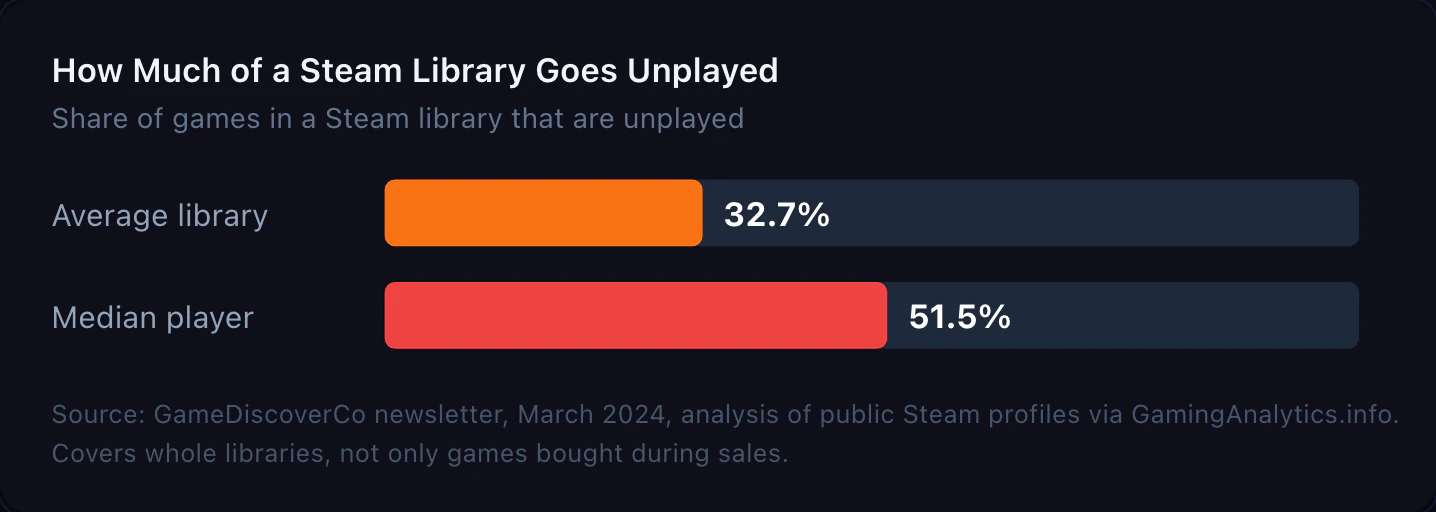
About a third of the average Steam library has never been played, and for the median player it’s more than half. Not every one of those was a sale impulse, but cheap, unplanned buys are an easy way to end up there. The games aren’t bad. They were bought for the wrong reason.
Step 1: Build Your Wishlist Before the Sale Starts
Lock in your list before the pressure starts
The wishlist is your purchase plan, not a browsing bookmark. Used correctly, it does most of the work for you.
Before any major Steam sale opens, open your wishlist and rank the games by how much you actually want to play them next — not by discount depth or hype, but by what you’d actually start first. That ranked order is your shopping list.
During the sale, you’re only buying from that list. You’re not browsing the front page, the sale categories, or the “you might also like” recommendations. Those sections are discovery tools, and during a sale they’re impulse triggers.
The mechanics work in your favor: Steam sends notifications when wishlisted games go on sale. You don’t need to browse — the system surfaces deals on games you’ve already decided you want. The list was built without sale pressure; it represents what you actually intended to play.
If you discover a game during the sale that isn’t on your list, add it to the wishlist — but don’t buy it this sale. Wait for the next one. If you still want it then, it was a real want.
Step 2: Set Your Budget Cap Before You Open Steam
Decide the number before you see the deals
Sale pressure distorts spending decisions in real time. The fix is to make the budget decision before any of that pressure exists.
Before the sale begins:
- Decide your total sale budget — a flat number that fits your gaming budget for the month. Keep it under your gaming subscription cost if you’re already subscribed to a service with a similar library.
- Load exactly that amount into your Steam Wallet. Not your card — your Wallet. Once the Wallet is empty, you’re done.
Loading the Wallet converts an abstract budget into a finite resource. You can physically see it decreasing with each purchase, which reintroduces the “pain of paying” that saved card checkout removes. Research on digital payments found that this friction matters — visible depletion of funds reduces spending relative to invisible card charges (PMC, 2025).
Work through your ranked wishlist in order. When the Wallet hits zero, close Steam.
Not sure how much of your entertainment budget should go to games in the first place? Our gaming subscription budget guide walks through setting that number before the sale starts.
Step 3: Use SteamDB to Check the Price History
Check the price history before the discount convinces you
Steam’s store page shows you the discount, not whether the game has been cheaper before. A big percentage off feels like a rare chance even when the same price comes around every sale. “Historical low” labels you may have seen come from third-party tools like SteamDB, IsThereAnyDeal, or browser extensions such as Augmented Steam, not from Steam itself.
Before any purchase — especially an unplanned one — open SteamDB and search the game. The price history chart shows the prices the game has hit on Steam over time, by region.
If the current sale price matches or beats the lowest point on that chart: the deal is genuine.
If the chart shows the game has been this price or lower before — often more recently than the countdown implies — the urgency is manufactured. The deal will come around again.
This step strips the psychological power from the discount trigger. Once you can verify the claim, it becomes a factual comparison rather than an emotional prompt.
Step 4: Apply the 72-Hour Rule to Unplanned Purchases
Wait before buying anything not already on your list
Anything not on your wishlist before the sale started gets a mandatory 72-hour wait before purchase.
The neuroscience behind this: the dopamine spike that drives impulse buying fades within hours. After 72 hours, the initial emotional response — the urgency, the FOMO, the “this feels like a great deal” feeling — has largely dissipated. What remains is whether you actually wanted the game, independent of the sale pressure.
If you still want it after 72 hours and the sale is still running, the purchase is no longer impulsive — it’s deliberate. Buy it if it fits the budget.
If the 72 hours runs out and the sale ends: if you genuinely wanted the game, it will be on sale again. Steam runs four major sales per year plus category-specific fests nearly every month. The deal returns. What doesn’t return is the money spent on something you never played.
A game at 90% off still costs money. A $50 game at 90% off is $5 — but if you never play it, the cost is $5 wasted, not $50 saved. The savings only exist if you would have bought it at full price. If you wouldn’t have, there’s no savings — just a purchase.
Step 5: Track What You Actually Play After Each Sale
Run the accountability check after each sale
After each major sale, do one quick check: of the games you bought in that sale, how many have you launched?
This isn’t about guilt. It’s about recalibrating what your “I’ll definitely play this” judgment is actually worth. Most people discover their hit rate is lower than they assumed. That data improves future decisions.
If you bought five games in the Summer Sale and played two, your actual purchase accuracy is 40%. Factor that into how many games you buy in the Autumn Sale.
If you track your gaming expenses already — or want to start — you can log sale purchases as a category and see the monthly pattern. The number is usually surprising.
You can do this without connecting a bank account — see our guide on how to track gaming spending without linking your bank.
Common Mistakes to Avoid
Browsing the sale looking for deals. Discovery during a sale is how impulse buys happen. If it’s not already on your wishlist, you weren’t planning to buy it — you found it under sale pressure. Shop the list, not the front page.
Buying a game just because it’s “a good deal.” A deal is only good if you play the game. The price is irrelevant if the game goes unplayed — which, in the average Steam library, is true of about a third of the games.
Treating a Steam sale as an event you participate in. Sales are a store, not a seasonal ritual you owe your time to. You don’t have to buy something in every sale. “I didn’t buy anything in the Summer Sale” is a win, not a miss.
Ignoring the gaming subscription overlap. If you have Game Pass or PS Plus, check whether the games you’re considering buying are already available through those libraries. Buying a game on Steam that’s currently on Game Pass is paying twice for the same content — our gaming subscription value check covers how to audit this.
Where Hunter Vault Fits
You can track Steam sale spending in a spreadsheet, but the pattern only becomes visible when you see it alongside the rest of your gaming spend. Hunter Vault’s expense tracker lets you log each sale purchase as it happens — no bank account linked — so the monthly gaming total is always accurate and visible, not estimated.
After each sale, your Spending Mix shows what gaming purchases cost you compared to subscriptions and other categories. If sale spending is consistently higher than you expected, that’s the data that changes the next decision.
Set a Vault for your next sale budget and record what you set aside in the weeks before each Steam sale. It’s a record (it doesn’t move money or block spending), but when the sale opens you can see exactly what you planned to spend.
Track your recurring gaming costs alongside one-off sale purchases and the full picture of what gaming costs per month becomes clear.
Final Takeaway
Steam sales aren’t a problem. Buying games you won’t play because the timer said to is the problem.
The solution isn’t more willpower during the sale. It’s building your list before it, setting your budget before you open Steam, and checking SteamDB before the discount tells you what to think. Make the decisions without pressure, then execute them when the sale is live.
Start with one action before the next Steam sale: open your wishlist and rank the top five games you actually want to play next. That list is your purchase plan. The sale is just how you execute it.
If you want to track gaming spending — sale purchases and subscriptions together — try Hunter Vault and keep the full picture visible.
This is general educational content, not financial advice. Choose an approach that fits your income, budget, and situation.
FAQ
When is the next Steam sale?
The next major Steam sale is the Steam Winter Sale, December 17, 2026 to January 4, 2027, per Valve’s Steamworks schedule (checked October 23, 2026). Before it, Steam runs two themed fests: Scream V Fest (October 26 to November 2) and the Auto-Battler RPG Fest (November 16 to 23). There’s no big Steam sale in November, because the Autumn Sale now runs in early October. In 2026 it ran October 1 to 8.
When is the Steam Winter Sale 2026?
Valve’s Steamworks schedule lists the Steam Winter Sale 2026 for December 17, 2026 to January 4, 2027. Valve lists dates, not times, but Steam’s seasonal sales have usually started and ended at 10 a.m. Pacific. After that, the next seasonal sale is the Spring Sale, March 18 to 25, 2027.
Is there a Steam Black Friday sale in 2026?
Valve’s 2026 schedule doesn’t list a Black Friday sale. The Autumn Sale, which used to overlap Black Friday, now runs in early October, and in 2026 it ran October 1 to 8. Individual publishers can still discount games in late November, but the next sitewide Steam sale is the Winter Sale on December 17.
Why do I keep buying Steam games I never play?
Steam sales are engineered to trigger purchases before the rational part of your brain catches up. Countdown timers activate emotional decision-making, big discount tags create artificial urgency, and the low prices make buying feel consequence-free. GameDiscoverCo’s 2024 analysis of public Steam profiles found the median player has about half (51.5%) of their library unplayed, and that deeply discounted games tend to be bought but not always played.
How do I stop impulse buying during Steam sales?
Build your wishlist before the sale opens, not during it. Set a hard budget cap and load it into Steam Wallet before browsing. Apply a 72-hour wait to any game not already on your wishlist. Use SteamDB to check whether a sale price is really a historical low before it drives a purchase. These steps move decisions out of the high-pressure sale environment where they tend to go wrong.
What is the best strategy for Steam sales?
Shop your wishlist in ranked order, not the front page. Decide your budget before the sale opens. Apply a 72-hour rule to anything you discover during the sale. Verify price claims with SteamDB. Close Steam when your Wallet hits zero. The strategy is to execute a pre-made plan, not to discover new games under sale pressure.
How do I know if a Steam deal is actually a historical low?
Use SteamDB. Search the game and view the price history chart — it shows the game’s Steam prices over time, by region. If the current price matches or beats the all-time low on that chart, the deal is genuine. If the game has been this price or cheaper before, the sale’s urgency is manufactured. To compare across other stores as well, check IsThereAnyDeal.
How much should I spend during a Steam sale?
Decide the number before the sale starts — not while you’re browsing. A practical method: load your sale budget into your Steam Wallet before opening Steam. When the Wallet is empty, you’re done. The cap should fit within your monthly gaming budget after subscriptions and other planned gaming costs are accounted for.
Is it worth buying games during Steam sales?
At 75–90% off on games you already planned to play, yes — the savings are real. On games bought because the price felt too good to pass up mid-browse, usually not — those tend to go unplayed. The value of a sale is only realized when you play the game. A $5 game that sits unplayed isn’t a deal; it’s a $5 waste.
What is the SteamDB historical low?
SteamDB is an independent database that tracks the price history of games on Steam across regions. It covers Steam only; for prices across other storefronts, use IsThereAnyDeal. The “historical low” is the lowest price that game has ever reached on Steam in your region. Steam’s store page doesn’t show that figure itself, so checking SteamDB takes 30 seconds and removes the manufactured urgency from the sale.