// adhd-friendly budget app

An ADHD-friendly budget app

built on quick wins

Hunter Vault gives you something back the moment you log: XP, a daily quest ticked off, a streak that grows. Fewer numbers, less admin, and a plain answer to what you can spend today.

  • Free to start
  • No account needed
  • Works offline
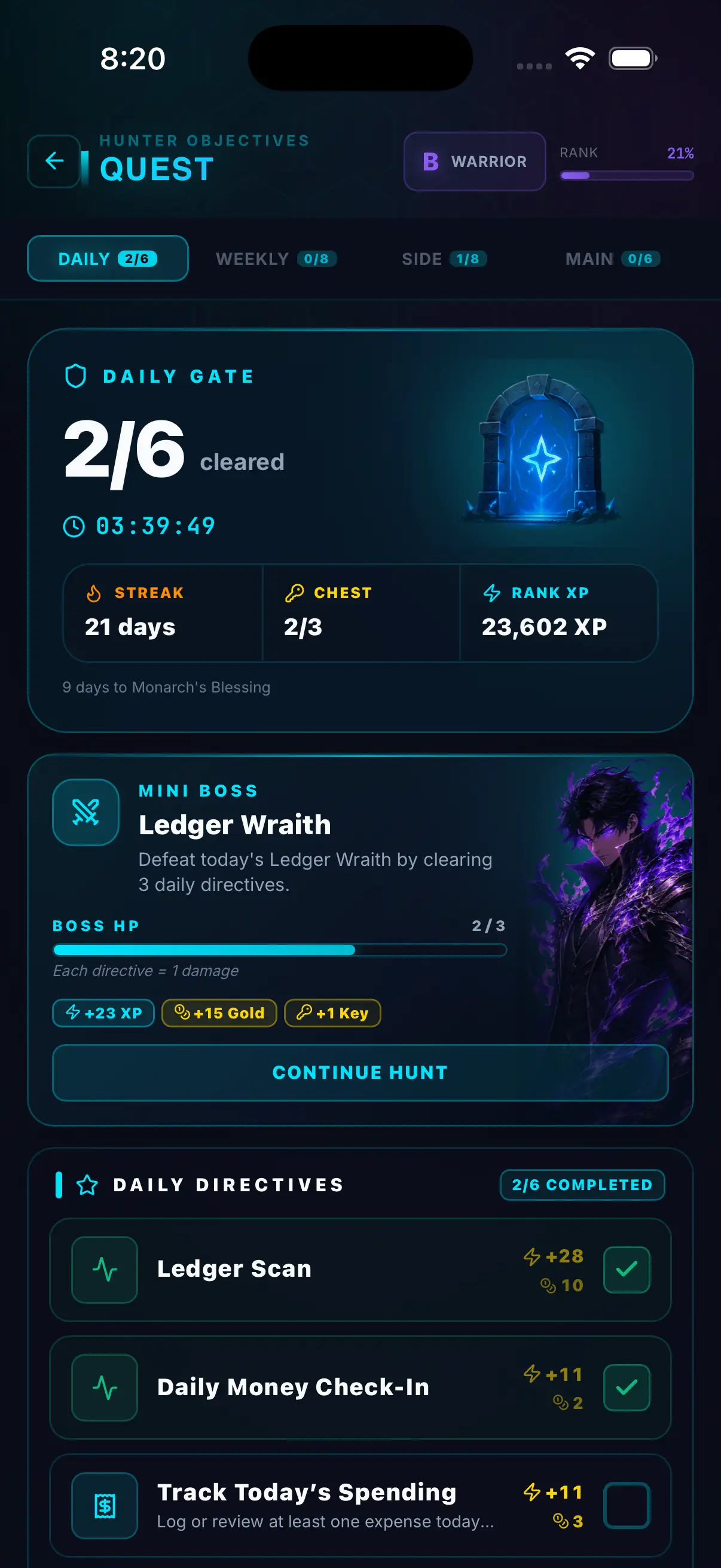
Hunter Vault quest screen showing daily money tasks, a streak counter and a daily mini boss
// the quick answer

What makes a budget app ADHD-friendly?

For a lot of people with ADHD, the problem with budgeting apps isn't knowing what to do. It's that the payoff is weeks away, the screens are full of numbers, and the app is easy to forget. A good budget app for ADHD shortens that loop: it rewards you right away, keeps the important number simple, and takes boring admin off your plate.

Hunter Vault is our own app, and it is a general budgeting app, not a medical tool. We built it around quick feedback because, in our experience, that is what helps people keep logging. This page shows what that looks like in practice, and what it won't do.

  • A reward the same day you log
  • One number for what you can spend
  • Bills and subscriptions that log themselves
  • A reminder you can move or turn off
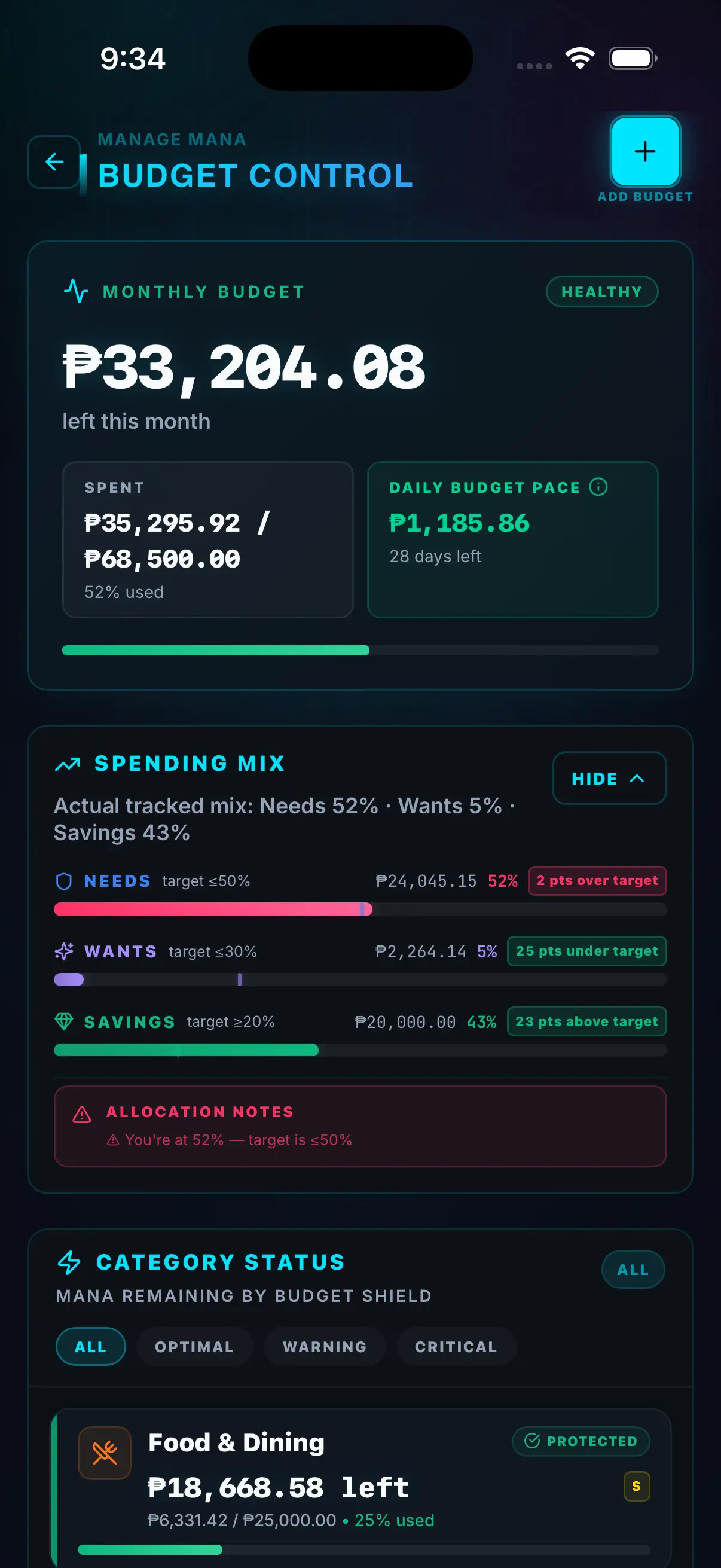
Hunter Vault budget control screen showing money left this month, daily budget pace and each budget's status
// why it matters

Money and ADHD: what the research shows

Studies find that adult ADHD is associated with harder money outcomes, not that it causes them. In a Swedish population study, adults with ADHD started adulthood with normal credit default rates, but those rates rose sharply in middle age, peaking at over six times the general population's risk by age 40 (Beauchaine, Ben-David & Bos, Science Advances, 2020). A smaller study led by the University of Groningen found adults with ADHD more often reported having debts, less often a savings account, and more impulse buying (Bangma et al., Neuropsychology, 2019).

A meta-analysis of 21 studies found people with ADHD tend to discount delayed rewards more steeply than others (Jackson & MacKillop, 2016). That matters for budgeting, where the reward usually arrives months later. The extra costs that build up along the way, from late fees to impulse buys, are often called the "ADHD tax".

  • Linked with more debt and late payments
  • Linked with less saving
  • Delayed rewards are discounted more steeply
  • None of this is a character flaw
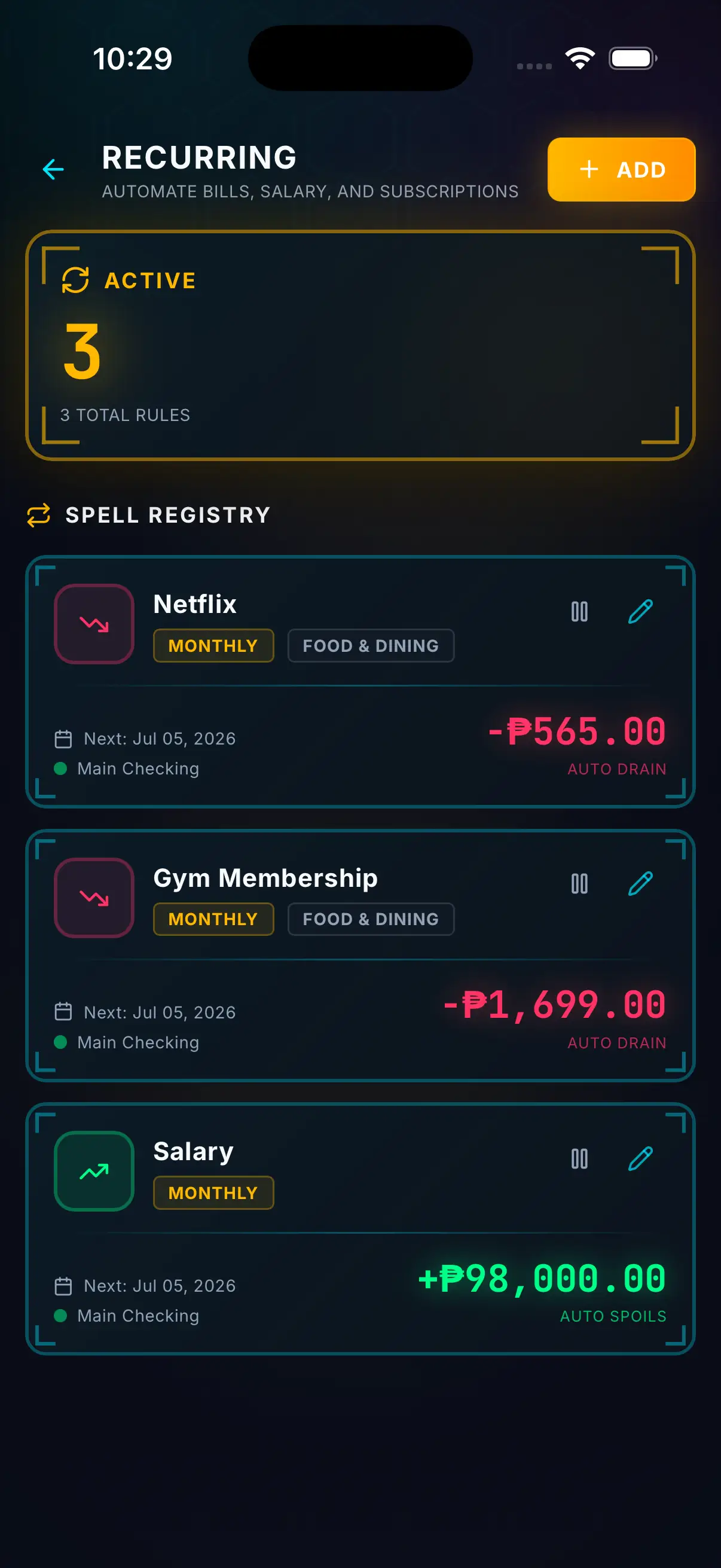
Hunter Vault recurring screen listing monthly entries (Netflix, a gym membership and salary) with their next date
// problem → feature

Common ADHD money snags, and what Hunter Vault does

These are common friction points, matched to what the app actually does. Nothing here is a treatment; it's just less friction.

The snagWhat Hunter Vault does
Forgetting to open the app A daily check-in reminder (on by default, and you can turn it off or change the time) and a fresh set of daily quests every day.
Rewards that feel too far away XP for logging, plus daily quests and a daily mini boss, so there is a payoff today, not at the end of the month.
Too many numbers at once Safe-to-Spend: one number for what is actually free after bills, savings commitments, debt minimums and a buffer.
Admin overload Recurring entries that log themselves (3 on the free tier), and a bank CSV that imports in one go for free.
Impulse buys Check Safe-to-Spend before you buy. Each budget shows what is left and switches to near-limit at 90% spent, inside the app.
Late fees and missed payments The bill tracker shows every due date and whether it is paid, and debt-payment reminders let you know when a payment is coming due.
All-or-nothing streaks Missing a day restarts your streak and costs a little in-app gold, but XP and rank never go backwards.
// low-effort setup

A setup that asks less of you

Do these once. After that, the daily part is logging what you spend and clearing a few quick quests.

  1. Set the reminder for a time you are already on your phone

    The daily check-in reminder is on by default. Move it to a moment that already exists in your day, like the commute home or right after dinner, so logging rides on a habit you have instead of needing a new one.

  2. Give the "ADHD tax" its own budget

    Create a budget called ADHD Tax and add subcategories for the costs that sneak up on you: late fees, impulse buys, forgotten subscriptions, rush shipping and replacing lost things. You can add a subcategory right from the expense screen. After a month, Reports show which one costs you most.

  3. Set up the boring stuff once

    Add your bills to the bill tracker so every due date is visible, and set up your subscriptions as recurring entries (3 on the free tier). Recurring entries log themselves on schedule, so the admin you would forget is already done.

  4. Use one number before you buy

    Before a purchase, open Safe-to-Spend. It has already subtracted your bills, savings and debt minimums from your balance, so the question becomes "does this fit under one number?" rather than a calculation.

// honest limits

What Hunter Vault won't do

It isn't a medical or therapy tool

It doesn't diagnose, treat or manage ADHD. It's a budgeting app with quick feedback built in.

No push alert when a budget is nearly spent

Near-limit status shows inside the app. Push reminders cover the daily check-in, debt payments and savings goals.

It doesn't connect to your bank

Purchases only appear if you log them, set them up as recurring entries, or import them. That's the trade for not sharing your bank login.

Slipping has a small cost

A broken streak or an overspent budget costs in-app gold. Real money, XP and rank are never touched.

// tell us what works

Using Hunter Vault with ADHD?

We would love to hear what helps and what gets in your way. Email support@huntervault.app with the subject "Hunter Vault and ADHD". We read every message, and we will always ask before quoting anyone.

// questions

Frequently asked questions

No. Hunter Vault is a general budgeting app, and it isn't a medical tool or a treatment. Some of how it works suits people who want quick feedback: fast manual logging, XP for logging, daily quests and one Safe-to-Spend number. Whether that helps you is something only you can judge, which is why the core app is free to try.

Not with a push notification. Each budget shows what's left this month and switches to a near-limit status at 90% spent, inside the app. The notifications Hunter Vault does send are a daily check-in reminder, debt-payment reminders and savings goal reminders, and you can turn each of them off.

Your streak restarts and you lose a little in-app gold, but your XP and rank never go backwards and none of your data is lost. You can log the missed days afterwards, or import a CSV from your bank to catch up in one go.

You log purchases yourself, which takes a few taps each, or import a CSV you export from your bank, which is free and processed on your device. Recurring bills and subscriptions can be set up once and log themselves. Importing from screenshots and PDFs uses Hunter Credits from the optional Hunter Pass subscription.

Core budgeting is free and has no ads. The free tier covers up to 8 budgets, 3 recurring entries, 5 accounts, 3 debts and 2 savings goals. Hunter Elite is a one-time $15.99 upgrade that removes those limits. Budgeting never requires a subscription; the optional subscriptions are Hunter Pass (for the Huntee AI assistant and Smart Import from screenshots and PDFs) and cloud sync.

On your device by default. No account or bank login is needed to start. Your financial data only leaves your phone if you turn on an online feature: cloud sync backs it up, and Huntee and Smart Import from screenshots and PDFs send the relevant data to Google's Gemini.

// your first quest

Your first quest: log one thing you bought today.

Download Hunter Vault free on iOS and Android. No account needed to start, and the XP lands the moment you log.

  • Free to start
  • No account needed
  • Works offline
See all guides →
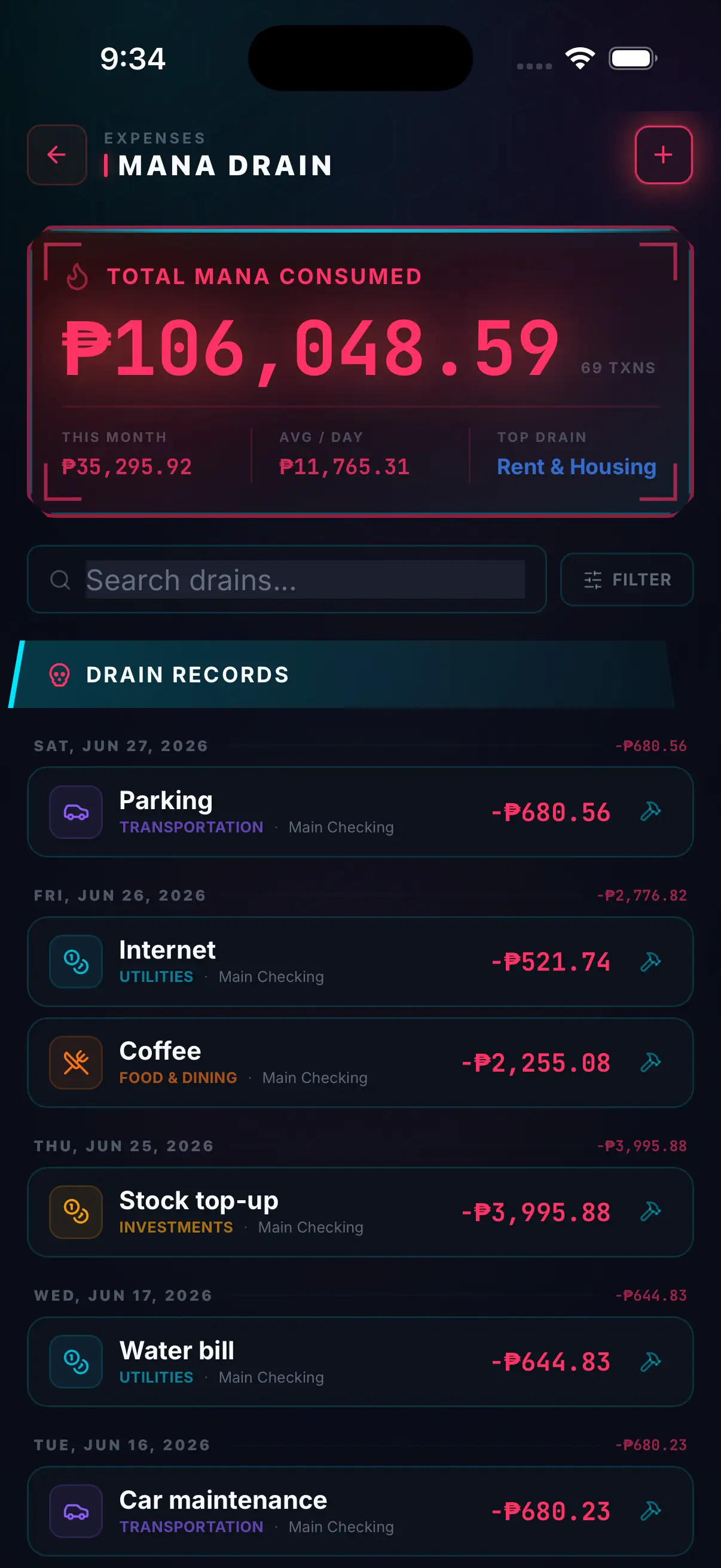
Hunter Vault expense list with a monthly total, a search bar and recent entries by category

This page is general product information, not medical, psychological or financial advice. Research cited above shows associations, not causes, and it did not test budgeting apps. If ADHD is affecting your finances, a clinician or a financial counsellor can help you build a plan that fits you.