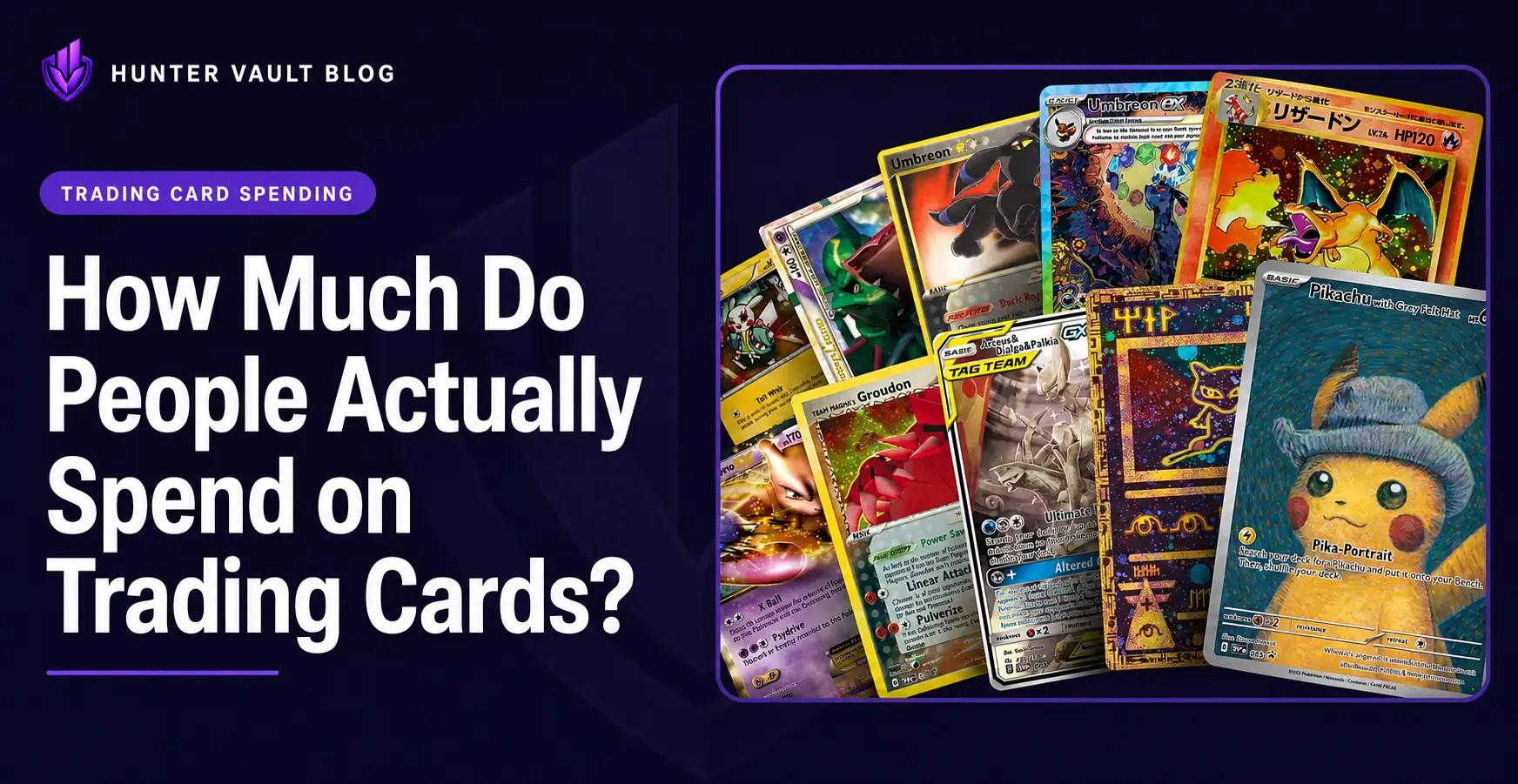
- The global TCG market hit roughly $8.4B in 2025 and is projected to reach $16.9B by 2035 — driven by Pokémon, One Piece, and digital crossovers like Pokémon TCG Pocket
- PSA grading all-in cost runs $135–$145/card including shipping and supplies — most cards don't return a profit after grading
- Pokémon TCG Pocket surpassed $500M in revenue and 150M downloads; many players are running a physical and digital TCG budget without realizing it
- Most hobbyists significantly underestimate their TCG spend because purchases happen in small, frequent increments across multiple categories
- Tracking sealed product, singles, grading fees, and digital spend together gives you the only accurate picture of what the hobby actually costs
Pack-opening videos get millions of views. Discord servers debate pull rates at all hours. Yet almost no one in the TCG hobby tracks what they actually spend month to month — and the gap between perceived spend and actual spend can easily run into hundreds of dollars per set release.
This post pulls together the best available market data to answer the question TCG players are quietly asking themselves: am I spending too much, or is this normal?
Key Findings: What the TCG Spending Data Shows
The global TCG hobby is larger — and growing faster — than most players realize.
- $8.4 billion: Estimated global TCG market size in 2025 (Inkwood Research, re-verify date at publish time)
- $16.9 billion: Projected market size by 2035 at a 6.9% compound annual growth rate
- ~12%: Pokémon’s estimated share of the global TCG market
- Q4 2025: One Piece TCG surpassed Yu-Gi-Oh! on TCGplayer by gross merchandise value (TCGplayer seller blog, re-verify at publish time)
- $135–$145: All-in cost per card when sending to PSA for grading (TCGscreener)
The data tells a consistent story: TCG is a serious hobby with serious money flowing through it. Most of that money moves in ways that don’t feel like “spending” in the moment — a booster here, a single there, grading fees paid months later and long since forgotten.
How Big Is the TCG Market, Really?
The global trading card game market reached roughly $8.4 billion in 2025 according to Inkwood Research’s TCG market report, and is projected to reach approximately $16.9 billion by 2035 at a 6.9% CAGR. That’s faster than the global toy market overall, and reflects a hobby in genuine expansion — not a nostalgia bubble slowly deflating.
Pokémon remains the category anchor. One Piece TCG surpassed Yu-Gi-Oh! on TCGplayer by GMV in Q4 2025 — a milestone that would have seemed unlikely just two years earlier. Disney Lorcana crossed $100M in revenue within 18 months of launch. Magic: The Gathering maintains a large and active tournament ecosystem.
What this means for individual hobbyists: price floors on competitive cards have risen alongside the market. A meta-playable card in most TCGs costs more now than it did in 2022, simply because aggregate demand has grown.
Most hobby spending happens in small increments — a $15 pack here, a $40 single there. Research on the “pain of paying” shows that small, frequent purchases feel less significant than equivalent single large ones. A TCG player who buys three packs a week for a year has spent roughly $2,340 without ever making a decision that felt big.
Where Does TCG Money Actually Go?
TCG spending isn’t just packs. Here’s a realistic breakdown of where money flows across an active hobbyist’s budget:
Sealed product is typically the biggest line item for set chasers. A standard booster box for a major Pokémon set retails at $150–$180; opening one box per set across four releases per year puts sealed spend at $600–$720 before you’ve bought a single accessory.
Singles are the more economical route for competitive players, but costs compound quickly: a tournament-viable deck in Pokémon TCG or Magic: The Gathering can run $100–$600 depending on format and how many chase rares it requires.
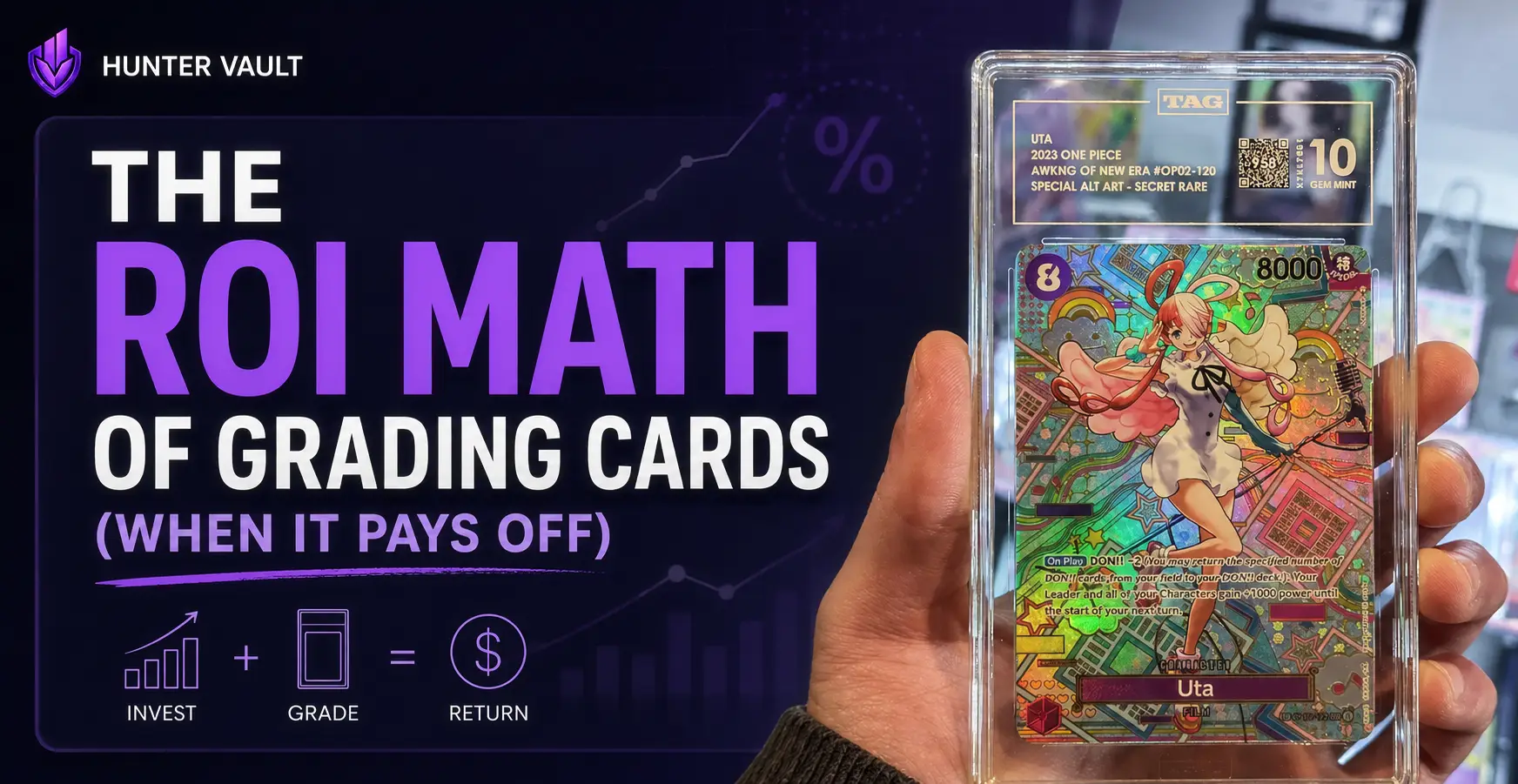
Grading fees are the category that surprises most hobbyists. PSA’s standard service starts at $79.99/card as of 2025. Add two-way insured shipping (~$25–$30 total), card savers, bubble wrap, and return packaging weight, and the real all-in cost per card typically runs $135–$145, according to a detailed cost breakdown published by TCGscreener. That means a card needs a raw value well above $100 — many practitioners suggest $150–$200 minimum — to be worth grading economically. The reality is that many collectors grade for the slab and the preservation benefit, not because the math works. That’s a valid choice, but grading costs should be budgeted as a hobby expense, not expected to pay for themselves.
Learn how to plan your full TCG hobby budget in How to Budget for Trading Card Games Without Going Broke.
The Digital TCG Factor: Pokémon TCG Pocket
Pokémon TCG Pocket launched in late 2024 and had surpassed 150 million downloads with over $500 million in revenue by October 2025 (Nintendo Life), outpacing Genshin Impact and Honkai Star Rail in their equivalent revenue windows. For what is essentially a digital card-collecting game with no physical equivalent, that is a striking number.
The spending mechanics follow the gacha model: two free packs per day, with additional packs purchasable through Poké Gold bundles. Revenue data suggests a meaningful share of players spends real money, following the typical gacha distribution where a small percentage of heavy spenders drive the majority of revenue (Kotaku).
The practical implication for TCG budgeting: many players are now running two separate hobby budgets — one for physical cards, one for Pocket — without treating them as a combined total. If you spend $50/month on physical packs and another $30/month on Pocket bundles, your actual TCG hobby spend is $80/month, not $50. The digital spend doesn’t feel like it belongs in the same category, which is exactly how it slips through untracked.
See how Pokémon card budgeting works in practice: How to Budget for Pokémon Cards.
What the Outliers Tell Us
The grading math rarely works for most cards. The $135–$145 all-in cost creates a hard floor: any card worth less than $150 raw is unlikely to profit after grading, even at PSA 10. Yet community discussion consistently shows a significant share of cards sent to graders are lower-value pulls that collectors couldn’t resist submitting. The motivation is usually sentimental or preservation-driven rather than economic — which is valid, but means grading costs need to be treated as a hobby expense line, not an investment.
Digital spend often isn’t counted as TCG spend. Players who carefully budget their physical card spending frequently exclude Pocket or MTG Arena purchases from the same mental bucket, even though all of it comes from the same discretionary income. This cognitive separation is one reason Pocket’s revenue has scaled so quickly — it doesn’t feel like card spending.
Set releases create spending spikes, not averages. Hobby spending isn’t evenly distributed across months. Major set releases — and the pre-order stacking they trigger — can push spending to 3–5× a typical month’s baseline. Planning for these as scheduled line items in your hobby budget is far more effective than trying to “resist” spending in the moment when everyone around you is opening new packs.
Hunter Vault’s safe-to-spend feature lets you set a monthly hobby budget and track actual spending in real time — so set release weeks don’t blindside you. Import your transactions or log purchases manually to see your true TCG spend across both physical and digital, together in one view.
Limitations: What This Data Can’t Tell Us
This post synthesizes available market research and publicly reported figures — it doesn’t represent original survey data, and several important questions remain unanswered:
- No per-hobbyist average exists from a rigorous source. Market size figures represent total industry revenue, not average individual spend. Community-reported figures are self-selected and likely skewed toward higher spenders who participate in hobby finance discussions.
- Digital and physical TCG may not be counted consistently. Some market reports separate TCG Pocket revenue from physical TCG market figures; others may combine them. Methodology varies by publisher.
- Geography changes everything. TCG spending patterns vary significantly across Japan, the US, Southeast Asia, and Europe due to retail structure, availability, and currency differences.
Open questions for future tracking:
- What share of TCG market growth is driven by new players vs. existing players spending more?
- How does a player’s physical TCG budget shift after they start spending on a digital TCG?
- What is the median (not average) monthly spend for an active hobbyist across different income levels?
How to Benchmark Your Own TCG Spend
The absence of formal per-hobbyist survey data is, itself, useful information: the TCG community doesn’t systematically track spending, which means most players are flying blind. That’s how a $30/month hobby quietly becomes a $200/month habit.
A practical self-check:
- Pull all card-related purchases from the last three months: packs, singles, grading fees, sleeves and binders, entry fees, and any digital TCG bundles
- Divide by three to get your monthly average
- Compare that number to what you thought you were spending
Most players who do this math for the first time find the number is higher than expected. That’s not a reason to feel bad about the hobby — it’s information that lets you make intentional choices about where the money actually goes.
Data Appendix
| Category | Figure | Source | Notes |
|---|---|---|---|
| Global TCG market size (2025) | ~$8.4B | Inkwood Research | Re-verify retrieval date at publish time |
| Global TCG market projection (2035) | ~$16.9B | Inkwood Research | 6.9% CAGR |
| Pokémon estimated market share | ~12% | Inkwood Research | Approximate |
| One Piece TCG vs. Yu-Gi-Oh! | Surpassed Q4 2025 (GMV) | TCGplayer seller blog | Re-verify at publish time |
| TCG Pocket downloads | 150M+ | Nintendo Life (Oct 2025) | As of October 2025 report |
| TCG Pocket revenue | $500M+ | Nintendo Life / Kotaku | As of October 2025 |
| PSA grading base tier | $79.99/card | PSA fee schedule | Re-verify before publish |
| PSA grading all-in cost | $135–$145/card | TCGscreener | Includes shipping + supplies |
Citation format:
Makiputin, Alger. “How Much Do People Actually Spend on Trading Cards?” Hunter Vault Blog, September 2026. [URL]