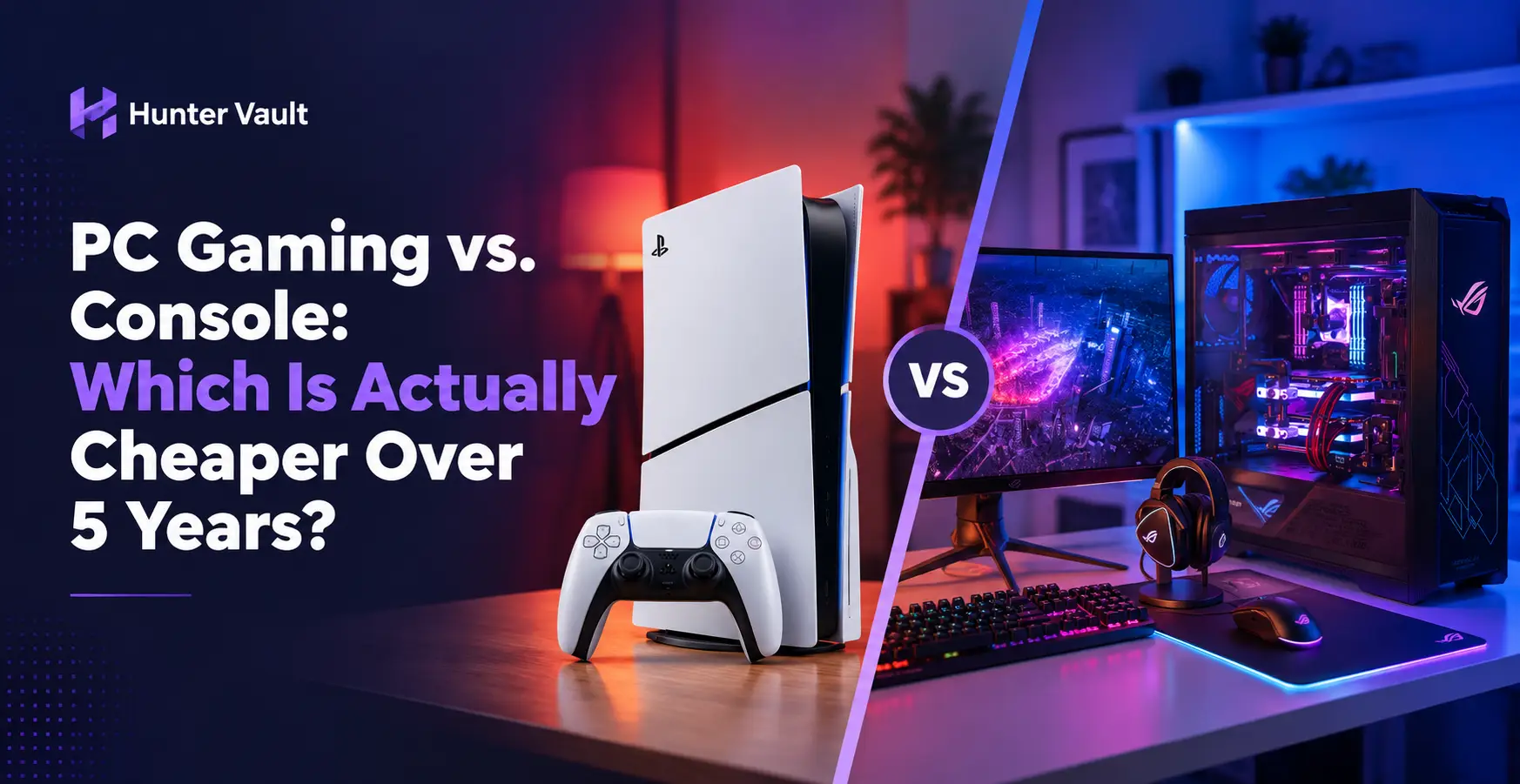
- PC costs more upfront ($700-1,400 for a build vs. $449-499 for PS5/Xbox Series X) but games are dramatically cheaper
- Steam sale prices average 40-70% off retail; console prices typically drop 20-30% and hold retail price longer
- PC has no mandatory subscription for online play — saving $60-180/year vs. PS Plus or Game Pass Core
- Over 5 years, a mid-range PC gamer buying 8+ games/year typically spends $300-600 less total than a console equivalent
- The verdict depends on playstyle: high-volume game buyers benefit from PC; casual or console-exclusive fans benefit from console
The PC-vs-console debate has been running since the 1990s and mostly generates more heat than light. Most of the arguments skip the actual numbers.
This post does the math across a full 5-year window — hardware, games, subscriptions, upgrades, and peripherals — for three different player profiles. The answer is nuanced and it genuinely depends on how you play. But the numbers tell a clearer story than most comparison articles admit.
Why the Upfront Comparison Is Misleading
The instinctive comparison is simple: PS5 is $449, Xbox Series X is $499, and a gaming PC is $700-1,400+. Console wins on upfront cost, end of discussion.
That framing ignores what matters most over a 5-year period: game prices. And on game prices, PC has an enormous structural advantage that compounds over time.
A quick baseline on hardware before we get to total cost:
Console hardware (2026 prices):
- PS5 Slim: $449
- Xbox Series X: $499
- Xbox Series S: $299 (lower performance)
PC builds for equivalent console-tier performance:
- Budget (1080p high, ~Xbox Series S performance): $650-850
- Mid-range (1440p high, ~PS5/Series X performance): $1,100-1,400
- High-end (4K/max settings): $1,800-2,500+
A pre-built gaming PC from major retailers (HP Omen, Alienware, Lenovo Legion) runs about 10-20% more than self-built equivalents for similar specs.
The console upfront cost advantage at launch is $200-900 depending on the PC tier. That’s real money. The question is whether game pricing closes the gap over 5 years.
The Game Pricing Gap: The Biggest Variable in the Calculation
This is where the comparison gets decisive for heavy buyers.
PC game pricing on Steam vs. console:
New releases typically launch at the same $60-70 MSRP on both platforms. The divergence starts 3-6 months after launch.
Steam’s regular sale schedule (Summer Sale, Winter Sale, Publisher Sales, Weeklong Deals) means most games hit 40-60% off within 6-12 months of release. Many hit 75-90% off by 18-24 months. The Humble Bundle model further depresses effective prices for PC players willing to buy in bulk.
Console digital stores (PlayStation Store, Xbox Store) do run sales, but:
- Discounts are typically shallower (20-40% vs. 40-70% on PC)
- Sales are less predictable and shorter-duration
- The best deals often require a PS Plus or Game Pass subscription to access
A real example: Marvel’s Spider-Man 2 launched at $69.99. On PS5, it dropped to $34.99 six months later and sat there for most of 2025. PC games at equivalent quality levels on Steam regularly hit $14.99-19.99 by the same timeframe.
The math for a moderate buyer (10 games/year):
Assume you spend $50 average per game on console (buying some on sale, some at near-launch price):
- 10 games × $50 = $500/year
- 5 years = $2,500 on games
Assume you spend $25 average per game on PC (using Steam sales, Humble, Epic free games):
- 10 games × $25 = $250/year
- 5 years = $1,250 on games
That’s a $1,250 difference over 5 years from game pricing alone — which closes most or all of the hardware premium gap.
Subscription Costs: The Invisible Console Tax
PC gaming has no mandatory subscription for online multiplayer. This point gets overlooked because it’s a cost that console players just accept as normal.
Console online requirements:
- PlayStation Network requires PS Plus Essential ($79.99/year) to play most multiplayer games online
- Xbox requires Xbox Game Pass Core ($59.99/year) or Game Pass for online play
- Nintendo Switch Online ($19.99/year) is required for Switch multiplayer
PC online situation:
- Steam, Battle.net, and Epic require no subscription for online play
- Games like Fortnite, Apex Legends, Valorant, League of Legends — all online, all free on PC without any subscription
- The only PC subscription that’s somewhat standard is Xbox Game Pass PC ($11.99/month), and it’s entirely optional
Over 5 years:
- PS Plus Essential: $79.99 × 5 = $399.95
- Xbox Game Pass Core: $59.99 × 5 = $299.95
- PC gaming subscription cost: $0 (assuming no optional Game Pass)
That’s another $300-400 the console player pays that a PC player doesn’t have to.
Upgrade Costs: GPU vs. Console Generation
Neither platform lets you stay static for 5+ years without feeling the age of your hardware.
Console generation transitions: Consoles typically run a 6-7 year cycle. Within a generation, there’s often a mid-cycle upgrade (PS5 Pro launched at $699, for example). A player who buys the base PS5 and then upgrades to the PS5 Pro has spent:
- PS5 Slim: $449
- PS5 Pro: $699
- Less trade-in value: ~$150-200
- Net upgrade cost: $500-550 additional
PC GPU upgrades: A mid-range GPU (RTX 4070 Ti, RX 7800 XT) in a 2024 build stays competitive at 1440p for 4-5 years. Upgrading after that cycle:
- Sell old GPU: $150-250
- Buy new mid-range GPU: $350-450
- Net upgrade cost: $100-300
PC upgrades are incremental — you’re replacing one component, not an entire system. You also keep your game library, your peripherals, your monitor. Console upgrades effectively require buying a new system (even if your digital library transfers).
Hidden Costs: Peripherals and Accessories
Both platforms have peripheral costs that don’t show up in the headline hardware price.
Console peripherals:
- Extra controller: $69-79
- Headset: $30-100+
- Charging dock: $20-40
- Total typical add-ons: $120-220
PC peripherals (if you don’t already own them):
- Monitor: $150-400 (1080p to 1440p)
- Mechanical keyboard: $50-150
- Gaming mouse: $30-80
- Headset: $30-100+
- Total typical add-ons (new setup): $260-730
This is the area where PC gets genuinely more expensive for someone starting from nothing. A person who has a laptop and nothing else, building a dedicated PC gaming setup, needs to buy a desk, a monitor, a keyboard, a mouse — even before touching the PC itself.
A console player who already has a living room TV sidesteps this entirely.
The caveat: Most adults building a gaming PC already own a monitor, keyboard, and mouse from work or general use. The true marginal cost of adding gaming to an existing setup is often just the PC itself. But for someone starting from scratch, the peripheral cost is real and shouldn’t be ignored.
The 5-Year Total Cost Comparison
Here’s the full picture across three player profiles:
Casual player (4 games/year, 5-10 hrs/week):
- PS5: ~$2,249 (hardware $449 + games $800 + PS Plus $400 + controller $70 + no major upgrade)
- Budget PC (1080p): ~$2,450 (build $800 + games $500 + monitor $200 + peripherals $150 + GPU upgrade $200)
- Winner: PS5 by $200
Moderate player (10 games/year, 15-25 hrs/week):
- PS5: ~$3,849 (hardware $449 + games $2,500 + PS Plus $400 + accessories $200 + mid-cycle upgrade $300)
- Mid-Range PC: ~$2,650 (build $1,200 + games $1,250 + no subscription + monitor/peripherals $300 + GPU upgrade $200)
- Winner: PC by $1,199
Heavy player (20 games/year, 30+ hrs/week):
- PS5: ~$5,649 (hardware $449 + games $5,000 + PS Plus $400 + accessories $200 + upgrades $300)
- Mid-Range PC: ~$3,300 (build $1,200 + games $2,500 + no subscription + peripherals $300 + GPU upgrade $200)
- Winner: PC by $2,349
The pattern is clear: the higher your game purchase volume, the more decisively PC wins on total cost.
The Verdict: Who Should Choose Each Platform
Choose console (PS5 or Xbox) if:
- You buy fewer than 6 games per year
- You primarily play exclusives (God of War, Halo, Zelda series) that aren’t on PC or arrive years later
- You value couch gaming on a TV without managing settings or drivers
- You’re starting from scratch with no existing PC peripherals
- You share gaming with others in the household on a single screen
Choose PC if:
- You buy 8+ games per year and will use Steam sales actively
- You play online multiplayer frequently (no subscription required)
- You want backwards compatibility across decades of games with no extra cost
- You use your computer for work and gaming shares the same machine
- You want flexibility: mods, emulation, indie games, higher frame rates
The nuanced cases:
- Both: Many players own a console for exclusives and a mid-range PC for everything else. If you’re already in one ecosystem, adding the other for exclusives is sometimes cheaper than switching entirely.
- PlayStation exclusives: Sony’s console exclusives (Spider-Man, God of War, Horizon) now come to PC, but usually 1-3 years later. If you’re patient, a PC player can access the full PlayStation library eventually.
- Xbox: Xbox publishes all first-party games on PC day one. Game Pass Ultimate includes both console and PC. There’s little reason to own both Xbox and PC unless you specifically want the console form factor.
For context on where gaming hardware costs sit within a broader gaming budget, how much do gamers actually spend per year breaks down the full picture. If you’re trying to save up for a new gaming PC specifically, how to save for a gaming PC lays out a concrete savings approach. And for a PC-only deep dive, the true cost of PC gaming over five years breaks down every category — hardware, peripherals, games, and subscriptions — by budget, mid-range, and enthusiast tier.
And if you’re trying to figure out how much you should realistically allocate to gaming as a monthly expense — hardware, games, and subscriptions combined — how much should you spend on games per month is a good next read.
Hardware prices, subscription costs, and game pricing shift throughout the year. The figures in this post reflect 2025-2026 pricing. The core principle — PC saves money through game pricing for high-volume buyers; console is simpler and cheaper upfront for casual players — holds regardless of specific price points.
The Bottom Line
PC gaming costs more upfront. Console gaming costs more over 5 years — for most player types.
The crossover point is roughly 6-8 games per year. Below that, console’s lower hardware cost and simpler setup often win. Above that, PC’s cheaper game pricing and no mandatory subscription erode console’s upfront advantage and then some.
The biggest variable is how aggressively you use PC game sales. A PC gamer who pays near-launch prices for everything doesn’t capture the platform’s main advantage. One who waits for sales and buys smart will consistently spend less per game than console equivalent.
Neither platform is objectively better. Both have genuine reasons to exist. The question is which one fits your actual play habits — and now you have the numbers to answer it honestly.