- Most games drop 50–80% within 12 months of launch — the math on waiting is dramatic
- 10 games/year at 70% off saves $420–490 annually compared to buying at launch
- A backlog of 3–5 games removes the pressure that makes you buy at launch
- IsThereAnyDeal, PS Deals, and SteamDB automate the price-watching for you
- Patience as a system beats willpower every time — here's how to build the system
There’s a corner of the gaming community that barely shows up in gaming discourse: people who play great games, have a massive library, and spend a fraction of what everyone around them spends. They’re not pirating. They’re not giving up quality. They’re just not buying at launch.
This is the patient gamer strategy — and run correctly, it’s not a sacrifice. It’s a compounding advantage that gets more powerful the longer you use it.
What the Patient Gamer Strategy Actually Is
The core principle: don’t buy games at launch prices, ever. Wait until the price drops to a point that feels proportionate to what you’re actually getting.
That’s it. No complex system, no spreadsheet you’ll abandon after a week. The entire thing runs on one decision: when a new game releases and you feel the pull to buy it immediately, you add it to a wishlist instead.
Where it gets interesting is in what that single habit compounds into over a year.
The patient gamer philosophy isn’t about deprivation — it’s about recognizing that the games industry has structurally mispriced new releases. Publishers charge $70 at launch because some percentage of players will always pay it. But the same game, six to twelve months later, is often $15–25. The content hasn’t changed. The only thing that changed is how urgently you feel like you need it — and that urgency is manufactured.
The Math: What Launch Price Versus Sale Price Actually Looks Like
Let’s run the numbers with real price ranges from Steam and PSN data.
A standard major release in 2025–2026 launches at $60–70. That same game, within 12 months, typically sees:
- First sale: 20–33% off, usually within 3–6 months
- Deep discount: 50–75% off, within 6–12 months
- Historical low: 70–85% off, within 12–24 months
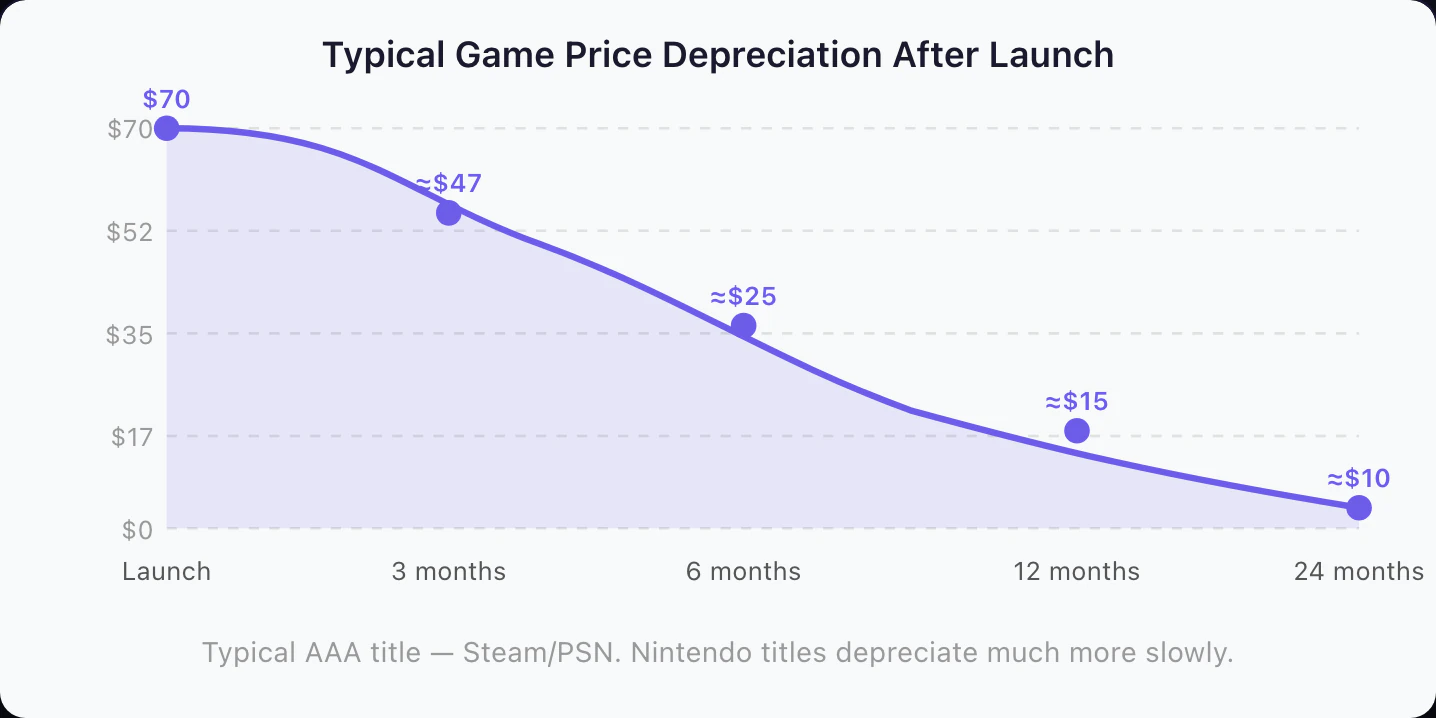
Nintendo is the exception worth noting — Switch games discount slowly, rarely go below 33% off even years after release, and often hold at $40+ for their entire commercial lifetime. If Nintendo is your primary platform, the patient gamer strategy still works, but the savings floor is higher.
For Steam and PlayStation, the numbers are clear: buying at launch is paying a premium for the privilege of playing before everyone else. That premium is real and quantifiable.
The Annual Savings Calculation
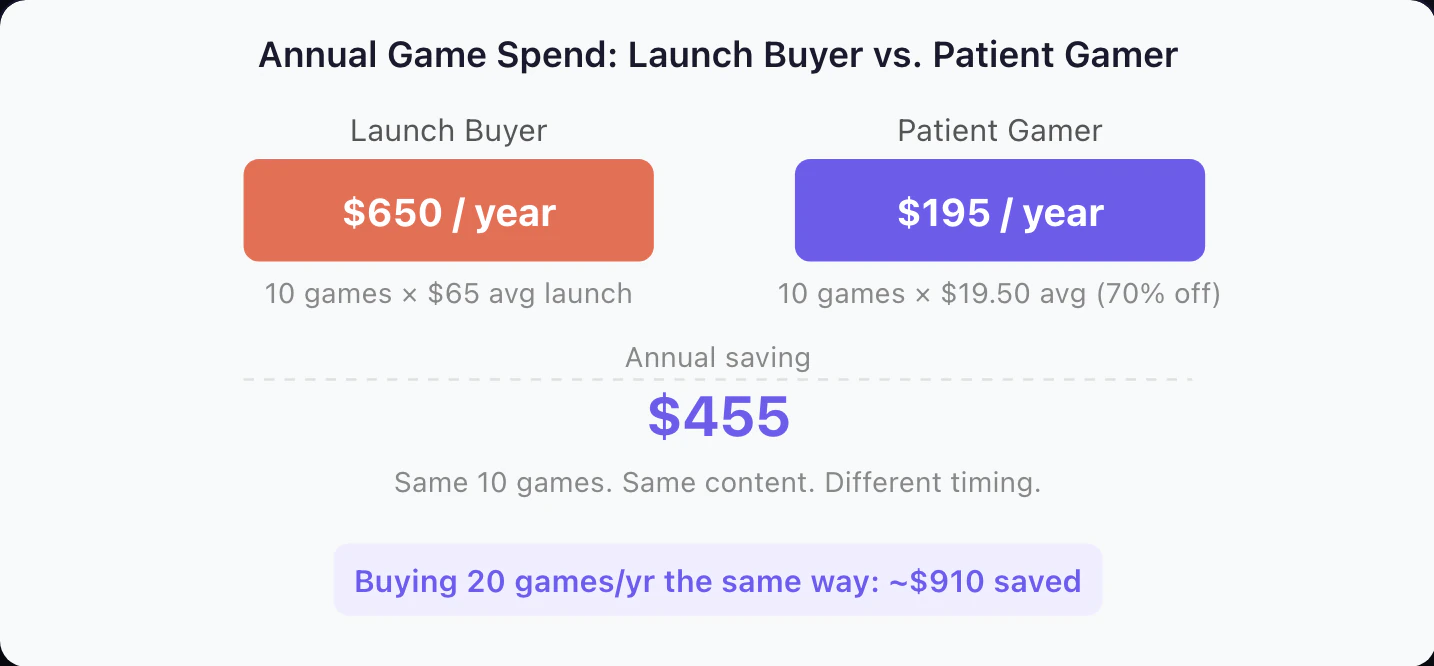
Here’s the arithmetic that makes the strategy concrete. Say you buy 10 games per year.
Scenario A — Buying at launch:
- 10 games × $65 average = $650/year
Scenario B — Patient gamer strategy (average 70% discount):
- 10 games × $19.50 average = $195/year
- Annual saving: $455
The saving scales with volume. Someone buying 20 games a year at the same prices would save about $910 (20 × $45.50). Buy fewer games, or wait for smaller discounts, and the number shrinks with it. Either way, it’s hundreds of dollars a year for most people who buy games regularly.
As a hypothetical: $455 saved per year and invested at a 7% average annual return would grow to approximately $6,300 after 10 years. Returns aren’t guaranteed, but the point stands: the patient gamer strategy is also an investing strategy — you’re just choosing when to make that trade-off explicit.
This is general educational content, not financial advice. Savings and investment figures here are illustrative; actual discounts, returns, and what makes sense for you depend on your own situation.
How to Build the Wishlist System
The patient gamer strategy fails without infrastructure. “Just wait” doesn’t work on its own — when a new game comes out and everyone is talking about it, you need a system that converts the impulse to buy into a frictionless add-to-wishlist action.
Step 1: Use Steam’s wishlist aggressively. Every game you want but won’t buy today goes on the wishlist. Steam notifies you when wishlist items go on sale. This alone catches a large portion of PC game deals passively.
Step 2: Set price alerts on IsThereAnyDeal. IsThereAnyDeal aggregates prices across Steam, GOG, Humble, Fanatical, and other storefronts. You set a target price per game — say, $15 — and it emails you when that threshold is hit. This covers PC games across every major retailer, not just Steam.
Step 3: PS Deals for PlayStation. PS Deals does the same job for PSN — you can browse by discount percentage, sort by genre, and set alerts on specific titles. Deku Deals covers Nintendo Switch.
Step 4: SteamDB for historical lows. Before buying anything on sale, check SteamDB for the price history. A 40% discount sounds good until you see the game has been 75% off twice before. SteamDB shows you whether the current deal is actually a deal.
This setup takes about 20 minutes to put together and then runs passively. The alerts come to you — you don’t have to go hunting.
The Backlog Method: Never Be Desperate for a New Game
The patient gamer strategy has one failure condition: you run out of things to play. When your backlog is empty and there’s nothing engaging you, a new $70 release becomes genuinely hard to resist.
The solution is the backlog method: always maintain 3–5 games you haven’t finished yet. If your ready-to-play list drops below three, start looking at the sale shelf — there are always recent quality games available at deep discounts.
A healthy backlog does two things:
- It removes urgency. You can’t FOMO-buy when you literally have great games waiting.
- It gives you context for what’s actually worth buying. After playing six hours of a $15 game that’s brilliant, you become much less excited about a $70 game that might not be.
Your backlog should include games you’ve bought but not started, not just games in your wishlist. Separate categories: owned and unplayed is your buffer, wishlist is your pipeline.
For a full method on managing this as part of a broader gaming budget, the gamer’s complete money system covers how to structure a gaming spending plan across subscriptions, hardware, and game purchases together.
Extending the Philosophy Beyond Games
The patient gamer mindset transfers directly to other gaming purchases:
Hardware. Waiting used to reliably bring console prices down. That’s no longer a safe assumption: console prices have gone up, not down, in recent years. Sony, for example, raised US PS5 prices in August 2025 and again in April 2026. The patient approach for hardware is to compare total value rather than wait for a cut: watch for bundles that include a game or an extra controller, and price-check before big sale events.
Subscriptions. Subscription pricing changes often, so check the current plan options before you renew. PlayStation Plus sells 12-month memberships, and if you know you’ll keep a service all year, compare the annual price against 12 months of the monthly rate. For services billed monthly, like Xbox Game Pass, the patient move is rotating in and out instead of paying for months you don’t use.
Peripherals. Headsets, controllers, and keyboards all follow the same pattern as games — launch prices are peak prices. The exception is limited-edition hardware that actually has collector value, but that’s a small category.
For a detailed look at how subscriptions should fit into your overall gaming budget, gaming subscription budget for 2026 breaks down how to evaluate each service against what you’re actually playing.
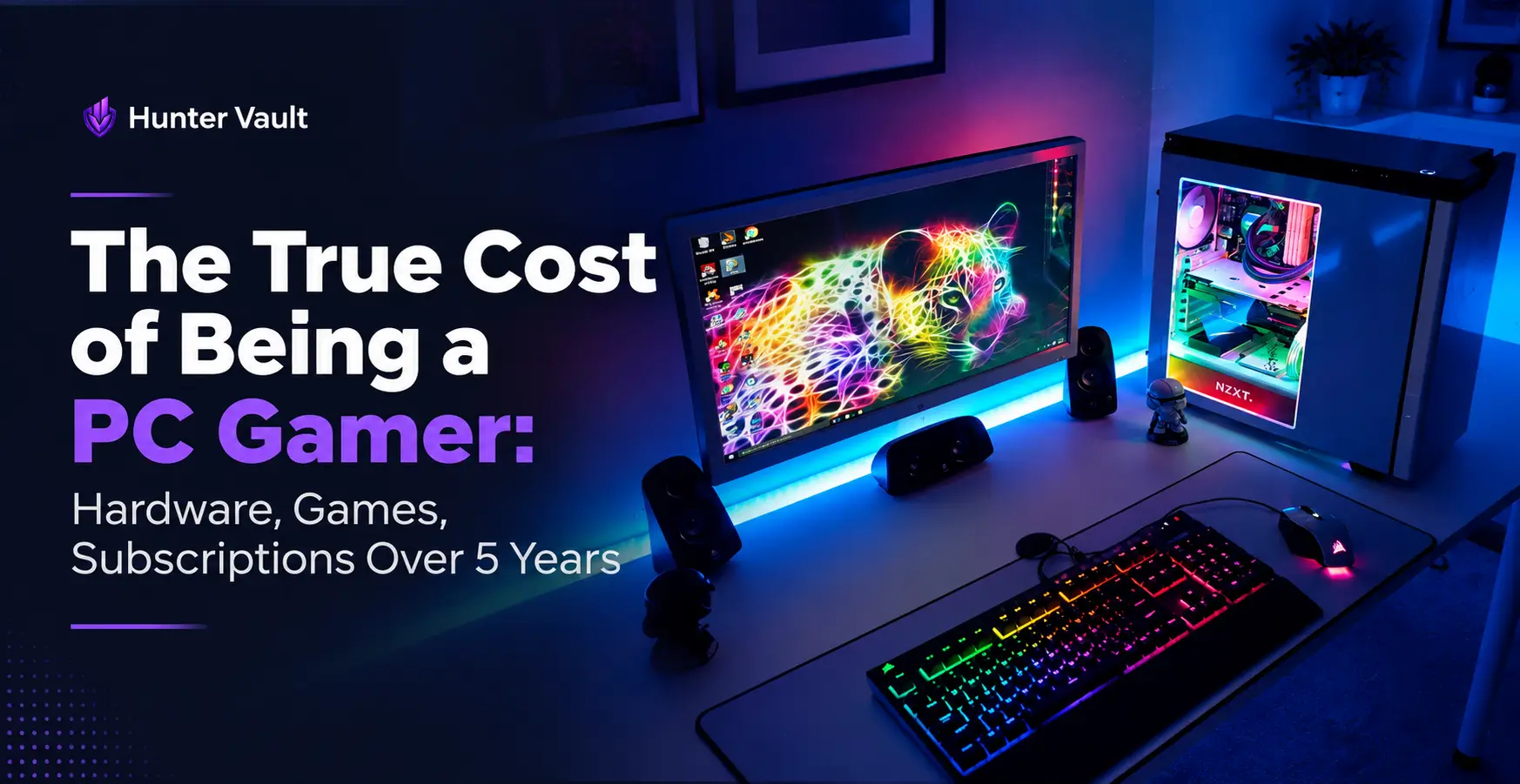
And if you game on PC, patient buying is the single biggest lever on long-term cost: the full 5-year cost of PC gaming shows that how you buy games moves the total more than which hardware tier you pick.
The Psychological Win: Turning Patience Into a Game
The patient gamer strategy works better when it feels like something you’re winning at, not something you’re restraining yourself from.
One approach that works: track your cumulative saves. Every time you buy a game at $12 that launched at $60, log the $48 save. At the end of the year, add it up. For most gamers running this method, that number is surprising — it’s real money that didn’t leave your account.
You can also run this as a personal leaderboard. “Last year I saved $380. This year I’m targeting $500.” Framing it as a game — which it literally is — makes the wait feel like strategy rather than sacrifice.
Another mental shift: getting a great game at 80% off feels like finding treasure. The same game at launch feels like a transaction. The patient gamer gets the same content for less money and gets a stronger emotional win from the purchase itself.
When to Break the Rule
The patient gamer strategy isn’t an absolute law. There are specific cases where buying at launch or near-launch makes sense:
Multiplayer games with momentum-dependent communities. Games like a live-service shooter or a new online RPG often have their biggest player base in the first 6 months. If you want to play them with a populated community, waiting two years means finding a smaller, different player pool. The social experience costs something to access.
Games where the cultural moment matters. Some games — mystery narratives, games that rely on shared discovery — lose something when you already know the twist. If the point is to experience something alongside a community discovering it simultaneously, that window has a cost.
Games from developers you want to directly support. Buying at launch is one of the clearest ways to signal to a studio that their work is worth funding. If you have a studio you genuinely care about and want to see make another game, a launch-price purchase is a deliberate investment in that outcome.
Outside these specific cases, the patient gamer rule holds. Single-player, story-driven games — which make up the majority of acclaimed releases — have zero downside to waiting. The game doesn’t change. Only the price does.
The patient gamer strategy doesn’t apply the same way to free-to-play games with ongoing spending mechanics. For those, the issue is in-game purchase habits rather than launch timing. The overspending on gacha games guide covers that case specifically.
Annual Savings Comparison: Patient vs. Launch Buyer
The Bottom Line
The patient gamer strategy is one of the highest-return habits available to anyone who games regularly. It requires no sacrifice in the games you play — only in when you play them. The same titles, the same experiences, for 60–80% less money.
The system that makes it work is simple: wishlist everything, use price alert tools, maintain a backlog so you’re never desperate, and track your annual saves to keep the motivation concrete.
For a broader look at how much gamers spend per year and where the money actually goes, the data puts individual spending choices in context. Most gamers who run the patient strategy end up well below the $325 North American average — while playing just as much.
If you’re tracking gaming spend and want to see how your annual game-purchase total compares across months, that’s a category worth separating out in your spending log. Whether you use a spreadsheet or an app built for this, the act of seeing the number is where the habit starts.
Frequently Asked Questions
What is the patient gamer strategy?
The patient gamer strategy means deliberately not buying games at launch and instead waiting until they go on sale — typically 3 to 18 months after release. Most PC and console games drop 50–80% from their launch price within the first year. The strategy works best when you maintain a backlog of 3–5 games so you're never in a position where you need something new right now.
How much can you actually save by waiting for game sales?
If you typically buy 10 games per year at launch prices averaging $60–70, you're spending $600–700. Buying those same games after they've hit a 70% discount brings that total to $180–210 — a saving of around $420–490 per year on 10 games. The saving scales with how many games you buy: someone buying 20 games a year at those prices would save roughly twice as much.
How long do I have to wait for a game to go on sale?
It depends on the game and platform. On Steam, most games see their first sale within 3–6 months of launch. Console games (PlayStation, Xbox) typically drop in price within 6–12 months. Games from smaller studios often discount faster and deeper than major releases. Nintendo titles are a notable exception — they discount slowly and rarely go below 33% off even years later.
What tools help you track game prices and sales?
IsThereAnyDeal.com is the most comprehensive tool for PC games — it tracks historical prices across Steam, GOG, Humble, and other storefronts. SteamDB shows Steam price history. PS Deals tracks PlayStation Store discounts, and Deku Deals covers Nintendo Switch. All of these let you set price alerts so you get notified when a game hits your target price.
When is it worth breaking the patient gamer rule?
Multiplayer games with active community momentum, limited-time live service content, and games where the community experience matters more than the content itself are cases where waiting costs more than money. If a game's appeal is tied to playing alongside friends right now, the social value may outweigh the launch price premium. For single-player experiences, there's almost never a genuine reason to buy at launch.