This article is for informational and educational purposes only. Trading cards are volatile, illiquid collectibles — not savings vehicles or guaranteed investments. Nothing here constitutes financial advice. Grading economics vary widely by card, condition, timing, and market conditions. Consult a licensed financial professional before making significant financial decisions.
- PSA all-in grading cost runs $135–$145 per card — not $79.99; always budget the full round-trip number
- The break-even formula: (PSA 10 value × 0.87) − (raw value × 0.87) must exceed the grading cost
- A $50 raw card with a 3× PSA 10 multiplier earns only $87 in premium — below the $140 break-even threshold
- A $100 raw card at 3× earns $174 in premium — crossing break-even by $34; $200 raw at 3× clears it by $208
- Vintage, low-population, and iconic cards with active PSA 10 demand have the strongest case; most modern cards do not pass the math
The PSA slab looks compelling. The PSA 10 label feels like a verdict. And the idea that a graded card might be worth several times the raw price creates a pull that’s hard to ignore.
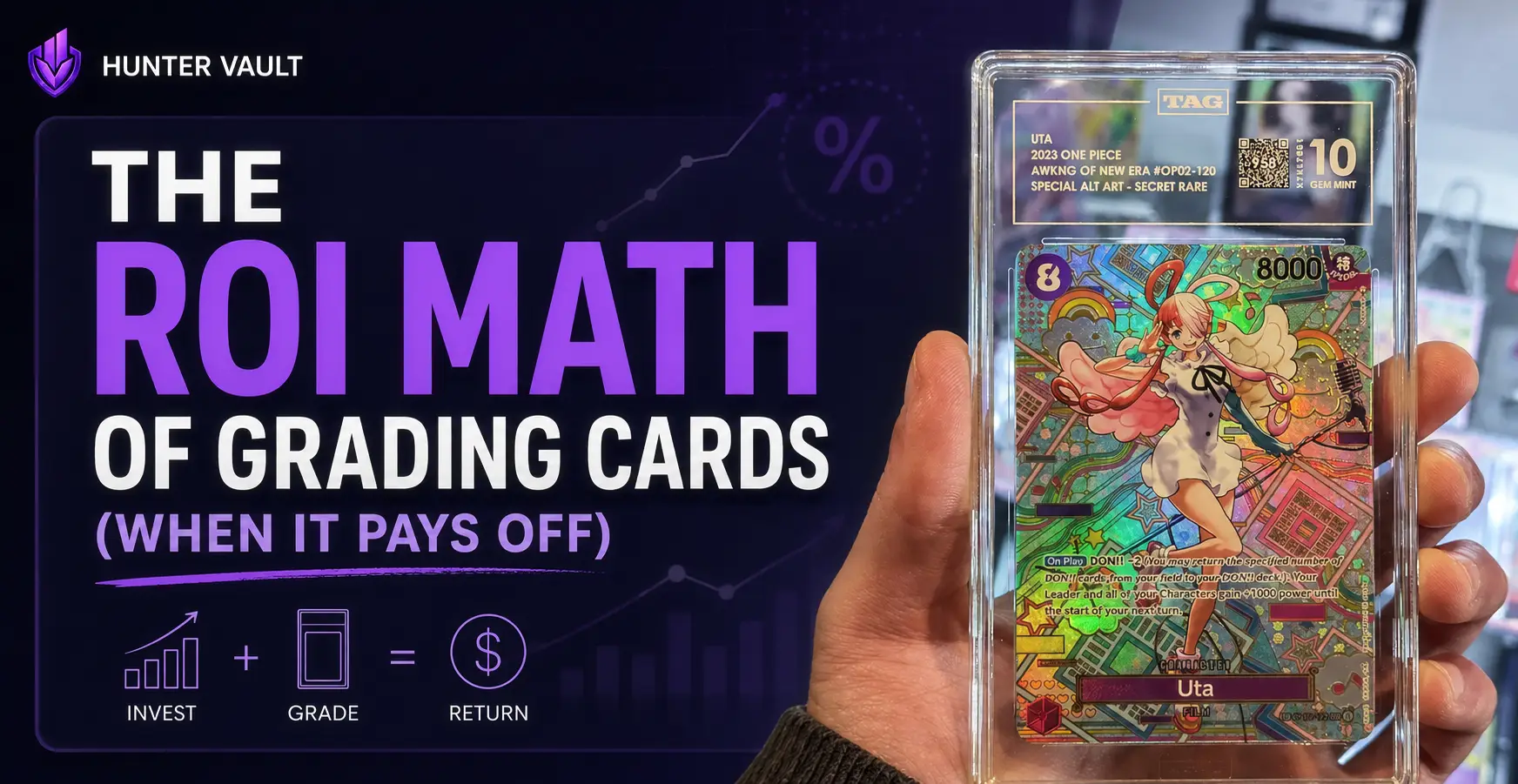
But grading is a financial transaction, and like any transaction, the numbers either work or they don’t. Most players run the math loosely — “I paid $80 to grade this card, and PSA 10s sell for $300, so I made money.” That calculation is missing three critical adjustments: the real all-in grading cost, selling fees on both ends, and the probability of actually getting a PSA 10.
Here’s how to run the numbers honestly.
The Real All-In Cost to Grade
The headline PSA fee is $79.99 at the standard service tier as of 2025–2026. That’s not the number to use in your ROI math.
| Cost component | Estimate |
|---|---|
| PSA standard service fee | $79.99/card |
| Outbound shipping (tracked, insured) | $12–$18 |
| Return shipping (PSA charges separately, insured) | $8–$15 |
| Card savers (1–2 per card) | $0.50–$1.00 |
| Packing materials | $2–$4 |
| Total per card (1–5 card batch) | $103–$118+ minimum |
Source: PSA fee schedule; shipping estimates via USPS Priority Mail (TCGscreener); verify current PSA tier schedule before submitting.
The reason the realistic number is $135–$145 rather than $103–$118 is that the estimates above are minimums. Insurance on higher-value cards, weight-based shipping adjustments, and return shipping often push the total higher. Use $140 as your working number for standard submissions.
The Break-Even Formula
With a real all-in cost in hand, the ROI formula becomes straightforward:
The card grades financially if:
(PSA 10 value × 0.87) − (raw card value × 0.87) > grading cost
The 0.87 multiplier accounts for 13% selling fees on eBay or TCGplayer. Both sides need the fee adjustment — you’re comparing net proceeds from selling a PSA 10 slab versus net proceeds from selling the raw card. The difference between those two numbers is what grading actually earns you.
Simplified version: if the PSA 10 premium over raw (in net proceeds) exceeds $140, grading passes the break-even test.
Look up the PSA 10 sold price for that exact card on eBay (filter “Sold”). Multiply by 0.87. Then look up the raw sold price. Multiply by 0.87. Subtract. If the result is above $140, grading clears break-even assuming you get a PSA 10. If you’re likely to get a PSA 9, run the same check with PSA 9 sold prices instead.
Where the Math Works — and Where It Doesn’t
The chart below shows the net premium earned over raw (after selling fees) at four common raw card value tiers, assuming a 3× PSA 10 multiplier. The dashed orange line marks the $140 grading cost threshold.
Running the Numbers at Each Tier
$50 raw card (3× PSA 10 multiplier):
- PSA 10 estimated value: $150
- PSA 10 net proceeds (×0.87): $130.50
- Raw net proceeds (×0.87): $43.50
- Premium earned: $87
- Grading cost: $140
- Result: −$53 loss
A $50 raw card needs to grade PSA 10 and the PSA 10 needs to command a 3× premium — and it still loses $53. For $50 raw cards, grading is almost never economically justified unless the PSA 10 multiplier is exceptional (8×+) and the card is highly sought.
$100 raw card (3× PSA 10 multiplier):
- PSA 10 estimated value: $300
- PSA 10 net proceeds: $261
- Raw net proceeds: $87
- Premium earned: $174
- Grading cost: $140
- Result: +$34 profit
This card technically passes the break-even test — but the margin is thin. A PSA 9 outcome instead of PSA 10 would likely erase the profit or create a loss.
$200 raw card (3× PSA 10 multiplier):
- PSA 10 estimated value: $600
- PSA 10 net proceeds: $522
- Raw net proceeds: $174
- Premium earned: $348
- Grading cost: $140
- Result: +$208 profit
Here the math works comfortably, even with some buffer for a PSA 9 scenario. This is the tier where grading starts making clear economic sense for the right cards.
$500 raw card (3× PSA 10 multiplier):
- PSA 10 estimated value: $1,500
- PSA 10 net proceeds: $1,305
- Raw net proceeds: $435
- Premium earned: $870
- Grading cost: $140
- Result: +$730 profit
At this raw value, grading is clearly compelling assuming the PSA 10 market is active for the card. The $140 grading cost is a small fraction of the expected upside.
The 3× multiplier used here is a moderate assumption for popular, sought-after cards. Some cards have higher PSA 10 premiums — iconic vintage cards or current chase cards with low graded populations can command 5×–10× over raw. Others, particularly modern set-standard cards with large graded populations, may have premiums of 1.5×–2×.
When Grading Makes the Strongest Case
The cards with the best grading economics share specific characteristics:
Vintage sets with genuine print scarcity. First-edition Pokémon Base Set, Jungle, Fossil, and early Team Rocket cards. Early Magic: The Gathering Alpha, Beta, and Unlimited. The key word is genuine scarcity — print runs that ended and won’t be reprinted. PSA 10 population for vintage cards is often small relative to the collector demand.
Iconic individual cards with low graded populations. A Charizard, a Mewtwo, a Black Lotus — cards where the PSA 10 label carries collector premium beyond just the raw card quality. Check the PSA Population Report before grading to understand how many PSA 10s already exist for your specific card and set.
High raw value plus provenance. Cards with provenance (case-fresh, pack-fresh with photos, purchased directly from sealed product and immediately protected) have stronger PSA 10 probability than cards that have been handled, traded, or stored in a binder. A $300 raw card that has never touched fingers has meaningfully better PSA 10 odds than a $300 raw card with light play wear.
Cards where you’re grading for preservation, not profit. Sentimental value is legitimate. Grading a card you pulled yourself or inherited is a valid hobby choice — just budget the cost as a preservation expense, not an investment.
The PSA 9 Risk and How It Changes the Math
The PSA 10 premium is the reason grading feels compelling. But PSA 10 (Gem Mint) requires near-perfect centering, no surface scratches under magnification, no edge or corner wear, and no print defects. Most opened cards grade PSA 8 or 9.
Here’s what the $100 raw example looks like with a PSA 9 outcome:
- PSA 9 estimated value: $140–$180 (1.4–1.8× raw, typical)
- PSA 9 net proceeds: $122–$157
- Raw net proceeds: $87
- Premium earned: $35–$70
- Grading cost: $140
- Result: −$70 to −$105 loss
If you’re submitting a $100 raw card expecting a PSA 10 and getting PSA 9 is a real possibility, the economics are fragile. For cards where a PSA 9 outcome is likely, grading is rarely worth it unless the raw value is significantly higher.
The PSA Population Report shows how many copies of a specific card have been graded at each grade. A card with 5 PSA 10s in circulation has a different market dynamic than one with 2,000 PSA 10s. High PSA 10 population suppresses the premium; low population supports it. Always check before submitting.
The Honest Grading Decision Checklist
Before submitting any card, work through these questions:
- What is the raw card’s current market price? Use eBay “Sold” listings filtered to raw (ungraded) copies — not TCGplayer, which tracks lower-end raw prices.
- What do PSA 10s of this exact card actually sell for? Check eBay “Sold” filtered to PSA 10 slabs.
- Does the formula pass? (PSA 10 × 0.87) − (raw × 0.87) > $140
- What’s a realistic PSA 10 probability? Has the card been handled? Has it been in a binder? Does it have visible scratches or centering issues? If you’re not confident in a PSA 10 outcome, run the PSA 9 math too.
- What’s the graded population? A PSA 10 in a high-population set competes against many others. Low-pop PSA 10s typically hold their premium better.
- Can you hold the card through PSA’s turnaround? Standard PSA turnaround runs weeks to months. The card’s market could shift in that window.
If the answers to these questions produce a comfortable financial case, grading may make sense. If any answer raises doubt, the safer default is selling the card raw and keeping the capital.
For the full breakdown of PSA cost structure and service tiers, see Is Grading Your Cards Worth It? The PSA Cost Math.
For context on how grading fits into the broader question of trading cards as an investment, see Is Collecting Trading Cards a Good Investment?.
If you’re budgeting for grading alongside your other TCG expenses, the broader framework lives in How to Budget for Trading Card Games.
Hunter Vault’s Reports feature lets you track your collection’s cost basis and estimated market value over time — so you can see whether your grading investments are paying off, not just guess at it. Import your transaction history and watch the numbers tell the story.