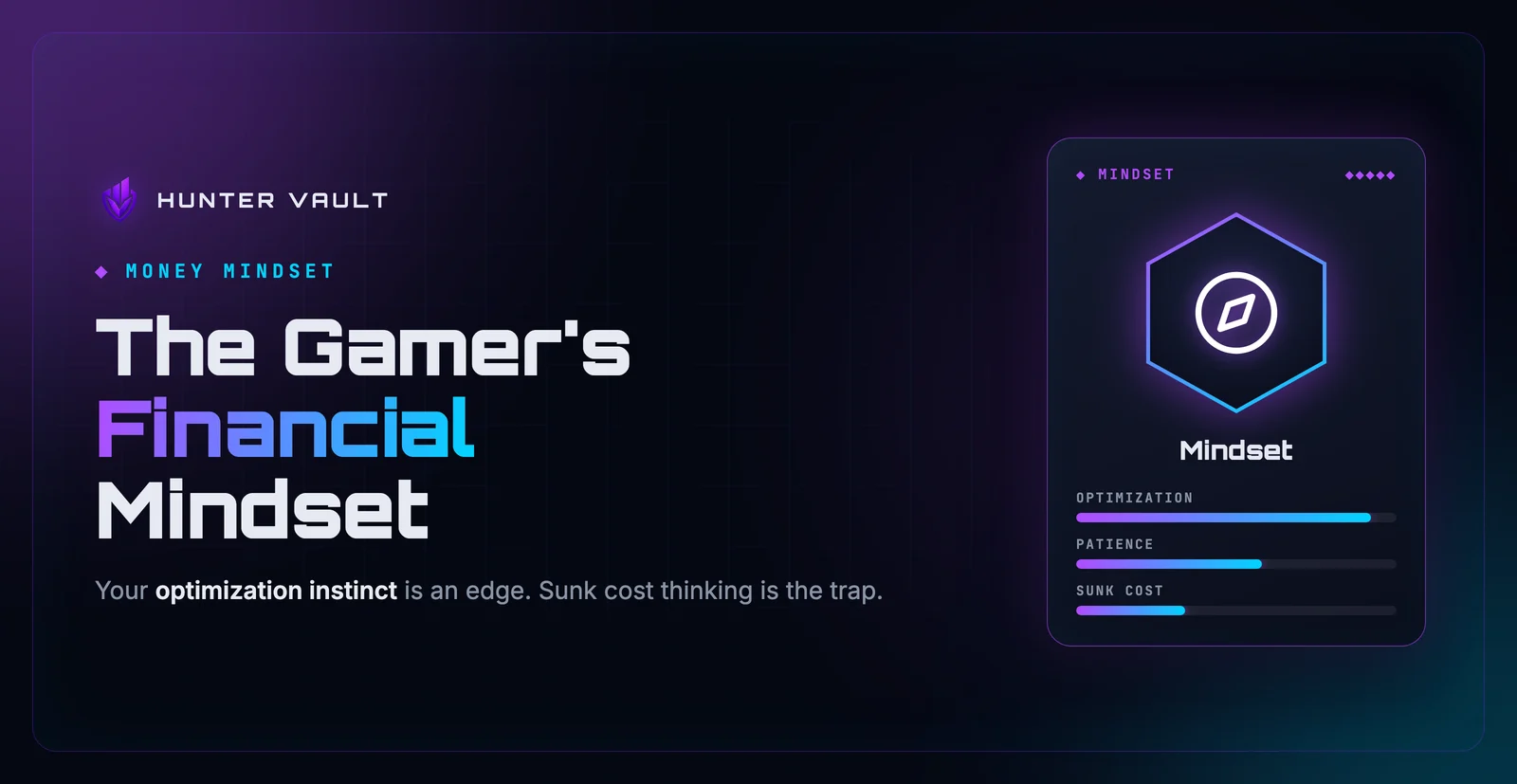
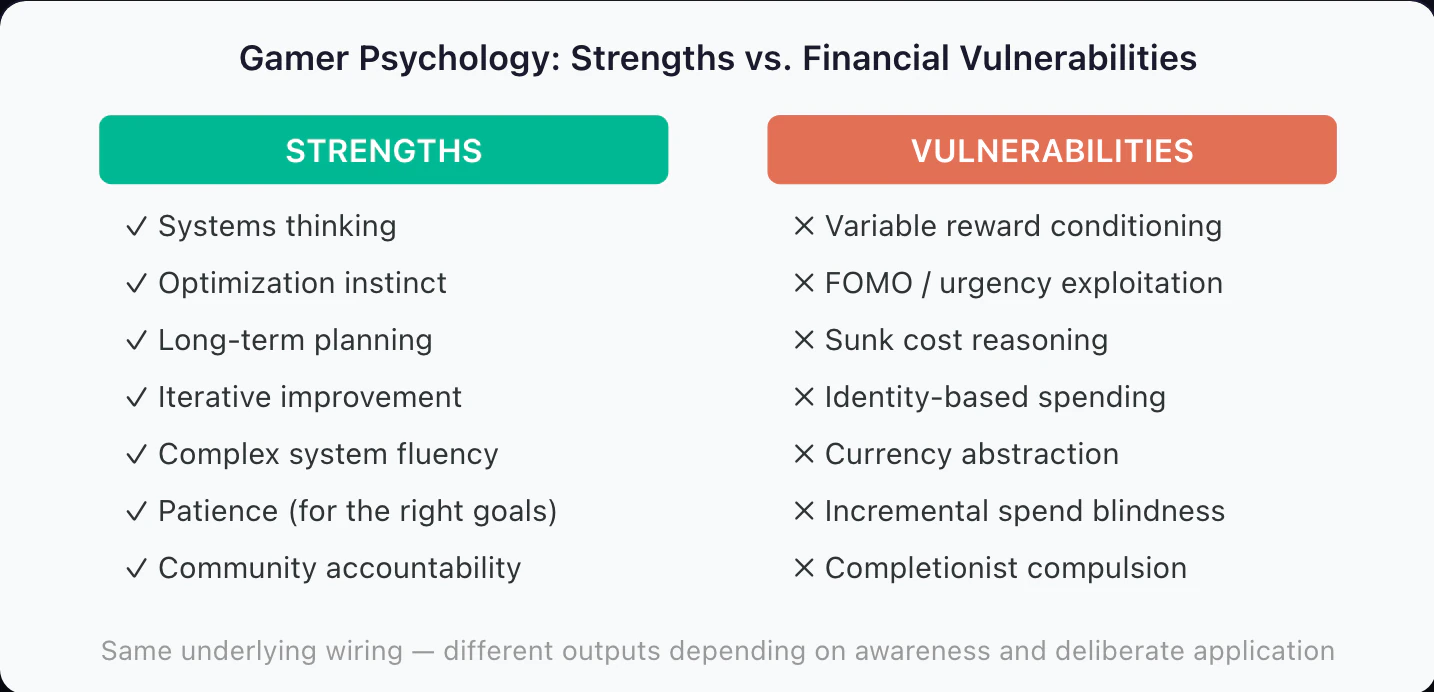
- Gamers already have the core mindset skills personal finance requires: optimization, systems thinking, and long-term planning
- Variable reward loops in games condition spending patterns that carry over into real-money decisions outside the game
- Treating a budget like a character build — with limited points to allocate across stats — reframes constraint as strategy
- Visual progress (XP bars, level milestones) outperforms abstract savings goals for sustained motivation over months
- The patient gamer who waits for sales is already practicing the delayed gratification that financial success is built on
The most common failure mode in personal finance advice is assuming people don’t know what they should do. Most people know they should spend less than they earn. Most people know debt is expensive. Most people know they should save more.
The problem isn’t information. It’s wiring.
Personal finance fails because the feedback loops are broken, the progress is invisible, and the skills required feel disconnected from anything the person has actually practiced. But for gamers, some of those gaps are already closed. The skills exist. The mental models are there. The obstacle is applying them deliberately — and recognizing the specific places where gaming psychology works against financial goals rather than for them.
This post is about that psychological layer: why gamers are unusually well-positioned to win at personal finance, which mental traps they’re more likely to fall into, and how to use gamer thinking deliberately rather than accidentally.
The Gamer Advantage
The overlap between gaming skills and financial management skills is not superficial. These are genuine cognitive competencies, developed through thousands of hours of practice.
Systems thinking — Gamers learn to see how mechanics interconnect. A build choice affects your combat rotation, which affects your clear speed, which affects your farming rate, which affects your progression timeline. The system is a web, not a list of isolated options. Personal finance works the same way. Income affects savings rate. Savings rate affects how quickly you build an emergency fund. Emergency fund size affects your risk tolerance. Risk tolerance affects investment decisions. Most people see these topics as separate modules of adult life. Gamers naturally see them as a system, because that’s how they’ve learned to see complex problems.
Optimization instinct — When given a system with rules and constraints, gamers ask: what’s the most efficient path to the goal? That question — “what’s the highest-leverage action here?” — is exactly what good financial planning requires. What order should I pay off these debts? Where does a dollar of investment produce the most return in my specific situation? This isn’t a specialized financial skill. It’s the same thinking you apply when you’re optimizing gear for a specific content type.
Long-term planning and deferred gratification — Anyone who has maintained a crafting queue for two weeks, farmed reputation for a month, or saved in-game currency for a major item has practiced deferred gratification at scale. You chose a suboptimal short-term path (doing the slower, less immediately rewarding activity) for a better long-term outcome. That’s exactly the cognitive pattern that saving and investing require. The timeline is longer, but the mental structure is identical.
Iterative improvement — Games teach you that failure is data. You wiped on the boss — what went wrong? What do you adjust? You try again with better information. This is the correct model for financial development, too. You overspent on gaming last month — what happened? What changes next month? The iteration mindset prevents the all-or-nothing collapse that derails most people’s budgets: “I failed at budgeting, so budgeting doesn’t work for me.” That conclusion doesn’t follow. Failure is a patch note, not a verdict.
Tolerance for complexity — The theory crafting communities around games like Path of Exile, Factorio, and EVE Online involve legitimate mathematical sophistication — probability distributions, economy modeling, multi-variable optimization. Personal finance mechanics, including compound interest, debt avalanche vs. snowball methods, and tax-advantaged account structures, are not more complex than these systems. The barrier for most people isn’t intellectual; it’s that financial systems don’t provide the engagement infrastructure that games do.
Most financial advice is written for people who need to be motivated to think systematically. Gamers already think systematically. The gap is that financial systems don’t have the feedback loops, progress visibility, or milestone architecture that games use to keep people engaged. Those have to be built deliberately.
The Dark Side: Why Gamers Are Also Wired to Overspend
The same immersion that makes gaming deeply engaging also creates specific vulnerabilities. This isn’t a character flaw — it’s the predictable result of behavioral engineering. The game designs you love are optimized for engagement and monetization, and understanding how that works is the first defense against it.
Variable reward conditioning — The most powerful behavior-forming mechanism in modern game monetization is unpredictable reward delivery. Loot boxes, gacha pulls, randomized crafting outcomes, and rare drops don’t deliver rewards consistently — they deliver them on a variable ratio schedule. That unpredictability is not accidental. Variable ratio reinforcement is the most psychologically compulsive reward structure known in behavioral science, and games that use it have deliberately adopted it from the gambling industry’s research. The result: persistent engagement, strong craving patterns, and real difficulty stopping once you’ve started.
This conditioning carries over. Significant exposure to RNG monetization trains the brain to tolerate and seek uncertain-outcome spending — which can make consistent, rule-based financial behavior feel flat by comparison. The impulse to “just try one more” extends beyond the game.
Fear of Missing Out (FOMO) — “Limited time,” “season ends in 48 hours,” “exclusive reward for early adopters”: these phrases are engineered weapons. FOMO exploits a specific cognitive bias — loss aversion, the tendency to weight potential losses more heavily than equivalent gains. The question FOMO triggers is not “is this worth $15?” but “will I regret not having this?” Those are structurally different questions, and the second is much harder to think clearly about under time pressure.
Outside gaming, FOMO drives impulse purchases, debt-funded lifestyle decisions, and the financial equivalent of panic-buying: locking in a fixed-rate mortgage at a bad time because “rates might go higher,” financing a car you can’t afford because “they’re going fast,” investing in volatile assets because “everyone is making money.”
The sunk cost fallacy — You’ve spent $200 on an account or $100 building a character. There’s now a $30 item that would meaningfully complete or upgrade what you have. The rational question is: does this $30 purchase provide $30 worth of future enjoyment? But the brain asks: “I’ve already invested this much — shouldn’t I finish it?” The $200 is spent regardless. It has no bearing on whether the $30 is a good decision going forward. But the sunk cost fallacy makes past spending feel like an argument for future spending, because abandoning it feels like acknowledging a loss.
In personal finance, sunk cost reasoning shows up constantly: staying in a bad investment because you’re “down” on it and selling would “lock in the loss,” continuing to repair a car that keeps breaking because you’ve already spent so much, holding onto a subscription you don’t use because you already paid for the year.
Identity-based overspending — “I’m a gamer” is an identity, and identities carry spending patterns. The gamer identity includes implicit expectations: staying current with hardware, playing major releases, supporting the games and creators you value. When a budget decision conflicts with identity, the budget usually loses — because changing the purchase feels like changing who you are. This is why spending cuts that touch identity categories always feel more threatening than equivalent cuts to neutral categories.
Currency abstraction — In-game currencies (V-Bucks, gems, coins, crystals) exist to create perceptual distance from real-money spending. The brain responds differently to spending “1,500 gems” than to spending “$14.99.” Platforms design this deliberately. The abstraction layer is a spending-acceleration mechanism, and gamers have been trained by it more than most other consumer groups.
The Financial Mindset Shift: Your Budget Is a Character Build
The single most useful reframe for gamers approaching personal finance: stop thinking about a budget as a restriction and start treating it as a build.
In any RPG with meaningful character customization, you have a finite pool of points to allocate. Every choice matters because you can’t max every stat. Investing in one attribute comes at the cost of another. Experienced players don’t resent the constraint — they optimize within it. The constraint is what makes the game interesting and the choices meaningful.
Your income is a fixed resource pool. Every dollar allocated to one category is a dollar unavailable to another. This is not a punishment or a sign that you don’t earn enough. It’s the mechanic. The job isn’t to wish you had more points — it’s to build the most effective character given what you have.
Income is your base stat. It can be raised over time — through skill development, career advancement, or additional income sources — but that’s a long-term build path, not an immediate lever.
Fixed expenses are your base stat minimums — the costs required to keep the character functional. Rent, utilities, food, insurance. You can’t dump-stat survival.
Discretionary allocation is your actual build choices — where you put the remaining points. Gaming, dining, savings, debt payoff, investing. Every allocation is a real choice with real trade-offs. Putting more into gaming means less into savings. Putting more into savings means less into gaming. Neither is wrong; both are choices.
Your financial goals are the endgame content. Emergency fund. Debt clearance. Down payment. Retirement. The build choices you make now determine how fast you clear each encounter.
When you’re working within a budget, you’re not depriving yourself of things you deserve. You’re playing your build. That shift sounds like semantics, but it changes how the constraint feels — from an external imposition you’re trying to escape to a chosen strategy you’re optimizing. That difference matters for long-term follow-through.
Progress Bars Beat Willpower
One of the most consistent findings in behavioral economics: visual progress dramatically outperforms abstract goals for sustained motivation.
Research from the Columbia Business School documented what’s called the “goal gradient effect” — motivation increases as people get closer to a visible goal. Games use this constantly. The experience bar in the corner of the screen isn’t decoration; it’s a motivation engine. You can see exactly where you are, how far you’ve come, and how far you have to go. That visibility makes the effort feel connected to the outcome.
Abstract financial goals fail because they’re invisible. “Save $5,000” looks identical in your head on day one and day ninety. There’s no XP bar. There’s no level indicator. There’s no visible signal that anything is working, which means the brain doesn’t register progress — even when progress is happening. This is why people abandon savings goals that are actually on track.
The fix is to manufacture the feedback infrastructure:
Level your savings goal — Break a $5,000 emergency fund target into 10 levels at $500 each. Create a tracker — a spreadsheet column, a physical chart, a dedicated view in a savings app — that shows your current level. “Level 4 of 10” is meaningfully more motivating than “I have $2,000 saved, only $3,000 to go.” The first is progress. The second is absence.
Track the debt HP bar — When paying down debt, visualize the balance as a health bar that takes damage with every payment. Looking at a balance drop from $8,500 → $8,100 → $7,620 over three months is more motivating than knowing abstractly that “you’re paying it down.” The bar depletes. You’re dealing damage. You can see the progression.
Add streak mechanics — Count consecutive weeks where you stayed within your gaming budget. A four-week streak is an asset — something with value that you don’t want to lose. Missing one week resets it. Streak protection is a powerful motivator because it turns compliance into something you’re guarding, not just something you’re attempting.
Milestone rewards — Define explicit rewards for hitting financial milestones. Reaching the halfway point of your emergency fund means you can buy a game you’ve been holding off on. Clearing your first debt means a dinner you’ve been skipping. The rewards need to be real — not vague future treats, but specific and concrete — and sized proportionally to the milestone.
The point isn’t to make budgeting into a game. It’s to recreate the feedback infrastructure that makes games engaging, because that infrastructure is what your brain already responds to. Building money habits that stick goes into the behavioral science behind why visible progress matters and how to build it into your financial tracking.
Long-Term Saving: You Already Think in Inventories
Long-term saving gets easier when you treat your budget like something you already know how to manage: an inventory. Both have:
- A fixed capacity (income / bag space)
- Items with different weights and values (expenses / gear)
- Mandatory slots that can’t be removed (rent, subscriptions / equipped skills)
- Discretionary slots you can optimize (eating out, entertainment / optional gear)
- A point at which you’re over-encumbered and things start breaking (overdraft / can’t carry)
Gamers who’ve managed a guild bank, a crafting economy, or even a complex Minecraft modpack have already practiced resource allocation. The terminology is different. The math is the same.
The practical application: treat spending categories like inventory slots with limits. Food: $400. Entertainment: $150. Gaming: $100. When a slot is full, the item doesn’t go in. For anyone who has spent time managing limited bag space, that’s more intuitive than the abstract instruction to “stay within budget.”
Savings works the same way. A named goal with a specific target (“$800 for a new GPU by March”) gives the money a slot to fill, which is easier to protect than a generic “savings” balance. And if you keep a logging streak going, it doubles as data: 22 consecutive days of logged spending is 22 data points, and patterns show up that a single month-end review would never reveal. The gamer savings playbook turns this into a step-by-step system of named funds.
The Identity Shift: From “I’m Bad With Money” to “I’m Optimizing”
Financial self-concept — what you believe about yourself as a money manager — is one of the strongest predictors of financial behavior. People who believe they’re “bad with money” act consistently with that belief. They don’t track their spending because they already “know” the result won’t be good. They don’t set budgets because they expect to fail. They don’t look at their accounts because ignorance is more comfortable than confirmation.
This isn’t irrationality. It’s self-consistency. People behave in ways that match their self-image.
The identity shift isn’t about forcing positive thinking or pretending the problems aren’t real. It’s about accuracy. Most people who believe they’re bad with money haven’t had a coherent financial system to work with. They’ve been trying to manage a multi-account, multi-platform, multi-category financial life with no tools, no training, no feedback loops, and financial systems that aren’t designed to help them see what’s happening. They’re not bad at money. They’ve been trying to win a game without understanding the mechanics.
That’s a different problem with a different solution. “I’m not bad with money. I’m working with a system I haven’t had the right tools for” is accurate — and it opens the door to engaging with the problem rather than avoiding it.
Gamers are uniquely equipped for this reframe because they’ve experienced it before. You weren’t “bad at the game” when you couldn’t beat a new boss. You were building skill, iterating on strategy, learning the mechanics. That’s the correct model for financial development. The boss has a specific health pool and attack pattern. You need the right build and the right approach. You’ll figure it out.
The guide to tracking and controlling gaming spending applies this growth-mindset framing to the specific habits that determine whether financial systems actually stick over time.
Patience Skills Transfer Directly
The “patient gamer” is a respected archetype in gaming communities: someone who waits for games to release fully, for reviews to land, and for prices to drop before buying. A $70 game often drops substantially, sometimes 50% or more within a year. Waiting is free money, and the patient gamer knows it.
That patience — the ability to want something, choose not to act immediately, and wait for better conditions — is one of the most financially powerful skills that exists. It’s not passive. It’s active discipline in the face of a real desire, and it produces better outcomes across almost every financial decision class.
The patient car buyer shops multiple dealers, waits for end-of-quarter pricing pressure, and finances only at the rate their credit score actually earns. The impatient buyer accepts the first number on the lot.
The patient homebuyer builds a 20% down payment before buying, which eliminates PMI and meaningfully reduces total loan cost. The impatient buyer qualifies for a 3% down loan and treats “you qualify” as “you should buy.”
The patient investor puts money into index funds on a regular schedule and doesn’t sell when the market drops 20%. The impatient investor tries to time entries and exits, sells scared, and misses the recovery.
The patient deal-hunter waits for annual subscription bundle pricing, gift card promotions, or cashback events on gaming platforms rather than paying full price every time. The gaming subscription budget guide for 2026 documents where the real savings opportunities are.
In every case, the patient decision produces materially better outcomes. The gap between the patient and impatient version of each decision is often measured in thousands of dollars over a lifetime — not small amounts.
And gamers who’ve resisted buying a new release at launch, waited for a deep discount, and felt smug about the result have already proven they can do this. The patience muscle works. It just needs to be applied beyond the Steam sale page.
Apply the patient gamer instinct to every non-essential financial decision: wait 48 hours before committing. Most urgency in purchasing decisions is manufactured or self-imposed. Two days is enough time for most impulse decisions to look different.
Community Accountability Scales
One of the most consistent findings in behavioral science: social commitment dramatically improves follow-through on goals. Telling someone what you’re trying to do — and having them check on you — produces better outcomes than private internal commitment alone.
Gaming communities already have this structure baked in. Guilds and raid groups have implicit accountability systems that work because they’re built around shared goals with real social stakes. Showing up prepared matters because other people are depending on you. The accountability exists because the shared goal creates it.
The same structure works for financial goals. A small group of people with aligned financial goals — even just two or three friends — creates social accountability for:
- Staying within a gaming budget for a month
- Running a subscription audit and reporting what you found
- Hitting a savings milestone
- Starting an investment account
The act of telling someone what you’re doing and checking in later activates the same social commitment mechanism that makes guild attendance reliable. You’re not just accountable to your own resolve; you’re accountable to someone who’ll ask how it went.
This doesn’t require a formal setup. Monthly check-ins with one or two people who share similar financial goals are enough. The format matters less than the consistency — same cadence, honest reporting, no judgment.
If you share finances with a partner, budgeting for gaming as a couple applies this accountability structure to a shared gaming budget, where both people have visibility into the goals and both have a voice in the allocation.
Building New Money Habits With Game Mechanics
The last element of the mindset layer is habit architecture — designing financial behaviors so they become automatic rather than requiring constant willpower.
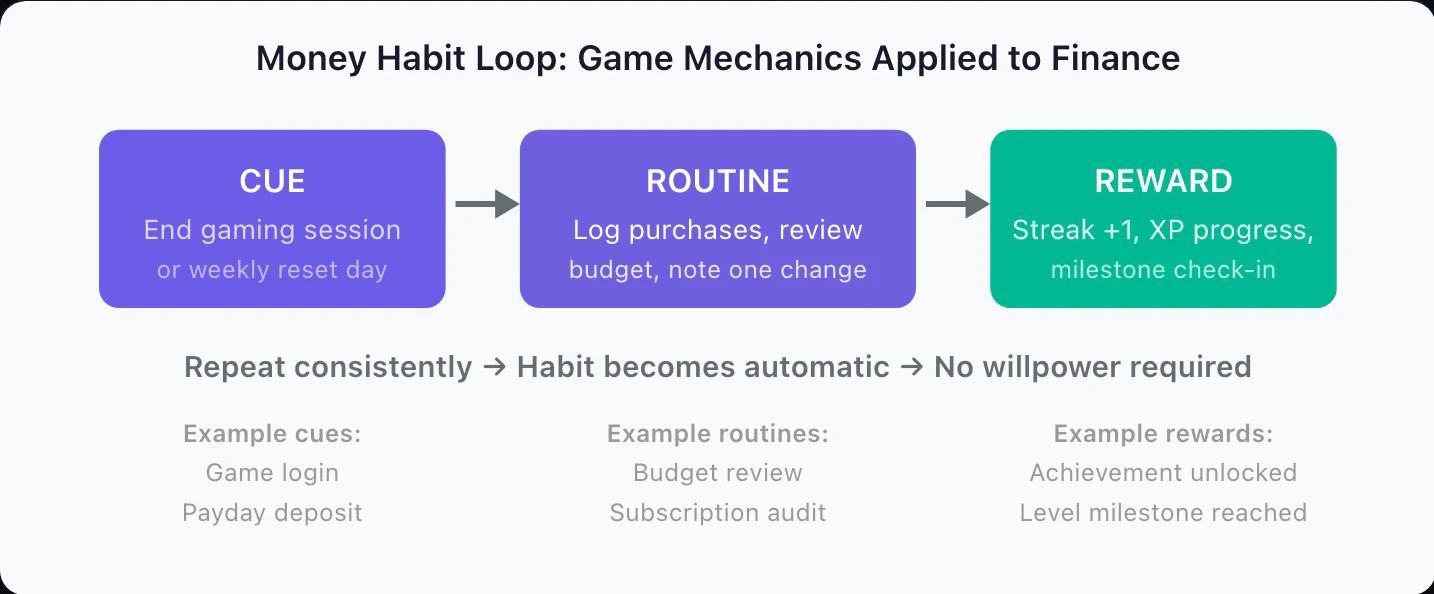
Habits form through a consistent three-part loop: cue, routine, reward. The cue triggers the behavior. The behavior produces a reward. Repetition makes the connection automatic. Games are extraordinarily well-designed around this loop — daily login bonuses, weekly reset quests, push notifications are all engineered cues that trigger engagement and deliver variable rewards.
You can apply the same architecture to financial habits deliberately:
Anchor to an existing habit — Link your financial check-in to something you already do consistently. If you open a gaming app every evening, that’s your cue to also open your budget tracker. The existing habit creates the trigger for the new one. This is more reliable than setting an intention to “track spending each day.”
The weekly review — A 10-minute Sunday review of the week’s spending. Same day, same time, same process. What did you spend this week? Are you on track? What adjustments do you make next week? Consistency matters more than the specific day — pick one and stick to it.
Achievement framing — Define explicit achievements for financial milestones: “First subscription audit completed,” “Level 1 emergency fund reached,” “First month under gaming budget,” “Debt paid below $5,000.” Create them consciously and acknowledge them when you hit them. The acknowledgment doesn’t need to be elaborate — but it needs to exist. Unmarked progress is less motivating than marked progress.
Streak protection — Consecutive weeks under budget, consecutive months of investment contributions, consecutive months of tracking. Streaks create loss aversion in your favor: the streak is worth something, and breaking it costs something. You’ll work to protect it.
Minimal viable habits — When building a new financial habit, start smaller than feels necessary. Five minutes of tracking per week is genuinely better than a one-hour monthly review session that never actually happens. Small habits that stick compound. Large habits that fail don’t.
The guide to tracking and controlling gaming spending covers the practical tools and weekly routines that make these habits sustainable in practice, not just in theory.
The Completionist Trap and How to Work With It
One gamer tendency worth naming specifically: completionism. The drive to have everything, unlock everything, finish everything. In games, this produces extraordinary persistence — 100-hour playthroughs, full achievement lists, every collectible found. It’s impressive and it comes from a genuine place.
In personal finance, completionism has a dark side. It can show up as wanting to pay off all debt before starting to invest (suboptimal — you should capture the employer match first). It can show up as wanting to have a “perfect” budget before tracking anything (better to track imperfectly than not at all). It can show up as wanting to solve the entire financial picture before addressing one piece of it (the correct approach is sequential, not simultaneous).
The completionist mindset also interacts badly with collection mechanics in games. If a game has a collector’s edition, a full character roster, a complete cosmetic set — the drive to have the complete set is a monetization vulnerability, not a feature. Game publishers know this. Incomplete collections are designed deliberately.
Work with the completionism tendency by redirecting it: apply it to the completion of financial levels, not to in-game collection sets. The emergency fund is a level that can be completed. The debt payoff is a level that can be cleared. The retirement account contribution is a streak that can be maintained. Give the completionist drive things that are actually worth completing.
Conclusion: You’re Already Playing the Long Game
The gamer who optimizes a build, waits for the right sale, adjusts strategy after a failed run, and manages complex resource systems over months of play is already thinking like a skilled financial manager. The skills exist. The mental models are developed. The obstacle is applying them intentionally to personal finance — and knowing which game-design psychology to watch for and neutralize.
The vulnerabilities are real. The gaming industry employs behavioral designers specifically to exploit the psychological patterns that make gamers engaging customers. Variable rewards, urgency, sunk cost framing, and currency abstraction are features, not bugs. Knowing they’re there makes them easier to see through.
But the advantage is real too. Systems thinking, optimization instinct, deferred gratification, and iterative improvement are not abstract virtues — they’re specific cognitive patterns you’ve been developing for years. Personal finance doesn’t require a personality change. It requires the same approach you bring to any complex game: learn the mechanics, pick a build, track your progress, and adjust when something isn’t working.
You already know how to do that.
For the full step-by-step financial system — budgets, tracking, sinking funds, and behavioral defenses — the complete gamer money system guide is the main quest.
Additional resources for specific mechanics:
- The gamer’s complete money system — full step-by-step budgeting and tracking system
- How gamers can track and control spending — tools, apps, and tracking routines for multi-platform spending
- How to stop overspending on gacha games — behavioral defenses against the most aggressive monetization mechanics
- How to build money habits that stick — the behavioral science of financial habit formation
- Gaming budget for couples — shared financial goals and gaming spend with a partner
- How to budget for gaming without quitting — keeping gaming in the budget sustainably
- Mobile gaming budget tracker — tracking in-app spend across mobile platforms
- What is a sinking fund? — how earmarked savings funds work and why they’re effective
This post is general educational content about financial mindset and psychology. It’s not personalized financial advice. Your specific income, obligations, debt, and goals should drive your actual financial decisions.
Frequently Asked Questions
Are gamers actually good at managing money?
Gamers have genuinely strong underlying skills for financial management — systems thinking, optimization instinct, long-term planning, and iterative improvement. But they also carry specific vulnerabilities: variable reward conditioning from loot boxes and gacha mechanics, FOMO from limited-time offers, and sunk cost reasoning. The mindset skills are real; the challenge is applying them deliberately to personal finance rather than letting game-design psychology work against you.
What is the sunk cost fallacy in gaming, and how does it affect spending?
The sunk cost fallacy is continuing to invest in something because of what you've already put in, not because of what future value you'll get. In gaming it shows up as: 'I've already spent $200 on this account, so I need to spend $50 more to get the character I want.' The $200 is spent regardless of what you decide now. The rational question is whether $50 of future enjoyment justifies $50 spent — not whether it validates the past $200. Past money is always gone. Only future value matters.
How do I use game mechanics to build better money habits?
The most effective approach is making progress visible. Break a $5,000 savings goal into 10 levels of $500 and track your current level. Add a streak counter for consecutive weeks under budget. Frame debt payoff as depleting a health bar — every payment deals damage. The mechanics that make games engaging — visible milestones, streaks worth protecting, rewards for progress — transfer directly to financial habits. You're not gamifying finance for fun; you're recreating the feedback infrastructure your brain already responds to.
What is the patient gamer approach to personal finance?
Patient gamers wait for games to drop in price rather than paying full price at launch. A $70 game often drops substantially, sometimes 50% or more within a year. Applied to personal finance, this means defaulting to a waiting period before significant purchases: buying a car when prices normalize rather than at peak demand, waiting to buy a home until you have a 20% down payment, and using a 48-hour rule on impulse purchases. The patience muscle is the same one you exercise waiting for a Steam sale.
How does variable reward conditioning in games affect real-money spending habits?
Variable reward conditioning — the unpredictable delivery of rewards — creates compulsive engagement because the brain keeps seeking the next reward hit. Loot boxes, gacha pulls, and random drops use this mechanism deliberately. The same psychological pattern that makes you want to open one more loot box can make it harder to maintain consistent financial rules, because rule-based behavior feels less rewarding than the chance of a hit. Recognizing this is the defense: the excitement is manufactured, the mechanism is visible, and naming it reduces its power.