- Budgeting for anime isn't about spending less — it's about spending on purpose so the hobby stays fun
- Give your fandom one monthly number you're happy with, split it across categories, and track against it
- The five money sinks: figures & merch, gacha, streaming subs, conventions/cosplay, and manga
- Pre-orders and gacha are the sneakiest — they defer or fragment the cost so the total stays invisible
- The fix is awareness plus a little friction, not quitting: a tracked cap keeps you in control without guilt
Loving anime is not expensive. Loving anime without a plan is what empties wallets. The hobby arrives as a stream of small, joyful purchases — a figure here, a gacha pull there, a con weekend, a new streaming sub — and any one of them feels harmless. It’s the total, tallied up at the end of the month, that makes people wince.
This guide is the opposite of “spend less on the things you love.” It’s a simple, no-guilt system for giving your fandom a budget you’re genuinely happy with, so anime stays a source of joy instead of quiet financial stress. Here’s how to do it.
Quick Answer: The Whole System in Four Steps
Budgeting for anime comes down to four moves:
- Add up one real month of anime spending so you know where you actually stand.
- Pick a monthly number you’re comfortable with — after bills, debt, and savings are handled.
- Split it across your categories — figures, gacha, streaming, cons, manga.
- Track against it so the running total keeps you honest.
That’s it. The rest of this guide is how to do each step well, and how to handle the specific traps — pre-orders, gacha, FOMO — that make anime spending sneak up on you. If you want the data behind why it adds up, see how much anime fans actually spend per year.
Step 1: See Your Real Number First
Before you set any budget, you need the truth. Almost every fan underestimates their anime spending, because it’s scattered across storefronts and arrives in small amounts.
Tally one full month
Go through last month and add up everything anime: streaming subs, gacha, figures, merch, manga, shipping, import fees. Don’t judge it — just get the real number.
Compare it to your guess
Write down what you thought you spent before you tallied. The gap between the guess and the real number is the spending that’s been invisible to you — and that’s the part worth managing.
The point isn’t to feel bad about the number. It’s that you can’t budget for something you can’t see. Once the real figure is in front of you, everything else gets easier.
Step 2: Give Your Fandom One Monthly Number
Now decide what you want to spend — on purpose. The healthiest way to size an anime budget is to fund it from what’s genuinely spare:
- Cover your bills, debt payments, and savings first.
- Whatever’s comfortably left over is your safe-to-spend pool.
- Choose an anime number from that pool that you’re happy with.
Whether that’s $30 or $300, the amount matters far less than the fact that you chose it rather than discovering it after the fact. A number you picked is a number you can stick to.
Step 3: Split It Across Your Categories
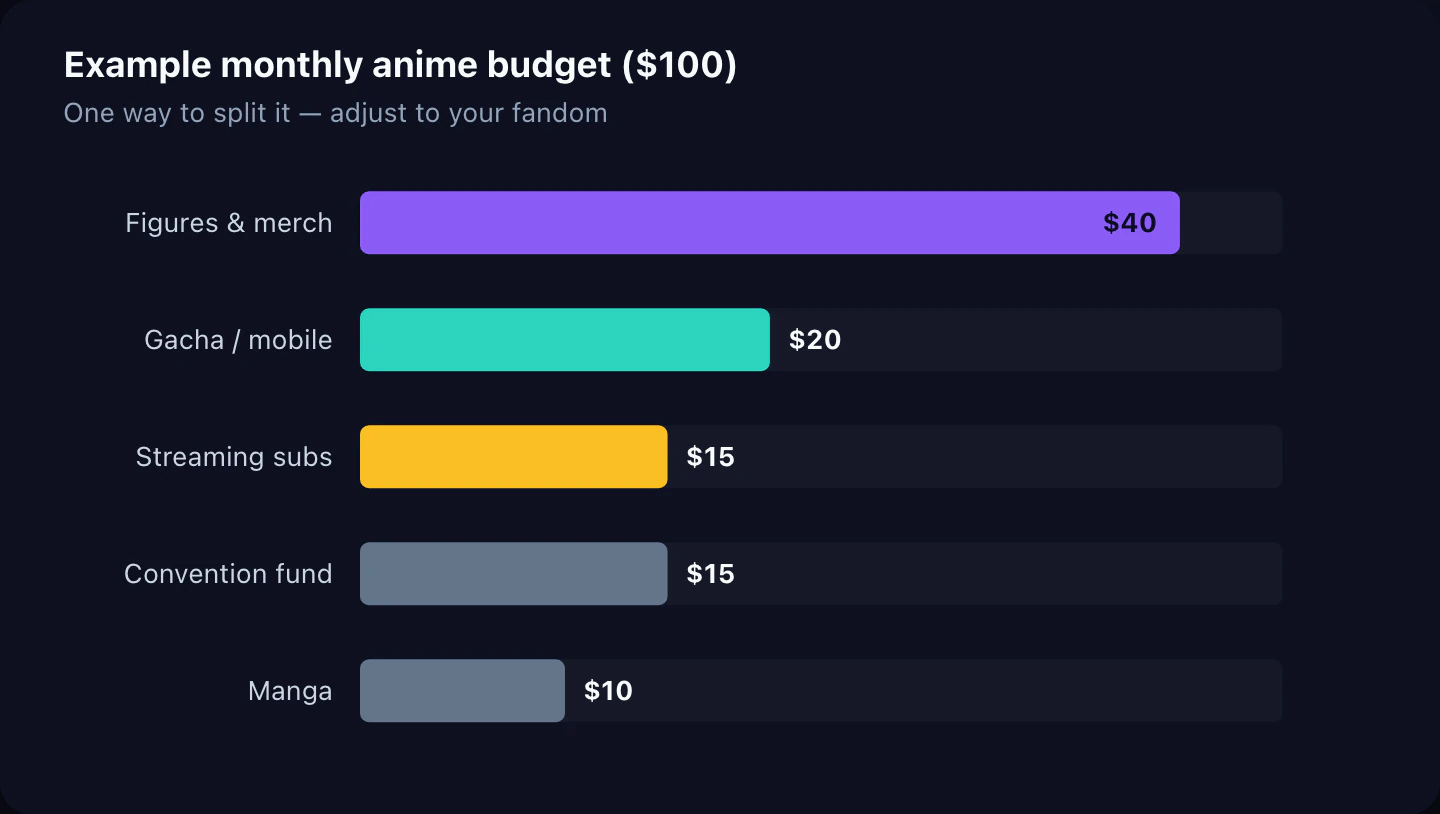
Anime spending isn’t one thing — it’s five-ish things that each deserve their own line. Splitting your monthly number keeps one category from quietly eating the whole budget. Here’s each money sink and how to handle it.
Figures & merch
For collectors, this is usually the biggest slice — and the one most prone to blowing up via pre-orders. Single figures run anywhere from $30 to $300+, and it’s easy to commit to several months of pre-orders whose payment deadlines all land at once. The full method is in how to budget for anime figures and merch.
Grail items (the big one you really want)
Some purchases are too big for a single month’s budget — the grail figure, the expensive import. Don’t impulse it or let it wreck a month; save for it deliberately with a sinking fund for your grail. You get the thing you actually want without the guilt or the credit-card hangover.
Pre-orders (the deadline trap)
Pre-orders are the single sneakiest part of anime budgeting because they separate the commitment from the payment. Stack a few and you can owe hundreds in a month you’d forgotten about. Tracking them is essential — see how to track anime pre-orders so deadlines don’t wreck you.
Streaming subscriptions
Crunchyroll, Netflix, and others recur quietly every month, and it’s easy to pay for more than you watch. A quick audit often frees up real money — how to stop overpaying for anime streaming walks through it. If you also support VTubers, superchats and memberships recur the same quiet way, so track and budget your VTuber superchat spending as its own line.
Conventions & cosplay
Cons hit in concentrated bursts — tickets, travel, costumes, artist alley — so they’re best funded by saving a little each month rather than absorbing the whole cost in one painful weekend. See budgeting for anime conventions and cosplay.
Manga
Volumes are individually cheap but relentless for ongoing series, and the total creeps. Manga collecting on a budget covers digital vs physical, library options, and how to keep up without overspending.
Trading card games
Several major anime series — One Piece especially — have launched popular TCGs that blend collector and player spending in ways that sneak up fast: booster boxes, singles, grading fees, and locals event costs all add up separately and rarely get tracked together. If you play or collect One Piece cards, give TCG its own sub-category rather than lumping it with merch. The One Piece TCG spending tracker covers the specific categories to watch, and the complete TCG budgeting guide applies to any card game you collect.
Gacha & mobile games
Gacha is engineered to fragment spending into amounts too small to notice. It deserves its own hard cap. How to budget for anime gacha games and the deeper guide to not overspending on gacha both help here.
Your split should match your fandom. A figure collector might put 60% toward figures and skip gacha entirely; a mobile-game player might do the reverse. The categories are a menu, not a requirement — the only rule is that the pieces add up to your chosen monthly number.
Step 4: Track Against It (The Part That Actually Works)
A budget you set and never look at is a wish. The tracking is what makes it real — and it’s easier than it sounds.
Log purchases as you make them
Every figure, pull, and sub — jot it the moment it happens or once a day. The small act of logging is also the moment you notice the spend, which is half the battle.
Watch the running total
The point of tracking is the number climbing toward your cap. Seeing “$78 of $100 this month” is what makes you pause on the marginal figure — the one you won’t remember next week.
Just ask, if your app can answer
With an assistant like Huntee, you can skip the mental math and ask “how much did I spend on figures this month?” and get an instant read. Turning scattered purchases into one clear answer is the whole point.
If forgetting to track is your real weakness — and for most people it is — a tracker built around staying consistent through streaks and progress gives you a reason to log tonight’s purchase that a plain spreadsheet never will. That’s the entire pitch behind Hunter Vault: same hobby, tracked in a way that actually sticks.
Handling the Impulse Buys
Even with a budget, the hardest moments are the impulse ones — a limited edition drops, a series you love gets new merch, and FOMO takes the wheel. Two defenses work:
- Add friction. Remove saved payment methods from your usual stores so an impulse buy takes 60 seconds of effort. That pause is often enough for the urge to fade.
- Use the cap as permission. If it fits your remaining anime budget, buy it guilt-free. If it doesn’t, the budget already made the decision for you. The full toolkit is in how to stop impulse-buying anime merch.
The reframe that matters: a budget isn’t a “no” machine. It’s a “yes, within this” machine. Everything inside your cap is guilt-free, which is a much nicer way to enjoy a hobby than vague anxiety about whether you’re overdoing it.
This is general educational content, not financial advice. Set an anime budget that fits your income, obligations, and goals. If anime or gacha spending feels compulsive or is causing financial harm, consider speaking with a qualified professional.
Final Takeaway
You do not have to choose between loving anime and being okay with money. Budgeting for the hobby isn’t about restriction — it’s about turning a scattered, invisible stream of purchases into one number you chose on purpose and can actually see.
See your real month, pick a number you’re happy with, split it across your categories, and track against it. Do that, and every figure, pull, and con becomes guilt-free, because you already know it fits. Start with the data on how much anime fans really spend, then set your number.
Frequently Asked Questions
How do I budget for my anime hobby?
Give your fandom one monthly number you’re genuinely happy with, then split it across your categories — figures, gacha, streaming, cons, manga — and track against it. The goal isn’t to spend less for its own sake; it’s to spend on purpose, so the hobby stays fun and never quietly crowds out bills or savings. Start by adding up one real month to see where you actually stand.
How much should I spend on anime per month?
There’s no universal number — it depends on your income and what else you’re saving for. A useful method is to decide what you can comfortably spare after bills, debt, and savings are covered, then make that your anime budget. Whether that’s $30 or $300, the amount matters less than the fact that you chose it on purpose and track against it.
Is it bad to spend money on anime?
Not at all. A hobby you love is a legitimate, healthy use of money as long as it fits within your means. Spending becomes a problem only when it’s unplanned and invisible — when pre-orders, gacha, and merch quietly add up to more than you realized and start displacing things that matter more. A tracked budget fixes that without killing the fun.
How do I stop overspending on anime merch and gacha?
Add friction and awareness. Set a monthly cap, remove saved payment methods so impulse buys take effort, track pre-order deadlines so they don’t stack up, and log purchases as you make them. Seeing the running total is usually enough to make you pause on the marginal buy — the one you won’t remember next week.
What anime expenses should I include in my budget?
All of them, because the total is what surprises people. Include streaming subscriptions, gacha and mobile-game spending, figures and merch (plus shipping and import fees), manga volumes, and a convention/cosplay fund. Grouping them into one “anime” budget line — or a few sub-categories — turns scattered purchases into one number you can actually manage.