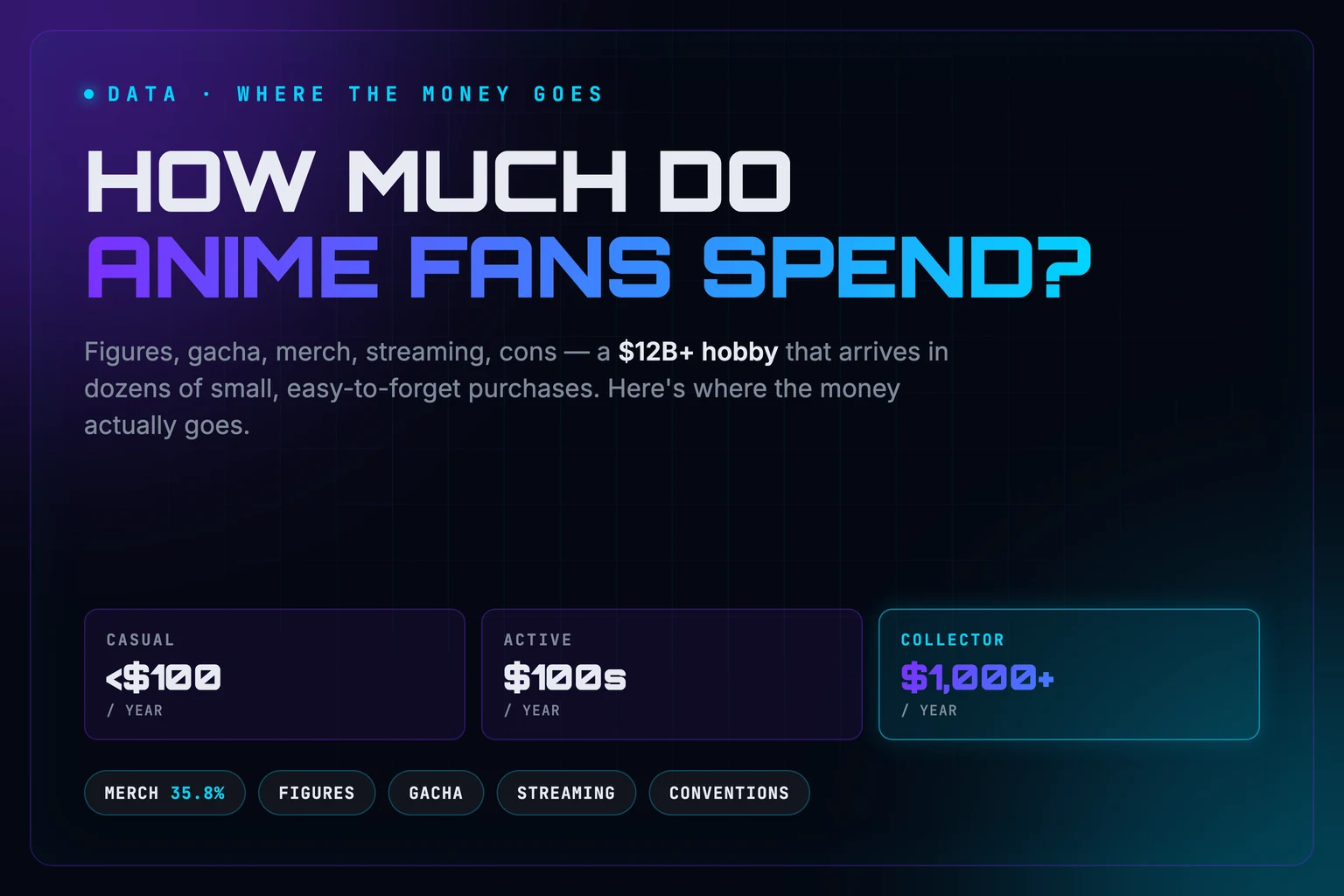
- Anime spending is concentrated among dedicated fans: casual fans spend under $100/year, collectors routinely spend hundreds to thousands
- The anime merchandising market hit ~$12.1B in 2025 and is projected to reach ~$27.4B by 2034 — a hobby that's booming, not fading
- Merch (figures, apparel, decor) is the biggest category at ~35.8% of the market; gacha, streaming, conventions, and manga fill out the rest
- Gen Z spends ~18% of its discretionary fashion budget on anime apparel vs ~4% for older generations
- Spending on anime isn't the problem — spending more than you planned without noticing is. A tracked monthly cap keeps it fun
Every anime fan has had the moment: you glance at your bank app after a good convention weekend, or tally up a few months of pre-orders, and the number is bigger than you expected. The hobby is a joy — but it’s a joy delivered in dozens of small, easy-to-forget purchases.
So how much do anime fans actually spend? The honest answer is “it depends wildly,” but the data paints a clear picture of a booming hobby where the spending is real, growing, and concentrated among the most devoted fans. Here’s what the numbers say, where the money goes, and how to tell if yours has crept past comfortable.
Quick Answer: What the Data Shows
There’s no single “average,” because anime fandom spans a huge range — from someone paying $8/month for one streaming service to a collector dropping four figures a year on grails. But two things are clear from the data:
- The overall market is large and growing fast — anime merchandising alone was worth about $12.1 billion in 2025.
- Spending is concentrated among core fans — Japan’s ~14 million “oshikatsu” (devoted-fan) consumers contributed roughly $23 billion in 2025, meaning dedicated fans spend far more than casual ones.
If you’re a casual watcher, your yearly spend is probably modest. If you collect, attend cons, or play gacha, you’re likely in the hundreds-to-thousands range — and the exact figure is usually higher than you’d guess without tracking it.
The Anime Economy Is Booming
Anime isn’t a niche anymore, and the spending reflects that. The global anime merchandising market was valued at roughly $12.1 billion in 2025 and is projected to reach about $27.4 billion by 2034, growing at around 9.5% a year (Fortune Business Insights, retrieved 2026-09-01).
That growth is driven by exactly the things fans love: more series, more merch, more conventions, and streaming making anime accessible everywhere. For you as a fan, the takeaway isn’t the market size itself — it’s that the temptations are multiplying, which makes a spending plan more useful, not less.
Where the Money Actually Goes
Anime spending isn’t one thing; it’s a stack of categories that each nibble at your budget. Merchandise is the largest — figures, apparel, posters, and home decor accounted for about 35.8% of the anime merchandising market in 2025 (Grand View Research, retrieved 2026-09-01). The rest of a typical fan’s spending spreads across:
- Figures & collectibles — the big one for collectors; single figures often run $30–$300+, and pre-orders stack up
- Gacha & mobile games — small, frequent, and engineered to keep you pulling (how gacha spending gets out of hand)
- Streaming subscriptions — Crunchyroll, Netflix, and others quietly recurring every month
- Conventions & cosplay — tickets, travel, costumes, and artist-alley hauls in concentrated bursts
- Manga — volumes add up fast for ongoing series
The reason anime spending sneaks up on people is that no single category feels expensive. It’s the sum that surprises you — the same way small purchases add up in any budget. Seeing all five categories in one place is usually the wake-up call.
How Much a Typical Fan Spends
Because fandom spans such a range, it helps to think in tiers rather than a single average:
- Casual fan: one or two streaming subs and the occasional item — often under $100/year.
- Active fan: regular merch, some gacha, a convention or two — commonly a few hundred dollars a year.
- Collector / core fan: figures, grails, imports, multiple cons — routinely $1,000+ a year, sometimes far more.
That top tier is where the market’s money concentrates. Devoted “oshikatsu” fans in Japan — around 14 million people — routinely spend several hundred to several thousand dollars a year on their primary fandoms, and their spending is disproportionately large relative to their numbers.
Generationally, younger fans lead. Gen Z allocates about 18% of its discretionary fashion spending to anime-themed apparel, versus roughly 4% for older generations (Anime Merchandising Market Analysis Report 2025-2033, retrieved 2026-09-01).
Almost everyone underestimates their hobby spending, because it arrives in scattered small amounts rather than one big bill. The single most useful thing you can do is add up one real month — every sub, pull, figure, and shipping fee. That number, not a national average, is the one that matters for your budget.
Why Anime Spending Sneaks Up on You
The data explains the “how much,” but the behavior explains the “why it’s more than I thought.” Anime spending has a few features that make it especially easy to lose track of:
- Pre-orders defer the pain. You commit today, pay in three months — and it’s easy to stack several before the deadlines land all at once.
- Gacha is frequent and small. A few dollars at a time doesn’t register the way a single big purchase would.
- Seasonal hype drives impulse. New season, new merch, limited editions — FOMO is built into the release calendar.
- Multiple storefronts. Crunchyroll, a figure site, a con, an import shop — the spending is spread across places your bank statement lists cryptically.
None of this means you should spend less than you want to. It means the spending is genuinely hard to see — which is the exact problem tracking solves.
How to Tell If You’re Overspending
Spending on anime is only a problem when it’s more than you planned or it’s crowding out things that matter more. Here’s the honest test:
- Add up one real month across every category — subscriptions, gacha, figures, merch, shipping.
- Compare it to your guess. A big gap means the spending is invisible to you, which is the risk.
- Check what it’s displacing. If anime is eating into bills, savings, or debt payments, that’s the line.
If the number’s fine, enjoy the hobby guilt-free. If it surprised you, the fix isn’t quitting — it’s giving your fandom a set amount you’re actually happy with and tracking against it. That’s the whole idea behind budgeting for your anime hobby without going broke: the hobby stays fun precisely because it’s no longer a mystery.
A tracker helps here. Logging your anime spending — or asking an assistant like Huntee “how much did I spend on figures this month?” — turns that invisible stack of small purchases into one clear number you can actually manage.
This is general educational content, not financial advice. Spending figures are drawn from cited market research and vary by fan, region, and methodology — re-check current data for your own decisions. Enjoy your hobby within a budget that fits your situation.
Sources and Methodology
This report compiles published market research rather than a proprietary survey, so treat the totals as industry estimates, not precise averages. Market-size estimates vary by firm: for 2025, Fortune Business Insights puts the anime merchandising market near $12.1B and Grand View Research near $12.0B, while other firms range from roughly $10.7B to $14B, with projected growth of about 8.8% to 9.5% a year through the early 2030s. Each figure above is cited beside its source with a retrieval date. The per-fan tiers are directional ranges drawn from those reports and public spending patterns, not a single measured average, which is why the most useful number is still your own tracked month.
Primary sources: Fortune Business Insights, Grand View Research, and the Anime Merchandising Market Analysis Report 2025-2033. All figures retrieved 2026-09-01.
Final Takeaway
Anime fans spend real money — casual fans modestly, collectors in the thousands — on a hobby that’s booming, not slowing down. The market’s growth means more temptation, not less, and the spending’s scattered nature makes it genuinely easy to lose track of.
The number that matters isn’t a national average; it’s your one real month, added up honestly. Do that once, and you’ll know exactly where you stand — and whether your fandom needs a friendly cap. Start with how to budget for your anime hobby without going broke.
Frequently Asked Questions
How much does the average anime fan spend per year?
It varies enormously by fan type. Casual fans might spend under $100/year on a streaming subscription and the occasional item, while dedicated collectors routinely spend several hundred to several thousand dollars a year on figures, merch, and gacha. Japan’s core “oshikatsu” fans — about 14 million people — contributed roughly $23 billion in spending in 2025, which shows how concentrated the spending is among devoted fans.
What do anime fans spend the most money on?
Merchandise is the biggest category — figures, apparel, posters, and home decor made up about 35.8% of the anime merchandising market in 2025. Beyond physical merch, the other major money sinks are gacha and mobile games, streaming subscriptions, conventions and cosplay, and manga. For collectors specifically, figures and grail-item chasing tend to dominate the budget.
Is spending money on anime a waste?
No — a hobby you enjoy is a legitimate use of money as long as it fits your budget. The problem isn’t spending on anime; it’s spending more than you planned without noticing. The goal is to give your fandom a set amount you’re happy with, then track against it, so the hobby stays fun instead of becoming a source of stress or debt.
Why does anime spending add up so fast?
Because it arrives in small, frequent, emotionally-charged purchases: a gacha pull here, a pre-order there, a convention weekend, a new figure from a series you love. Each feels minor, but pre-orders stack up months in advance and seasonal hype drives impulse buys. Without tracking, the total is almost always higher than fans estimate.
How do I know if I’m overspending on anime?
Add up everything for one month — subscriptions, gacha, figures, merch, shipping — and compare it to what you assumed you spent. If the real number surprises you, or if anime spending is crowding out bills, savings, or debt payments, that’s the signal. A simple monthly cap you actually track is the fix, not quitting the hobby.