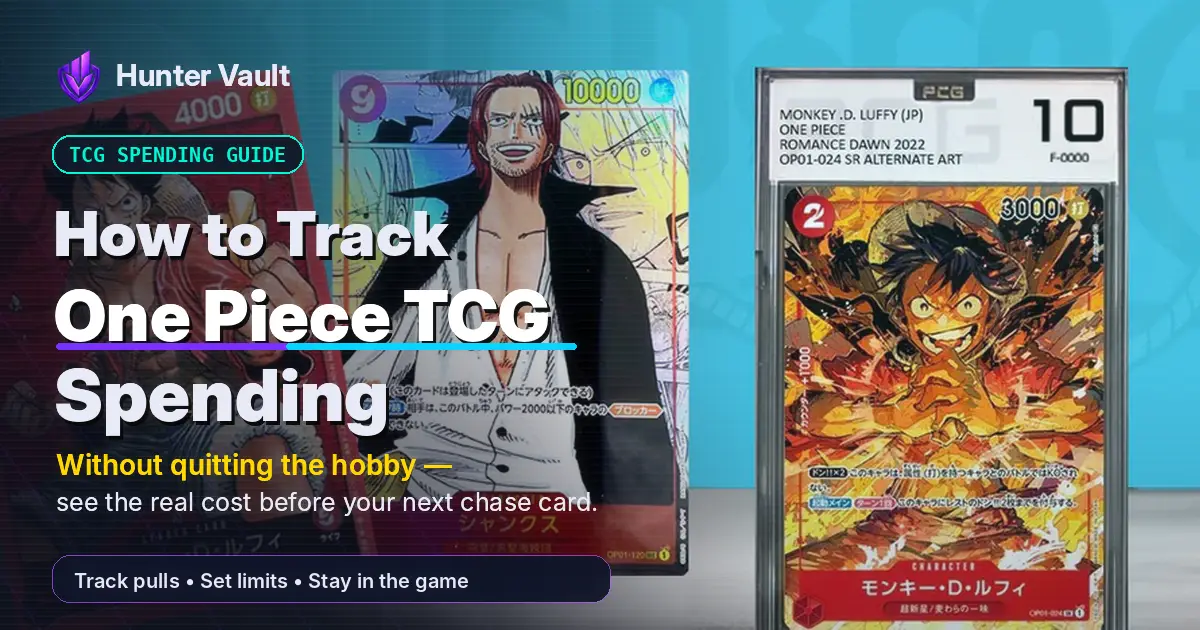
- One Piece TCG spending scatters across boxes, singles, grading, sleeves, and locals fees — so it stays invisible
- The fix isn't quitting — it's making the running total visible and setting a cap you decide in advance
- Track BOTH gross (what you put in) and net (after sell-backs and prizing) — they tell different truths
- Give the hobby its own pot, log every purchase as real money, and check the total before the next buy
- You don't need more discipline — you need to see the number before the decision, not after
You started tracking your One Piece TCG spending, added up a few months of boxes, singles, grading, sleeves, and locals fees — and the total was higher than you expected. If that’s you, you’re in very good company. It’s one of the most common realizations in the hobby, and it has almost nothing to do with being careless with money.
The spending sneaks up because it’s scattered. A box here, a few singles there, an entry fee, a grading order, a set of sleeves — none of it feels like a big purchase in the moment, and it lives in a dozen different places. So it stays invisible until you deliberately add it up.
This guide is about doing exactly that: seeing your real number, and setting a cap you can actually keep — without quitting the game you enjoy.
This is an independent guide to managing your own hobby spending. It isn’t affiliated with, endorsed by, or connected to Bandai or the One Piece Card Game — we just reference it because it’s what you’re playing. The approach works for any trading card game.
Quick Answer: How Do You Track and Cap One Piece TCG Spending?
To get One Piece TCG spending under control, give the hobby its own pot separate from your everyday money, log every purchase as real money — boxes, singles, grading, sleeves, locals, events — and track your sell-backs too so you can see both your gross spend and your net. Then set a monthly cap from the money left after your essentials, and check the running total before each purchase. You don’t have to quit. You need the number in front of you before you spend, not after.
Why TCG Spending Is So Hard to See
Before fixing it, it helps to understand why it sneaks up — because the structure of the hobby is working against your awareness, not your willpower.
It’s spread across too many streams. Sealed product is only one piece. There’s also singles for deck-building, grading fees, sleeves and binders, locals entry, event fees, and travel. Each stream is small enough to feel harmless, and together they’re anything but. As one player put it, they “stopped tracking once they realized they were spending more on cardboard than their car payment.”
Set releases spike it. Your baseline month might be modest — locals fees and a few singles — but release months stack boxes, prereleases, and chase singles on top. Averaged over a year, the release spikes are often where most of the money actually went.
Singles spending is sneaky. “Just grabbing the pieces I need for a deck” feels controlled, but alts, max-rarity upgrades, and “I’ll future-proof this deck” add up fast. Plenty of players spend more filling out decks with singles than they ever did on sealed.
There’s no running total anywhere. This is the big one. Nothing tells you “you’ve spent X on the hobby this year.” The purchases are split across your LGS, online singles sites, grading services, and event fees — so unless you build the total yourself, it simply doesn’t exist where you’ll see it.
None of this means you’re bad with money. It means the hobby’s spending is structurally invisible. Naming that moves the problem from “what’s wrong with me” to “here’s a system I can put in place.”
Gross vs. Net: The One Distinction That Matters Here
TCG is different from most hobbies in one important way: you can make money back. Singles sell, prizing has real value, and plenty of players flip boxes or net positive on a set. Any honest spending guide for this hobby has to account for that — ignoring it would miss how the community actually operates.
So track two numbers:
- Gross — everything you put in. Boxes, singles, grading, sleeves, fees, travel. This is what leaves your account, and it’s what protects your cash flow month to month.
- Net — gross minus what you make back from sell-backs, prizing, and flips. This is the honest “what this hobby actually costs me” number.
Both are true and both matter. Some players sit near break-even on net while running a large gross — which is fine, if the cash flow works and the gross isn’t quietly coming out of rent or savings. The danger isn’t a big gross by itself; it’s a big gross you can’t see, funded by money that had another job. Track both, and you’ll know which situation you’re actually in.
How to Track and Cap It (Step by Step)
You can do all of this in a notes app or spreadsheet. The structure is what matters, not the tool.
Before changing anything, add it up. Pull the last few months from your card or bank statement, your LGS purchase history, online singles orders, and grading invoices. Total the gross, then subtract anything you’ve sold back to get your net.
It can sting to see a year added up. Do it once anyway — the honest total is the baseline everything else is built on, and it’s usually the thing that changes the next decision.
Take your income, subtract the non-negotiables — rent, bills, food, debt minimums, anything you’ve committed to saving — and look at what’s left. Your TCG budget comes out of that, never off the top.
A common rule of thumb is keeping a single hobby around 10% of that leftover money, but treat it as a starting point, not a law. A student and a full-time earner will land in very different places, and both can be right. If you reliably sell back or prize, you can budget against your net — but keep enough room for the gross so you’re never floating purchases on money you need.
Wall your TCG money off from your real budget — a separate category, envelope, or vault. The rule that makes it work: when the pot is empty, you’re done until it refills. No borrowing from rent, no “I’ll pay it back next set.” Sell-backs and prizing can top the pot back up — that’s the reward for playing the resale game well — but the wall stays up. It turns an open-ended temptation into a finite amount you’ve already decided you can afford.
This is what makes the cap real instead of theoretical. Log every purchase the moment it happens — boxes, singles, grading, sleeves, entry fees — in actual money. And log what you make back too, so your pot reflects your true net position.
When you can see “I’ve used most of my hobby budget this set” before the next box or chase single, the decision changes. The whole reason it sneaks up is that it’s never totaled in real money until the statement arrives. Logging as you go puts the number in front of you while you can still act on it.
A Simple Example
Say your honest monthly TCG number is a set amount you’re comfortable with, and you sometimes sell singles back.
- Your cap: that amount, from money you’ve already covered essentials with.
- Its own pot: a “TCG” category, walled off from your real budget.
- Logging: every box, single, grading order, and locals fee logged as real money — and every sell-back logged too, topping the pot back up.
- The check: before any purchase, you open the pot and see what’s left.
A set release lands. The old pattern is to grab a couple of boxes plus chase singles and quietly blow past your number, noticing only at payday. The new pattern: you open the pot, see you’ve got room for one box, decide whether to rip or buy the singles you actually need — and if you pull something good and sell it, that flows back into the pot for next time. You’re not blocked from spending. You’re spending on purpose, with the number visible. That’s the whole shift.
Common Mistakes to Avoid
Swearing off the hobby entirely usually backfires — the ban builds pressure until one set release blows the whole thing up. For most people, a planned cap holds far better than a total ban. (If you’ve genuinely decided to step away, that’s valid too — just know cold turkey isn’t the only path.)
Tracking gross but ignoring net — or net but ignoring gross. One hides how much you’re really floating; the other flatters you into thinking a hobby is “free” when the cash flow says otherwise. Track both.
Forgetting the small streams. Sleeves, grading, and locals fees feel trivial and get left out of the math. They’re a real part of the total — log them.
Topping up from your main balance. The moment the hobby pot borrows from rent or savings, the wall is down. Let sell-backs and prizing refill it, not your essentials.
Treating one big set as a personal failure. Front-loaded a release? That’s one data point, not proof you’re hopeless. Reset and keep the system.
How Hunter Vault Can Help
Everything above works with a spreadsheet. The catch is the same one that makes TCG spending invisible in the first place: doing it by hand means remembering to log every box, single, grading order, and sell-back — and totaling it yourself — which is exactly the step people skip.
That’s where a tool helps. In Hunter Vault you can set up a TCG or hobby vault so your card spending lives in its own pot, separate from the money that pays your bills. Every purchase you log as an expense counts against that pot in real money, so the running total stays visible without you adding it up — and because it turns the habit into a streak you build, staying under your cap starts to feel like something you’re winning instead of a rule you’re enduring.
Hunter Vault is a gamified personal finance tracker that turns budgeting, expense tracking, saving, and debt payoff into RPG-style progress using quests, XP, ranks, streaks, vaults, and goals. It fits collectors and players well, since you already understand progress, ranks, and keeping a streak alive — and it works offline with no bank connection, so your data stays on your device. (For the HoYoverse version of this same tracker approach, see Genshin & Honkai spending tracker. For the broader hobby budgeting version, see how to budget for hobbies without guilt.)
If hobby spending ever feels out of your control — you can’t stop, you chase a card or a pull, you hide purchases, or it’s hurting your bills or relationships — that’s no longer a budgeting problem, and no app or tip will fix it on its own. Ripping packs shares some mechanics with gambling, and that’s not a personal failing. Reaching out to someone you trust, or a professional, is a genuinely reasonable step. Many regions have free, confidential support lines worth looking up.
This is general educational content, not financial advice. Choose an approach that fits your income, responsibilities, and situation.
Final Takeaway
You don’t have to quit One Piece TCG to get your spending under control. It sneaks up because it’s scattered across boxes, singles, grading, sleeves, and fees with no running total anywhere — not because you lack discipline. Find your real number first, track both gross and net, wall the hobby off in its own pot, and log every purchase as real money.
Start with one small step: add up what you spent on the hobby last set, gross and net. Seeing the real number is usually the thing that changes the next decision.
If you’d rather not track it all by hand, try Hunter Vault and let the app keep your hobby pot visible for you. It’s free to start on iOS and Android.
More TCG budgeting guides:
- How to Budget for Trading Card Games Without Going Broke — the complete framework covering all five spending categories across any TCG
- How Much Do People Actually Spend on Trading Cards? — market data and spending benchmarks for the broader TCG hobby
- Is Grading Your Cards Worth It? The PSA Cost Math — the all-in cost breakdown before you submit a card
- Chase Cards & Pull Rates: The Real Cost of Hitting a Hit — the pull rate math that makes singles look very compelling
If One Piece TCG is one slice of a broader anime hobby budget — figures, streaming, cons, and manga — see How to Budget for Your Anime Hobby Without Quitting It for a framework that covers all the categories together.