- Pokémon TCG Pocket earned an estimated $1.25B in player spending in its first year, so the monetization is well-engineered and designed to feel incremental
- The two free packs per day are genuinely free and sustainable as a baseline; every Poké Gold purchase beyond that should be budgeted in advance
- Set your monthly Pocket budget BEFORE an expansion drops — not during launch week when new cards are driving excitement
- Pocket and physical card spending come from the same money; track them in one budget, not two separate mental buckets
- Define your 'whaling threshold' — the pack count at which you stop buying and try for the card through Wonder Pick or trades instead
Pokémon TCG Pocket launched in October 2024, hit 150 million downloads (Nintendo Life), and earned an estimated $1.25 billion in player spending in its first year (PokeBeach). By April 2026 that total had passed $1.6 billion (PocketGamer.biz). Those numbers aren’t an accident — the monetization model is carefully designed to feel frictionless.
Two free packs daily. Wonder Pick mechanics. Small Poké Gold bundles. A premium pass. Regular new expansions. Each element is tuned to make spending feel optional, then increasingly natural. This guide covers how to stay in control of your Pocket budget without quitting the game.
Understanding the Monetization Model
Before setting a budget, understand what costs money and what doesn’t.
What’s genuinely free:
- 2 booster packs per day (daily free packs)
- Wonder Pick participation (up to your Wonder Stamina, which recharges over time)
- Deck building and casual play
- Basic social features
What costs money:
- Additional booster packs beyond the 2 daily free ones (purchased with Poké Gold)
- Poké Gold bundles (premium currency used for packs and cosmetics)
- Premium Pass subscription (~$9.99/month for bonus packs and cosmetic content)
- Wonder Stamina refills (purchasable with Poké Gold)
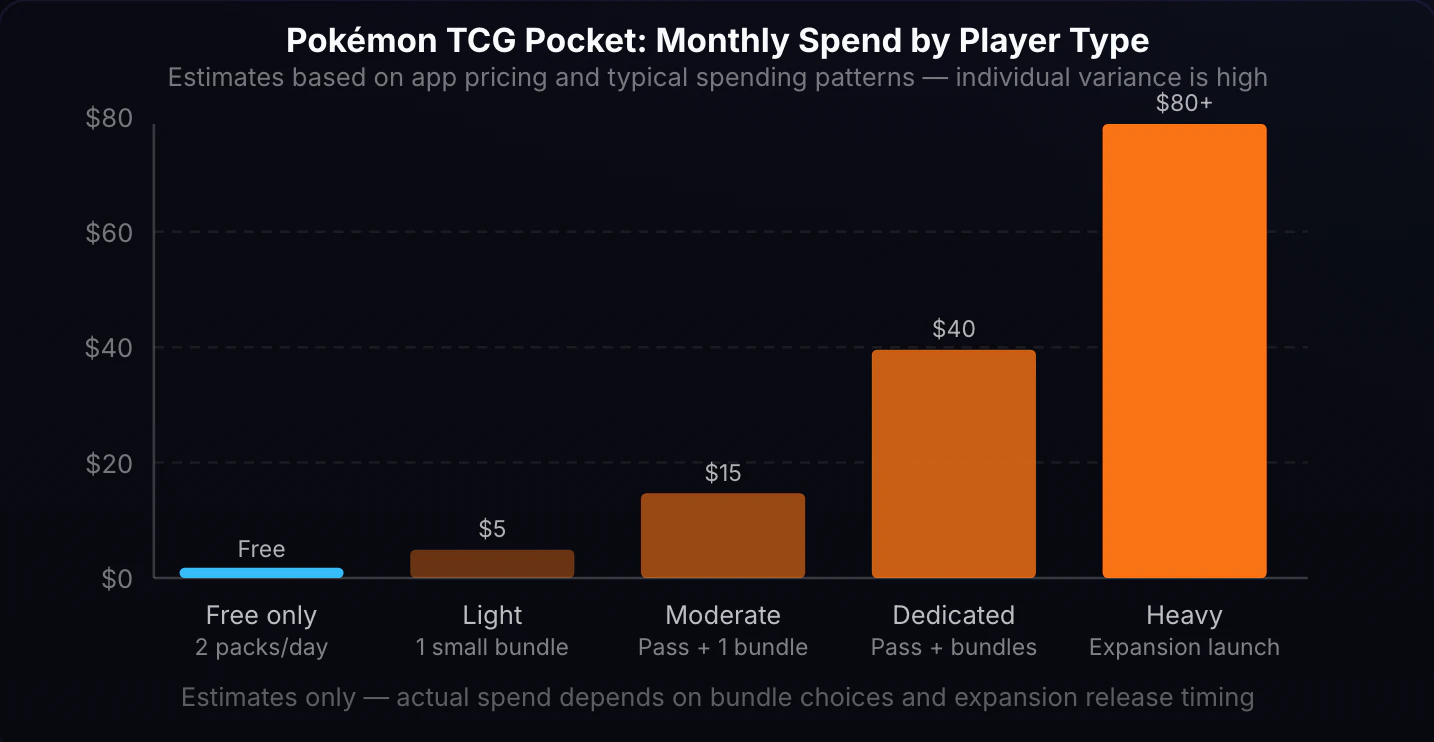
The chart illustrates how quickly spend escalates. The gap from “free” to “moderate” looks like two small steps. The gap from “moderate” to “heavy” during an expansion launch can happen in a single week.
Step 1: Understand What Actually Costs Money
The two daily free packs are a genuine value. You get two packs, you open them, you collect what’s inside. Over a month, that’s 60 free pack openings — more than enough to build a reasonable collection through the base set.
Where spending starts:
Poké Gold bundles are the primary monetization. You use Poké Gold to buy additional pack openings beyond your two daily free ones. Bundles start at $0.99 and scale up through much larger tiers, and the bigger tiers can include bonus Poké Gold, which nudges you toward buying bigger. Prices vary by region, so check the in-app shop for current amounts.
Premium Pass (~$9.99/month) gives bonus packs and cosmetic content each month. It’s a subscription that compounds: if you subscribe for 12 months, you’ve spent $120 before any additional bundle purchases.
Wonder Stamina refills let you do more Wonder Picks. Wonder Pick lets you take one card from a pack another player recently opened: you spend Wonder Stamina, the cards are flipped face down and shuffled, and you pick one without knowing which card it is. Stamina recharges slowly on its own, and refills cost Wonder Hourglasses or Poké Gold (Game8). Because the pick is random, paying for refills is another way of paying for a chance, not a specific card.
Expansion launches are the highest-spend periods. New cards, new meta relevance, and the pressure to build competitive decks around new mechanics. This is when “just one more bundle” logic is most likely to take hold.
Step 2: Set Your Monthly Pocket Budget Before an Expansion Drops
The worst time to set your Pocket budget is during expansion launch week. New cards are generating excitement, your friends are pulling strong rares, and the new meta is forming in real time. Every pull you see on social media is a subtle spending trigger.
The right time to set your budget: the week before an expansion drops, when you’re not emotionally engaged with the new cards.
A practical budget-setting approach:
- Decide your monthly Pocket ceiling — the maximum you’ll spend on Poké Gold and passes in any given month
- Write it down somewhere you’ll see it: a note in your phone, a line in your TCG budget spreadsheet, or a category in your budget app
- Convert the number to “bundles” so you can make decisions in the store: $15/month is roughly one $9.99 bundle plus one $4.99 bundle at US prices (check your in-app shop for local pricing)
- Treat the budget as a hard stop, not a soft guideline
Sample budgets by player type:
| Budget | What it covers |
|---|---|
| $0/month | Two free packs daily, Wonder Pick with naturally recharged Wonder Stamina only |
| $5–$10/month | One small Poké Gold bundle per expansion, no premium pass |
| $10–$20/month | Premium pass only, or pass + one small bundle |
| $30–$50/month | Premium pass + multiple bundles across an expansion launch |
There’s no right answer for what your budget should be. The right number is whatever you can spend every month for 12 months without affecting rent, savings, or other priorities.
The ideal moment to set your Pocket budget is 2–3 weeks after the last expansion launched — when the initial hype has settled, you have a clear view of what you actually needed versus what you wanted in the heat of launch week, and you’re not mid-excitement for the next one.
Step 3: Track All Poké Gold Purchases in Your TCG Budget
Pokémon TCG Pocket purchases belong in the same budget line as your physical card spending — not in a separate mental category labeled “phone game.”
This matters because the categories feel distinct. Buying a $5 Poké Gold bundle on your phone feels different from buying a $5 single on TCGplayer. But both reduce your available hobby money by the same amount, and both are Pokémon spending.
The practical consequence of separating them: players consistently underestimate their total Pokémon spend because they’re tracking physical and digital in different mental buckets. When they add it up, the total is almost always higher than their intuition suggested.
What to track:
- Every Poké Gold bundle purchase, regardless of size
- Premium Pass subscription renewals
- Any one-time promotional in-app purchases
- Wonder Stamina refill purchases
Where to track it: In the same place you track physical TCG spending — whether that’s a notes app, a spreadsheet, or Hunter Vault’s transaction tracking. The goal is one number that reflects total Pokémon hobby spend, not two separate numbers that let you rationalize both.
Step 4: Define Your Whaling Threshold
“Whaling” is mobile gaming terminology for spending heavily to acquire specific cards. In Pokémon TCG Pocket, it looks like this: you want a specific rare from the new expansion, Wonder Pick hasn’t turned it up, and you start buying bundles to open more packs hoping to pull it.
The whaling problem isn’t that spending happens — it’s that it continues past the point where it makes financial sense. Pulling your 15th pack looking for one specific card you can’t acquire any other way is a different situation than pulling your 50th pack because stopping feels like admitting defeat.
Setting your whaling threshold means deciding in advance: at what pack count do I stop buying and find another way to get the card?
Other ways to get cards without opening more packs:
- Wonder Pick: Wait for the card to appear in Wonder Picks from other players. This takes patience and costs Wonder Stamina, not Poké Gold, unless you buy refills. The pick itself is random, so treat it as a free extra chance rather than a guaranteed way to get one specific card.
- Trades: The in-game trading system lets you exchange cards with friends. A specific rare you want might be available from someone who pulled it but doesn’t need it, though trades are limited to eligible rarities, so check that the card can be traded first.
Defining your threshold before you’re mid-run removes the decision from a high-emotion context. “I’ll open packs until I’ve spent $20 on this expansion, then switch to Wonder Pick” is a decision you can make clearly. Making that same decision at pack 30 with the card still not pulled is much harder.
Step 5: Use “Two Free Packs and Stop” as Your Default
The two free daily packs are a complete, sustainable game loop if you let them be. You open two packs, you see what you got, you check your collection, you plan your Wonder Picks. That’s a 5–10 minute daily session that costs nothing.
The discipline is the “and stop” part. The free packs are calibrated to feel incomplete — you’ll occasionally pull something great, more often pull something ordinary, and always feel the pull toward one more pack. That feeling is the product working as designed.
A practical implementation: after opening your two free packs, close the app. Don’t immediately browse the Wonder Picks. Don’t check the shop. The transition from “I just opened my free packs” to “I’m browsing the shop” is where unplanned purchases happen. Breaking that transition by closing the app removes the opportunity.
If you do want to spend beyond your free packs, use your pre-set monthly budget and spend it intentionally — not reactively in the 30 seconds after a disappointing free pack pull.
Pokémon TCG Pocket releases new expansions regularly. Each expansion is designed to feel like a fresh start — new meta, new chase cards, new need to open packs to stay current. Your monthly Pocket budget should stay constant regardless of whether an expansion just dropped. If you budget $15/month, that’s $15/month in expansion launch weeks too.
Framing Pocket and Physical Cards as One Pokémon Budget
Pokémon TCG Pocket and physical Pokémon TCG are part of the same hobby. They share the same characters, many of the same cards in digital form, and the same collector community. Treating them as separate financial decisions — with separate budgets and separate tracking — creates two opportunities to rationalize overspending rather than one clear total.
The more grounded approach: one Pokémon hobby budget that covers:
- Physical booster packs and boxes
- Physical singles (TCGplayer orders, local shop purchases)
- Physical accessories (sleeves, binders, deck boxes)
- Grading fees (PSA submissions)
- Pokémon TCG Pocket (Poké Gold, premium pass)
When you see the total number in one place, the spending pattern becomes visible in a way it isn’t when each category feels small on its own.
For the full physical Pokémon card budget framework, see How to Budget for Pokémon Cards. If you’re still deciding whether the app or paper cards fit your budget better, Pokémon TCG Pocket vs. Paper Cards: Which Costs More? runs the side-by-side numbers.
For the complete TCG budget covering all five spending categories, see How to Budget for Trading Card Games.
For more on the psychology of why mobile game spending accumulates the way it does, see How to Stop Overspending on Gacha Games.
This is general educational content, not financial advice. Pocket packs are randomized, much like loot boxes, so only spend money you’ve already set aside for fun and stop if buying packs starts to feel compulsive.
In Hunter Vault, a Pokémon budget shows what’s left this month across the Pocket and physical purchases you log, and your Safe-to-Spend number shows what’s free after bills, debt minimums and savings, based on what you log — so you know where you stand before you open the shop, not after.
Frequently Asked Questions
Is Pokémon TCG Pocket free to play?
Yes — the core gameplay is free. You receive two free booster packs every day, and Wonder Pick is accessible without payment. The free packs provide a genuinely sustainable way to build a collection over time. The paid elements are Poké Gold bundles (which buy additional packs and Wonder Stamina refills) and the Premium Pass subscription. You can play indefinitely without spending money — but the monetization is designed to make spending feel natural and incremental.
How much do people typically spend on Pokémon TCG Pocket?
Pokémon TCG Pocket earned an estimated $1.25 billion in player spending in its first year (PokeBeach, October 2025) and passed 150 million downloads after its October 2024 launch. Spending is heavily skewed: many players spend $0, while a smaller group of heavy spenders accounts for a disproportionate share of revenue. As rough estimates, light spenders might put in $5–$15/month, dedicated buyers $30–$60/month, and heavy spenders well above $100/month during expansion launches.
What are Poké Gold bundles and how much do they cost?
Poké Gold is the premium currency in Pokémon TCG Pocket, used to purchase additional booster packs. Bundles range from roughly $0.99 at the smallest to $19.99 and above for larger quantities. The app also offers a premium pass subscription (around $9.99/month) that provides bonus content and extra packs. Bundles are priced to make incremental purchases feel small — but they compound over time and across each expansion release.
Should Pokémon TCG Pocket spending be tracked in my TCG budget?
Yes — Pokémon TCG Pocket spending belongs in your total Pokémon hobby budget, not tracked separately. Many players mentally categorize Pocket as 'just a phone game' with separate spending, which creates a blind spot for total hobby costs. Whether you spend $5 on a digital pack or $5 on a physical card, both come from the same money. Track them in one place.
What is the 'two free packs and stop' discipline for TCG Pocket?
The two free packs and stop approach means treating your two daily free packs as the default activity, without purchasing additional packs beyond your pre-set monthly budget. The free packs provide a genuine daily loop — you open them, you see what you get, you participate in the meta. The 'and stop' part means not using the free packs as a warmup that naturally leads to buying more. Set a monthly Pocket budget before expansion launches, use free packs as your baseline, and spend from your pre-set budget — not from FOMO.