This post covers the practical mechanics and cost structure of trading card reselling for educational purposes. It is not financial advice. Card flipping involves real financial risk — you can lose money. Past returns from card flipping do not predict future results. Consult a financial advisor before treating card reselling as income.
- Card flipping looks more profitable than it is — platform fees, shipping, and packaging compress margins significantly on every sale
- Buying for $100 and selling for $140 nets roughly $18–$25 after costs, not $40 — before accounting for time
- Flipping requires real expertise: knowing fair market value, sourcing below it, and timing the sell into demand
- Keep flipping capital in a separate 'flipping float' — never mix it with hobby spending or you'll lose track of whether you're actually profitable
- Card flipping is not passive income for beginners; it's active work with real loss potential when executed without market knowledge
Card flipping — buying trading cards below market and selling at or above market — is a real activity with real practitioners who do it profitably. It’s also an activity that looks far easier than it is from the outside, and that beginners routinely approach with margin math that bears no resemblance to reality.
This post covers what card flipping actually involves, what the margins actually look like after costs, what makes it work (and fail), and how to structure a budget if you decide to pursue it seriously.
What Card Flipping Actually Is
Flipping is arbitrage: buying something at one price and selling it at a higher price. In trading cards, this takes a few forms:
Condition arbitrage. Buying raw cards cheaply and having them graded (PSA, BGS), then selling the graded version at a premium if the grade is high.
Platform arbitrage. Finding cards listed below fair market on one platform (local Facebook Marketplace, trade binders, eBay with poor photos) and selling them on higher-visibility platforms at full market price.
Timing arbitrage. Buying cards when demand is low (off-meta, recently rotated, post-hype) and selling when demand rises (card gets reprinted and people want the original, card becomes meta-relevant, nostalgia cycle).
Collection buying. Purchasing entire collections at bulk prices, extracting value cards, and selling them individually. The spread between bulk collection prices and individual card prices can be meaningful.
Each approach requires different expertise and has different risk profiles.
The Real Margin Math
This is where most beginner flipping plans fall apart. The headline math looks simple: buy a card for $X, sell for $X + 40%, profit 40%. The actual math includes costs that don’t show up in the plan.
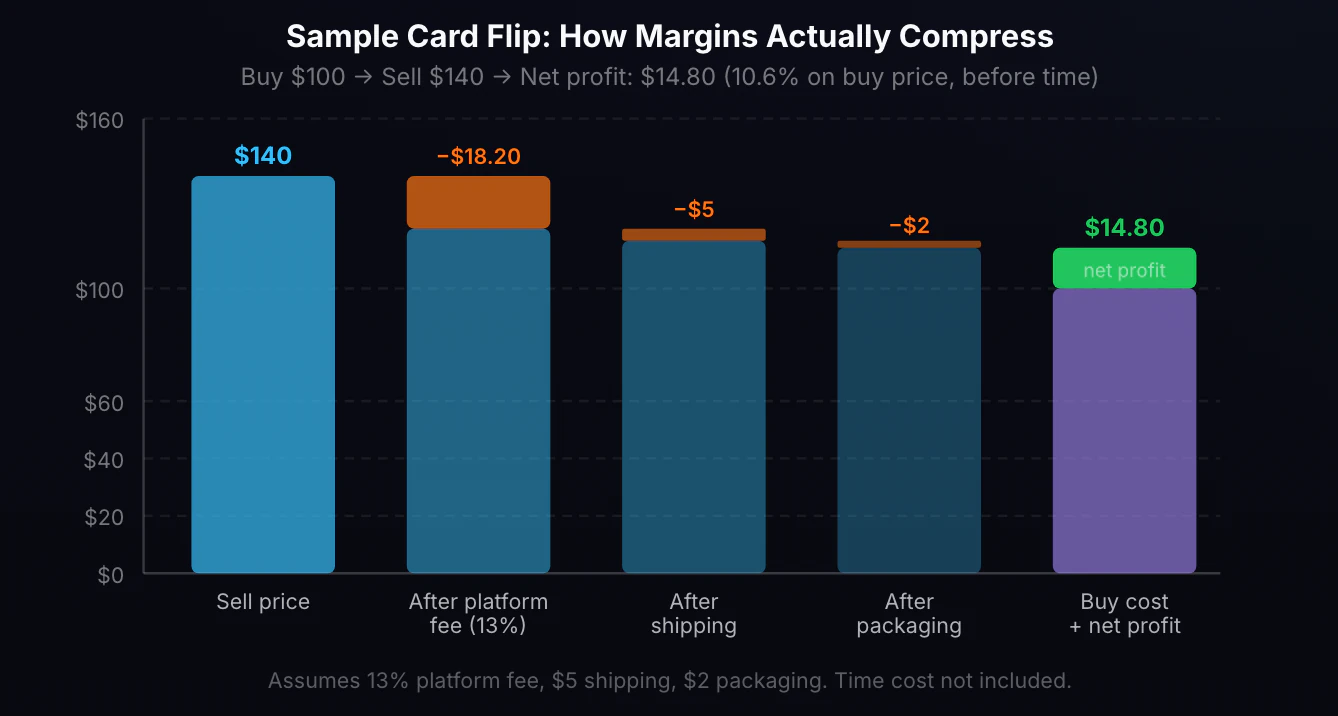
The real cost structure for a $140 sale:
| Line item | Amount |
|---|---|
| Sell price | $140.00 |
| Platform fee (13% — eBay or TCGplayer) | −$18.20 |
| Shipping (PWE or bubble mailer) | −$5.00 |
| Packaging materials (toploaders, bags, tape) | −$2.00 |
| Net proceeds | $114.80 |
| Buy price | −$100.00 |
| Net profit | $14.80 |
That’s a 10.6% return on the buy price, not 40%. And that’s before accounting for time — research, listing, packaging, post office trips.
Now run this at scale. If it takes 20 minutes per flip (find the card, list it, package it, ship it), ten flips per month equals 3+ hours of work for roughly $148 in profit. That’s a real hourly rate of about $45/hour — not bad — but it’s active work with ongoing risk that some positions go sideways.
What Makes Flipping Work
Consistent card flipping profitability requires three things simultaneously:
Market knowledge. You need to know what fair market value is for specific cards, what price trends look like, and which cards are likely to appreciate or depreciate. This knowledge is not obvious and takes time to develop. Beginners who start flipping before developing this knowledge tend to buy at market (thinking they’re buying below) and sell below market (not understanding what buyers actually pay).
Access. Profitable flips require buying below market. That means having sources: locals players with trade binders, collection buyers at estate sales or online, Facebook Marketplace, or platforms with poor presentation where good cards get missed. Finding consistent sources takes networking and time.
Timing. Knowing when to sell is as important as knowing when to buy. A card bought at $60 when the meta is weak might sell for $120 when the meta strengthens — but only if you sell during the strength window, not after a reprint announcement brings it back down to $50.
Without all three, flipping is speculative rather than systematic.
What Makes Flipping Fail
Buying hype. Newly announced cards, tournament hype, set release excitement — these drive prices to peaks that often don’t last. Buying when a card is being discussed everywhere usually means buying at or above fair value, not below it. The card you’re buying into peak excitement is the card someone with better information is selling.
Overestimating sell prices. TCGplayer and eBay listings show asking prices. Completed sales show what buyers actually paid. These differ significantly for many cards — particularly mid-range cards that have plenty of supply. Pricing your flip at the listed market price without checking completed sales leads to cards that sit unsold or sell at lower prices than projected.
Holding losers. When a card drops from your buy price, selling it at a loss feels worse than holding it. But holding a card that’s declining while capital is tied up is a decision to keep making the same loss. Experienced flippers cut losers quickly. Beginners hold them and watch small losses become larger ones.
Underestimating time cost. Listing 30 cards per month at 20 minutes each is 10 hours. That’s a part-time job’s worth of work. If the profit doesn’t reflect a reasonable hourly rate for your time, flipping may not be worth it relative to alternatives.
Budgeting for Flipping: The Flipping Float
If you’re going to flip cards seriously, the most important structural decision is keeping flipping capital entirely separate from hobby spending.
Why separation matters:
- Flipping capital is working capital — it’s expected to come back. Hobby spending is consumption.
- Mixing them means you can’t tell whether your flipping is profitable or whether wins are subsidized by hobby money
- It prevents “borrowing” from the float for a pack purchase and distorting your position tracking
Setting up a flipping float:
A practical starting float for someone flipping $50–$150 cards is $400–$600. That’s enough to have 3–5 positions active simultaneously without needing a sale to fund the next buy. Start smaller if you’re learning — there’s no reason to deploy significant capital before you’ve demonstrated consistent results.
Track every transaction: buy price, sell price, fees, shipping. Your real profit per flip is the number that matters — not your gross revenue.
In most jurisdictions, income from selling trading cards for profit is taxable. If card flipping generates meaningful income, consult a tax professional about how to report it correctly. This varies by country and income level. Keeping records of every buy and sell price makes tax calculation significantly easier.
Is Flipping Worth It for You?
Card flipping can generate supplemental income for people with genuine market expertise and reliable sourcing. For beginners without those advantages, it tends to produce inconsistent results, tie up capital in slow-moving positions, and generate less profit than the hours invested would suggest.
The honest benchmark: if your first six months of flipping — with real tracking of every transaction — produce a consistent positive return after fees, shipping, and a fair hourly rate for time, you have something worth continuing. If you’re breaking even or running small losses while telling yourself it’ll get better, that’s the data talking.
For the broader investment context of trading cards — including what historical appreciation data actually shows and what it doesn’t — Is Collecting Trading Cards a Good Investment? covers the evidence without the hype.
For knowing when to sell your existing collection versus hold, When to Sell Your Cards covers the signals worth watching.
The complete TCG budget framework — including how to track a flipping float alongside your hobby spending — is at How to Budget for Trading Card Games.
Hunter Vault’s transaction tracking lets you maintain separate budget categories for hobby spending and a flipping float — so your card purchases and sales stay organized and your actual profit picture stays clear. Track both in one place without mixing the numbers.
Frequently Asked Questions
How much profit can you make flipping trading cards?
Margins are tighter than they appear. After platform fees (10–15% on eBay or TCGplayer), shipping costs ($3–$8 per card), and packaging materials, a card bought for $100 and sold for $140 nets roughly $18–$25 in actual profit. That's an 18–25% return on the buy price — before accounting for the time spent sourcing, listing, packaging, and shipping. Experienced flippers with good sourcing can achieve this consistently; beginners typically underestimate all three cost categories.
What skills are needed to flip trading cards successfully?
Card flipping requires three things consistently: market knowledge (knowing which cards are undervalued and which are at or above fair market), access (finding cards to buy below market through locals, trade binders, collection purchases, or arbitrage between platforms), and timing (knowing when demand is strong enough to sell at your target price). Without all three, flipping tends to produce inconsistent results or losses.
Should I use my hobby budget for card flipping?
No. Flipping capital should be tracked separately from hobby spending. If you buy a $100 card to flip, that money is working capital — it should be expected to come back, not spent. Mixing flipping capital with hobby spending creates accounting confusion and means losing track of whether flipping is actually profitable. Keep a separate 'flipping float' account or budget category.
What are the biggest mistakes beginner card flippers make?
The most common: buying hype (paying peak prices for newly announced cards, then watching them drop), overestimating sell prices (listing at market price without accounting for fees and shipping), holding losers too long (hoping a card recovers rather than cutting the loss), and underestimating the time cost. Card flipping is not passive income — it requires active monitoring, listing work, and shipping logistics.
What is a 'flipping float' and how large should it be?
A flipping float is dedicated capital set aside exclusively for buying cards to resell — separate from your hobby budget. Its size depends on your deal volume, but a practical starting point is 3–5× your average flip deal size. If you flip cards in the $50–$150 range, starting with $300–$500 in float gives you enough to have 3–4 active positions without having to wait for a sale to fund the next buy. Track it separately from hobby money so you always know your actual position.