- Variable reward schedules — used in loot boxes and gacha — are the same behavioral mechanism as slot machines, documented since Skinner's 1950s research
- Loss aversion means 'you'll lose your progress' lands twice as hard as 'you'll gain a reward' — games exploit this asymmetry constantly
- Social comparison mechanics (leaderboards, visible cosmetics, guild pressure) create spending pressure through status competition, not just personal desire
- Spending velocity is a deliberate design choice — games compress multiple purchase decisions into short windows to bypass deliberate thinking
- Understanding the mechanics provides partial resistance; structural interventions (budgets, friction, logs) provide the rest
Most articles about gaming overspending treat it as a willpower problem. “Just stop spending so much.” But willpower research is pretty clear that willpower is a limited resource, and pitting it against systems designed by teams of behavioral scientists and A/B tested on millions of players is a structurally unfavorable fight.
This post is about the mechanics themselves — what they are, where they come from, and why they work on virtually everyone. The goal isn’t to make you feel manipulated (though you are). It’s to give you enough understanding of the system that you can build better defenses than “try harder.”
The Science of Variable Reward Schedules
B.F. Skinner’s operant conditioning research in the 1950s produced one of the most replicated findings in behavioral psychology: variable ratio reinforcement schedules produce the highest and most persistent rates of behavior.
In practical terms: if you reward a behavior every time it occurs, the behavior is stable but stops quickly when rewards stop. If you reward it on a fixed schedule — every tenth time — behavior is consistent but drops off at predictable points. But if you reward it randomly — sometimes on the second try, sometimes on the fiftieth — the behavior becomes extremely persistent and highly resistant to extinction.
This is not a subtle effect. It’s one of the strongest and most consistent findings in behavioral science, replicated across species, contexts, and time periods. And it’s the direct ancestor of every loot box, gacha pull, and random drop mechanic in modern gaming.
The game designers who built these systems know the research. The connection is explicit in game design literature — “variable rewards” appears as a core engagement mechanic in widely-read game design texts. What gets obscured is that “engagement” in a monetized game means “spending behavior,” not just play behavior.
The critical feature: the uncertainty itself is what drives the behavior. It’s not that the reward is valuable (sometimes it isn’t). It’s that the next pull might be the good one. That anticipation is the hook.
Loot Boxes and the Gambling Correlation
The academic literature on loot boxes has grown substantially since 2018, and the findings cluster in a consistent direction.
A frequently cited 2019 study by David Zendle and Paul Cairns published in PLOS ONE found a statistically significant correlation between loot box expenditure and problem gambling scores across a survey of 7,422 gamers. This relationship held up after controlling for gaming engagement — it wasn’t just that people who played more games also spent more and gambled more; the loot box spending itself tracked with problem gambling indicators.
A 2020 follow-up meta-analysis by Zendle, examining data from multiple countries, found the correlation was consistent across regions and game types, with an estimated effect size indicating loot boxes explain around 5% of variance in problem gambling scores. That sounds small, but it’s comparable to many established gambling risk factors. A correlation isn’t a diagnosis, though, and the research on gaming disorder and overspending separates heavy spending from the clinical condition.
The structural similarities are concrete:
- Unknown outcomes before purchase — you don’t know what you’re getting
- Variable ratio reinforcement — the same mechanic as slot machines
- Real-money entry — you spend real money for a randomized digital reward
- Near-miss effects — getting a “rare” item just below what you wanted maintains the pull
- Loss chasing — spending more to recover from a “bad” streak
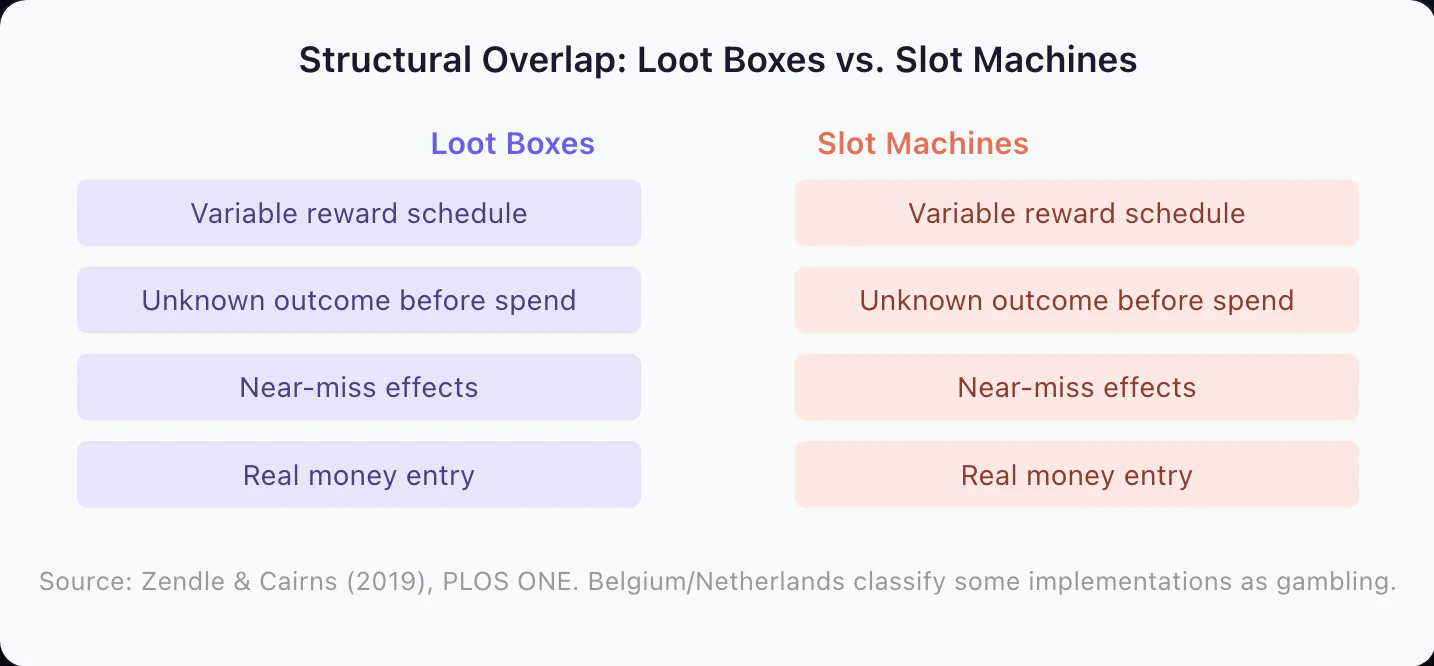
Not all countries have acted on this research. The US has not regulated loot boxes at a federal level. But Belgium and the Netherlands have both ruled that certain loot box implementations constitute gambling under existing law, requiring licensing or removal from their markets. The UK Gambling Commission has been examining the question, and the ESA — the US game industry’s lobbying body — has resisted classification while offering voluntary self-regulation measures.
If you’ve opened weapon cases, it helps to see the number before reading any more research. Here’s how to find what CS2 cases have actually cost you.
Loss Aversion in Games: Why “Losing” Your Progress Feels Catastrophic
Prospect theory, developed by Daniel Kahneman and Amos Tversky in their landmark 1979 paper, established that people weight losses more heavily than equivalent gains — empirically, losses feel roughly twice as painful as gains feel good. This asymmetry is loss aversion.
Game designers apply loss aversion with precision:
Battle pass expiry. You’ve paid for the battle pass. You have 14 days left. The rewards you haven’t earned yet aren’t gains you’re missing — in the game’s framing, they’re losses you’re accumulating. This is a psychologically significant reframe. “Miss out on a reward” feels different from “lose a reward you’re on track to earn,” even when the material outcome is identical.
Progress that resets. Events, streaks, stamina systems — anything that can be “wasted” generates loss aversion pressure. You feel compelled to log in (and often spend) to protect something you already feel you possess.
Ranked season expiry. Your rank, your MMR, your position on a leaderboard — these feel like possessions that depreciate if you don’t actively maintain them. Spending to boost or protect them is spending to avoid a loss rather than to achieve a gain.
The result: games don’t just offer rewards for spending. They create conditions where not spending feels like losing something. That’s a much stronger motivational pull than simple positive reinforcement.
Social Comparison Mechanics: Leaderboards, Cosmetics, and Guild Pressure
Leon Festinger’s 1954 social comparison theory proposed that humans evaluate their opinions and abilities by comparing themselves to others — and that when a measurable gap exists between yourself and someone “better,” you’re motivated to close it.
Games are comparison engines. They surface social comparison through:
- Leaderboards — explicit rank, visible to everyone
- Visible cosmetics — your character’s appearance is a status signal in multiplayer spaces
- Guild and clan systems — your contribution (gear score, performance, spending) affects your status within a social group
- Social feeds — seeing what others unlocked, achieved, or acquired
The comparison pressure is most effective when the gap is closable by spending — a better skin, a gear upgrade, a character unlock that closes a performance gap. Games place these opportunities close to the moments when comparison is most salient. You just watched someone with the limited-edition skin carry the game. The shop is one button away.
Guild pressure is particularly effective because it adds interpersonal stakes. Being asked by teammates to upgrade your gear, or feeling like you’re underperforming your contribution to a group you care about, introduces social obligation alongside the comparison pressure. That’s a harder force to resist than wanting a cosmetic for personal aesthetic reasons.
The “Just One More” Loop and Long-Term Planning
There’s a well-established psychological pattern called “projection bias” (Loewenstein, O’Donoghue & Rabin, 2003): people systematically underestimate how much their current emotional state will change in the future. When you’re in the middle of a session, excited, engaged, running on the dopamine of a near-win, you genuinely underestimate how different you’ll feel in an hour when you’re tired and rational.
Games structure their highest-pressure spending moments for peak engagement — the moment right after a close loss, during an event finale, after watching a friend get the drop you wanted. These are the moments when projection bias is most extreme and when “just one more” feels most justified.
The “just one more” loop also interacts with the sunk cost trap: each session you stay in, each pull you make, increases the invested amount that now has to be justified by continuing. The loop feeds itself.
Long-term financial planning operates on a completely different time scale than the emotional present of a gaming session. The two rarely coexist in the same moment of consciousness. Games understand this and target their monetization at the emotional present.
Spending Velocity: How Games Accelerate Purchases
Spending velocity refers to the pace at which a game moves you through purchase decisions. High-velocity purchase flows are a deliberate design choice — the goal is to get multiple purchase decisions made before deliberate thinking has time to engage.
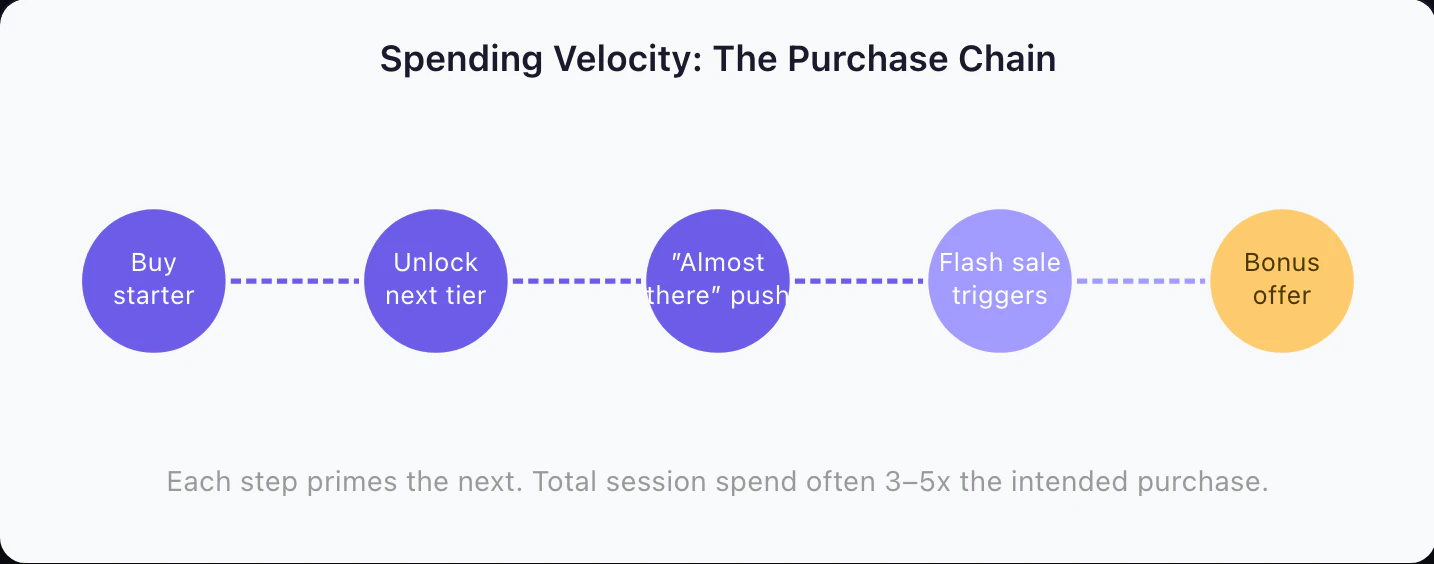
Tactics that accelerate spending velocity:
- Tiered offers that unlock immediately — completing a purchase immediately surfaces the next offer, at a slight premium
- “Almost there” pushes — being shown that you’re 80% of the way to something prompts a spend to close the gap, triggering immediately after a previous spend
- Flash sale timing — appearing right after a previous purchase, when the payment barrier has just been lowered
- Currency bundles that don’t match purchase prices — forcing you to buy more currency than you need, which then needs to be “used up”
The common thread: each purchase makes the next one more likely, and the gap between each decision is deliberately minimized. A game that surfaces a new offer five minutes after you just bought something is a game that has calculated that five minutes is the right window to catch you before deliberate thinking re-engages.
What Knowing This Actually Gets You
Behavioral economics research on “inoculation” — exposure to persuasive tactics to reduce their effectiveness — suggests that understanding manipulation techniques provides partial resistance. A 2019 study by Cook and Lewandowsky found that pre-exposure to argumentation tactics reduced susceptibility to misinformation, and similar dynamics appear in spending behavior research.
But partial is the operative word. You can understand exactly why a countdown timer works and still feel the urgency. The emotional response is largely automatic; the knowledge has to work against it after the fact.
This is why the more reliable interventions are structural rather than cognitive:
- Pre-set spending caps decided before gaming sessions, not during purchase flows
- Cooling-off periods that create mandatory delay between impulse and purchase
- Spending logs in real currency that make patterns visible — tracking what you spend on games surfaces the aggregate that individual small purchases conceal
- Payment friction — removing saved card details from game accounts
If you want to understand the broader picture of how much gamers typically spend per year, that gives useful context for where you sit. For gacha specifically, how to stop overspending on gacha games addresses the highest-intensity version of these mechanics.
The gamer financial mindset covers the bigger picture of how to approach gaming and money without treating every dollar spent on games as a moral failure — which it isn’t.
This post covers behavioral economics and game design research. It’s general educational content, not personalized financial or clinical advice. If you’re concerned about compulsive spending behavior, a therapist or financial counselor who works with behavioral issues is the appropriate resource.
The Bottom Line
The mechanics games use to drive spending have names, documented histories, and research literatures behind them. Variable reward schedules from Skinner’s research. Loss aversion from Kahneman and Tversky. Social comparison theory from Festinger. Projection bias from Loewenstein. These aren’t vague psychological forces — they’re specific, well-understood mechanisms being applied deliberately.
That doesn’t make spending in games wrong. It makes it worth doing deliberately, with clear numbers and a pre-set limit, rather than reactively in the moment the game has engineered for maximum impact.
You can enjoy games and still understand the business model. Those two things aren’t in conflict.
Frequently Asked Questions
What is the connection between loot boxes and gambling?
Multiple peer-reviewed studies have found structural and psychological similarities between loot boxes and gambling. Both use variable reward schedules, both can trigger compulsive behavior, and both obscure the real probability of outcomes. A 2019 meta-analysis by Zendle and Cairns found statistically significant correlations between loot box spending and problem gambling scores. The Belgian and Dutch gaming authorities have classified certain loot box implementations as gambling under existing law.
What does loss aversion mean in the context of games?
Loss aversion is the documented tendency for people to feel losses more intensely than equivalent gains — Kahneman and Tversky found losses feel roughly twice as painful as gains feel good. Games exploit this by framing non-spending as a loss: 'You'll lose your battle pass progress if you don't level up,' or 'This offer expires in 3 hours.' The fear of losing something you already feel you possess drives more spending than the promise of gaining something new.
How do social comparison mechanics in games drive spending?
Leaderboards, visible cosmetics, guild rankings, and social feeds all create comparison pressure. Research on social comparison theory (Festinger, 1954) shows that upward social comparison — comparing yourself to those doing better — increases motivation to close the gap. In games, the gap often closes by spending. Guilds amplify this through direct social pressure: teammates who expect you to gear up, carry your weight, or match their level.
What is spending velocity in gaming?
Spending velocity refers to how quickly a game accelerates purchases through artificial urgency — flash sales, tiered offers that escalate in cost, purchase chains that unlock the next offer immediately after the last. The goal is to move through multiple purchase decisions faster than deliberate thinking can intervene. High-velocity spending events (like a game anniversary sale or limited event) are specifically designed to compress decision time.
Does knowing about these mechanics actually help you resist them?
Partially. Research on 'inoculation theory' suggests that exposure to persuasion tactics reduces their effectiveness — but doesn't eliminate it. You can understand that a countdown timer is manufactured urgency and still feel the urgency. The more reliable protection comes from structural interventions: pre-set budgets, cooling-off periods, and spending logs. Knowledge sets up the resistance; structure maintains it.
Are all in-game purchases manipulative?
No. A cosmetic DLC at a fixed price with no artificial scarcity or variable reward involved is a straightforward purchase. The problematic mechanics are specific: variable reward schedules that randomize outcomes, artificial time pressure, loss framing, and social comparison pressure. Many games don't use these tactics. The ones that do are operating a different kind of system.