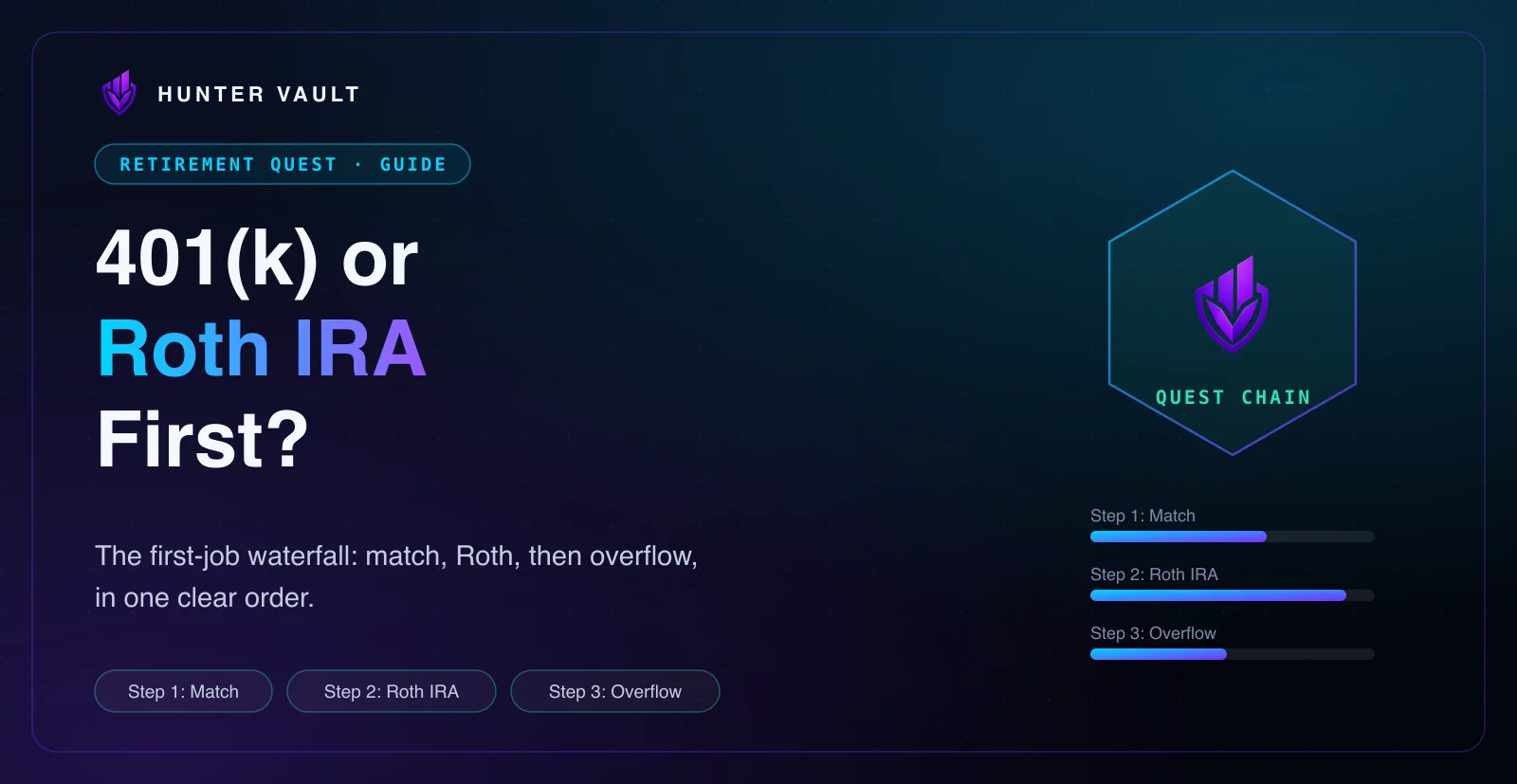
- The first-job waterfall: 401(k) up to the employer match, then a Roth IRA, then more 401(k)
- The match is part of your pay; skipping it leaves compensation on the table
- Low early-career tax brackets are why young workers are usually pointed toward Roth
- Roth 401(k) and Roth IRA share a tax flavor but are different accounts with different rules
- A down market does not change the order; time in the market is the point
Your first substantial paycheck arrives alongside access to a benefits portal crowded with unfamiliar terminology nobody ever taught you. Traditional 401(k), Roth 401(k), Roth IRA, vesting schedules, and salary reduction appear as disconnected vocabulary without explanations attached. You legitimately earned the compensation, yet allocating it across unfamiliar accounts resembles an examination covering material you never studied.
Fortunately, the entire decision collapses into one dependable sequence that permanently eliminates guesswork for first-time retirement savers. Visualize the progression as a quest chain where completing each objective immediately unlocks the subsequent assignment in order. Finish the opening step thoroughly, advance toward the following objective without hesitation, and continue progressing while surplus money remains available each month. No advanced textbook or expensive advisor is required to execute the sequence correctly.
Two preliminary assumptions support everything that follows, so confirm both conditions honestly before contributing a single dollar. First, monthly spending stays controlled enough that each month concludes with a genuine investable surplus remaining afterward. If budgets currently leak, read how to start investing after you stop overspending first, because retirement accounts cannot repair a leaking budget. Second, at least a starter emergency cushion already exists to absorb ordinary surprise expenses without resorting to borrowing. If an unexpected bill would land on a credit card, build the gamer’s starter emergency fund before chasing retirement contributions.
Quick Answer: 401(k) or Roth IRA First?
Both, in this order: contribute to your 401(k) up to the full employer match, then fund a Roth IRA, then return remaining retirement money to the 401(k). That three-step waterfall represents the standard first-job sequence, and everything below explains why each step occupies its position.
| Step | Action | Why it comes here |
|---|---|---|
| 1 | 401(k) up to the full match | The match is part of your pay; nothing else beats that return |
| 2 | Fund a Roth IRA | Flexible account with tax treatment that suits most starters |
| 3 | Add more to the 401(k) | Higher ceiling and automatic paycheck contributions |
Step 1: Contribute to the 401(k) Up to the Match
Capture the full employer match
Log in to your benefits portal and set your 401(k) contribution high enough to capture every dollar of the employer match. This single configuration delivers the highest return of any money move in this entire post.
A 401(k) is a retirement account your employer sponsors, with money flowing directly from each paycheck into investments selected from the plan menu. The employer match is additional compensation your employer contributes when you contribute, calculated according to a formula tied to your salary. That matching money is not a discretionary bonus or an optional perk, but rather a standard component of total compensation that only requires a contribution setting to claim.
Walk through a simple hypothetical example with clearly illustrative numbers that do not represent any particular employer plan. For example, suppose an employer matches contributions up to 4% of salary as a purely illustrative assumption. Contributing 4% captures the complete match, contributing 2% captures roughly half while forfeiting the remainder, and contributing nothing earns nothing additional. Exact formulas differ across employers, so verify your personal documents, but the underlying shape stays constant: below the match threshold, unclaimed compensation waits patiently.
That dynamic explains why the match dominates step one so completely over every alternative use of the same dollars. No conventional investment return and no clever tax maneuver reliably multiplies money the way matching contributions multiply it. Skipping the match to fund another account first means purchasing retirement at full price while abandoning part of your salary simultaneously. For the complete examination of match mechanics, paystub terminology, and vesting timers, read how a 401(k) match and vesting schedule actually work.
Vesting: when the match money becomes fully yours
Now consider the contractual detail that surprises nearly every new hire: employer matching dollars frequently vest across a defined timeline. Vesting is the schedule determining when employer contributions become fully and irrevocably yours to keep. Your personal contributions remain entirely yours from the first day, while employer matching contributions may transfer ownership gradually according to plan rules. Confirm your own schedule in your plan documents, and confirm current plan contribution rules at the IRS website before making assumptions.
Two dominant schedule structures cover the overwhelming majority of employer plans in practice today. Cliff vesting transfers complete ownership at a single moment after a defined service period concludes successfully. Graded vesting transfers ownership incrementally across several years, with each service anniversary unlocking another proportional slice. Departing before full vesting generally means retaining personal contributions plus their earnings while forfeiting some or all unvested employer money.
Open your plan documents or benefits portal and search for the phrase vesting schedule. Record whether the structure is immediate, cliff, or graded, alongside the associated timeline for reference. Then continue saving normally, because even partial vesting outperforms no match while personal contributions and growth always remain yours.
A final honest observation closes this subsection: vesting schedules never justify skipping step one under any circumstances. The pessimistic outcome still preserves every personal contribution while surrendering only some employer dollars upon an early departure. The alternative guarantees zero employer dollars immediately, so contribute toward the match regardless of future employment plans.
Step 2: Fund a Roth IRA
Open and fund a Roth IRA
After the match is captured, direct subsequent retirement dollars into a Roth IRA you open and control yourself. It represents the adaptable middle stage of the three-step waterfall sequence for early-career savers.
A Roth IRA is an individual retirement account established independently, entirely separate from any employer sponsorship or workplace plan. You contribute after-tax dollars, balances compound inside the account across decades, and qualified retirement withdrawals emerge completely tax-free. Annual contribution limits and income eligibility requirements apply, and authoritative current figures appear only at the IRS website, which remains the sole source trustworthy enough for numerical details. Two companion lessons extend this step substantially in complementary directions for motivated readers. Where to open a Roth IRA compares beginner-friendly venues systematically, while Roth IRA withdrawal rules separates contributions from earnings precisely.
Why does Roth treatment suit most first-job savers so consistently across widely different personal situations? Consider the tax bracket as a price tag attached to every contributed dollar at deposit time. Early-career salaries generally occupy lower brackets than peak-earning years, so taxes paid on Roth contributions today carry a comparatively discounted price. You accept that lower rate presently in exchange for tax-free qualified withdrawals arriving decades later. That exchange represents the general principle behind the conventional Roth preference for younger workers.
Notice the deliberate phrasing throughout this section: general principle describes background orientation, never personalized financial advice. Individual circumstances can diverge meaningfully from standard patterns in several realistic ways. For instance, consider the hypothetical case of unusually high starting compensation, substantial deductions, or an unconventional career trajectory, which might strengthen the case for Traditional treatment instead. The waterfall supplies the standard sequence reliably, while only your complete financial picture determines the appropriate personal fit.
The flexibility trap: yes, you can usually withdraw contributions, but do not plan on it
Roth IRAs include a famous flexibility feature deserving precise understanding rather than casual forum assumptions. As a general rule, contributed principal (distinct from earnings) can be withdrawn anytime without additional tax or penalty. Those deposits entered after tax already, so reclaiming them generates no additional tax obligation whatsoever. Earnings obey stricter regulations involving account longevity and owner age, so never assume both pools behave identically.
That flexibility genuinely comforts beginners facing their first locked-away savings, and such reassurance serves a legitimate psychological purpose. It confirms Roth money stays less imprisoned than most conventional retirement savings vehicles. But reassurance marks the boundary of its proper role in sound planning. A Roth IRA is not an emergency fund, and treating it as one quietly undermines its fundamental purpose.
Three substantial arguments close the case decisively against routine reliance on early withdrawals. First, every withdrawn dollar abandons decades of compounding, which constitutes precisely the growth the account exists to capture. Second, withdrawn contributions cannot be restored beyond standard annual limits, so surrendered contribution space disappears permanently. Third, genuine emergencies deserve reserves immune from market volatility at inconvenient moments, a guarantee invested retirement funds cannot provide.
If surprise expenses would force retirement raids, pause step two and construct a proper cushion first. Our emergency fund guide establishes the appropriate target, while the emergency-fund calculator converts monthly expenses into a concrete numerical goal. Fund the safety net completely before proceeding, then return here with genuine confidence.
Step 3: Go Back to the 401(k)
Add remaining dollars to the 401(k)
Once the match is captured and the Roth IRA receives funding, redirect leftover retirement money toward the 401(k). Automation plus a higher contribution ceiling makes the workplace plan the natural overflow destination.
Reaching step three signifies successful completion of the two highest-value maneuvers available to beginners. The remaining question concerns where additional retirement dollars perform most effectively across subsequent decades. For most first-job savers, the answer points back inside the workplace retirement plan.
Three distinctive characteristics earn the workplace plan its overflow designation convincingly. First, the contribution ceiling sits substantially higher than IRA limits, accommodating serious savings as compensation increases. Exact limits evolve periodically, so verify current figures at the IRS website rather than trusting remembered numbers. Second, contributions depart each paycheck automatically, removing willpower from the savings process entirely and permanently. Third, many plans permit choosing between pre-tax Traditional contributions and after-tax Roth 401(k) contributions for additional money.
That final choice reuses the same analytical framework established during step two. Traditional contributions reduce taxable income presently while facing ordinary taxation upon eventual withdrawal. A Roth 401(k) is the after-tax workplace alternative, with taxes paid presently and qualified withdrawals emerging tax-free eventually. At modest starting salaries, the familiar general principle nudges many beginners toward Roth treatment, though personal circumstances always govern.
Either selection preserves forward momentum inside the waterfall structure without compromising progress. The meaningful victory involves retirement dollars flowing into investment accounts automatically every pay period. Meticulous tax-flavor optimization matters far less than establishing the automatic contribution habit reliably.
Decoder: Roth vs Traditional vs Roth 401(k)
Beginners frequently stumble across three confusingly similar account names, so this section decodes all three within one consolidated table. Two independent concepts combine into every available option: tax treatment (Roth means after-tax presently, Traditional means pre-tax presently) and account location (401(k) means employer plan, IRA means personal account). Confirm current account rules at the IRS website before acting on any specific detail.
| Account | Where it lives | Tax treatment | Funded by |
|---|---|---|---|
| Traditional 401(k) | Employer plan | Pre-tax now, taxed on withdrawal | Paycheck |
| Roth 401(k) | Employer plan | After-tax now, tax-free qualified withdrawals | Paycheck |
| Roth IRA | Your own account | After-tax now, tax-free qualified withdrawals | You, directly |
Observe the pattern spanning the rows carefully, because it simplifies every subsequent retirement conversation. The two 401(k) variants share an employer home while differing in tax timing across decades. The two Roth variants share tax timing while occupying different locations governed by different regulations. Identifying both dimensions transforms five intimidating terms into straightforward coordinates anyone can navigate confidently.
The paystub line, translated
One additional decoder entry follows here, because this particular terminology confuses nearly every newly hired worker. Paystubs often display lines reading salary reduction, employee deferral, or 401(k) elective deferral among routine deductions. Salary reduction is payroll terminology describing your own 401(k) contribution, not a penalty imposed by anyone. Taxable salary decreased by the contributed amount (for Traditional contributions), and the money transferred directly into your investment plan. Nothing valuable was confiscated from you at any point; earnings were simply relocated toward your future security.
If the expected line never appears anywhere, enrollment may remain incomplete and require prompt attention. Some employers enroll newcomers automatically at modest rates, while others await explicit employee action before starting. Confirm actual contribution rates inside the benefits portal sometime during the current week. Automatic enrollment rates frequently rest below match thresholds, silently recreating exactly the problem step one eliminates.
When the Waterfall Changes Course
The waterfall represents standard sequencing for typical beginners, not inflexible universal law applicable to every conceivable situation. Three recurring situations redirect the sequence, and acknowledging them honestly matters more than pretending one order fits universally.
Expensive debt comes first. If high-interest balances drain money monthly, redirect extra dollars toward those balances before steps two and three. Capture the 401(k) match initially, since nothing outperforms it, then assault the expensive debt aggressively. Resume the standard waterfall sequence promptly once the expensive balances disappear completely for good.
No match changes step one. Some employers sponsor 401(k) plans without any matching contributions attached whatsoever. Under those circumstances the match step stays empty, so progress effectively begins at step two with the Roth IRA. The 401(k) still functions admirably as overflow capacity within step three afterward.
No workplace plan at all. Some first jobs provide no retirement plan whatsoever to their workers. Under those circumstances the waterfall compresses into funding a personal IRA and, with remaining money, a taxable investment account. The sequential logic survives intact: capture free money initially, then flexible tax-advantaged accounts, then everything remaining.
Notice carefully which fundamental elements persist unchanged across all three alternative scenarios. You still spend below earnings, maintain an emergency cushion, and invest surplus funds steadily across time. Account selections differ situationally across scenarios, but the underlying wealth engine stays completely identical.
Wondering what to purchase inside these accounts once contributed money arrives successfully? That important subject receives separate dedicated treatment intentionally within this publication sequence. Begin with index funds explained for gamers, which introduces the beginner-friendly concept without naming specific funds, since no single investment suits every saver. Once concepts feel secure, what to buy first in a Roth IRA resolves the target-date versus index-fund decision confidently.
What to Do This Week
Five compact tasks convert this post into tangible progress quickly and efficiently. Each requires only minutes, and together they complete the entire waterfall configuration process.
- Confirm your match formula. Open your benefits portal and record exact match terms alongside the current contribution rate. Raise the rate toward the full match threshold whenever current settings rest below it.
- Check your vesting schedule. Discover whether employer contributions vest immediately, across a cliff, or gradually through graded service. Preserve a screenshot so future-you understands the complete ownership timeline without confusion.
- Verify your paystub line. Confirm 401(k) contributions actually depart each paycheck at the configured rate. Repair any automatic-enrollment shortfalls immediately upon discovering any discrepancy whatsoever.
- Open your Roth IRA. Select a provider, establish the account, and configure a modest automatic transfer immediately. Funding consistently outperforms perfecting, so refine contribution amounts after automation begins working smoothly. If spring timing applies, the Roth IRA deadline guide keeps every contribution window filled appropriately.
- Name your next lesson. Bookmark the index-funds explainer for purchasing decisions, plus the emergency-fund guide if cushions need reinforcement first.
Where Hunter Vault Fits
The waterfall operates on one essential fuel: monthly surplus remaining after all spending concludes. Every step assumes money remains available afterward, and discovering that surplus represents exactly why Hunter Vault was built for savers. Track spending systematically, watch surplus figures grow steadily, and route proceeds through the steps outlined above. (That “we” is a disclosure: Hunter Vault is our app.) This post recommends the method whether or not you ever touch the app.
Final Takeaway
401(k) to the match, then the Roth IRA, then back to the 401(k). Three steps, one clear order, and zero guesswork define the complete sequence. The match captures complete compensation, the Roth step exploits lower early brackets wisely, and overflow automation sustains the contribution habit. Begin during the current week: confirm the match, investigate vesting, and open the Roth account. Future-you already appreciates the initiative enormously across coming decades.
Sources
- US Internal Revenue Service (the IRS website): current contribution limits, income eligibility rules, and withdrawal rules for 401(k) plans and IRAs. All tax and account claims in this post are qualitative; verify current figures at the source before acting.
Methodology note: this guide synthesizes general IRS guidance into a beginner sequence, and every scenario is a hypothetical illustration rather than personal data. Technical note: search-engine structured data for this page is injected by the site layout at build time.
This publication provides general educational content, not personalized financial advice. Retirement choices depend substantially on individual income, debts, taxes, and long-term goals. When in doubt, consult a qualified professional who can see your full picture.
About This Guide
About the author: Alger Makiputin writes beginner investing guides for first-job workers navigating workplace benefits. This post was reviewed by an editor for clarity, and every paragraph above stays general background information rather than personal advice. For corrections or questions, use the site contact page and mention the post title in your message.
Frequently Asked Questions
Should I do a 401(k) or a Roth IRA first at my first job?
Do both, in order: contribute to your 401(k) up to the full employer match first, then fund a Roth IRA, then add more to the 401(k) if money remains. The match is part of your pay, so capturing it comes first. The Roth IRA comes second because its flexibility and tax treatment suit most early-career workers. This is a general educational sequence, not personal advice.
What does 401(k) to the match mean?
It means contributing enough of your salary to your workplace 401(k) to receive the full matching contribution your employer offers. As a hypothetical example, if your employer matches your contributions up to a percentage of your salary, you contribute at least that percentage. Anything less leaves part of your compensation unclaimed.
Is Roth better when you are young?
As a general principle, Roth accounts are often discussed for early-career workers because starting salaries usually sit in lower tax brackets. You pay tax now at that lower rate, and qualified withdrawals later are tax-free. But the right choice depends on your full situation, including current versus expected future income, so treat this as background knowledge rather than a personal recommendation.
What is a Roth 401(k) vs a Roth IRA?
Both use Roth (after-tax) tax treatment, but they are different accounts. A Roth 401(k) lives inside your employer's workplace plan and is funded through your paycheck. A Roth IRA is an individual account you open yourself at a brokerage of your choice, with its own eligibility and contribution rules. Check current rules at IRS.gov.
Should I still invest for retirement when the market is down?
A down market does not change the order of operations. Retirement money is invested for decades, so what matters most is time in the market and consistent contributions, not picking the perfect entry moment. Trying to wait for the right moment usually costs more than it saves. Keep contributing steadily and let compounding do its work.