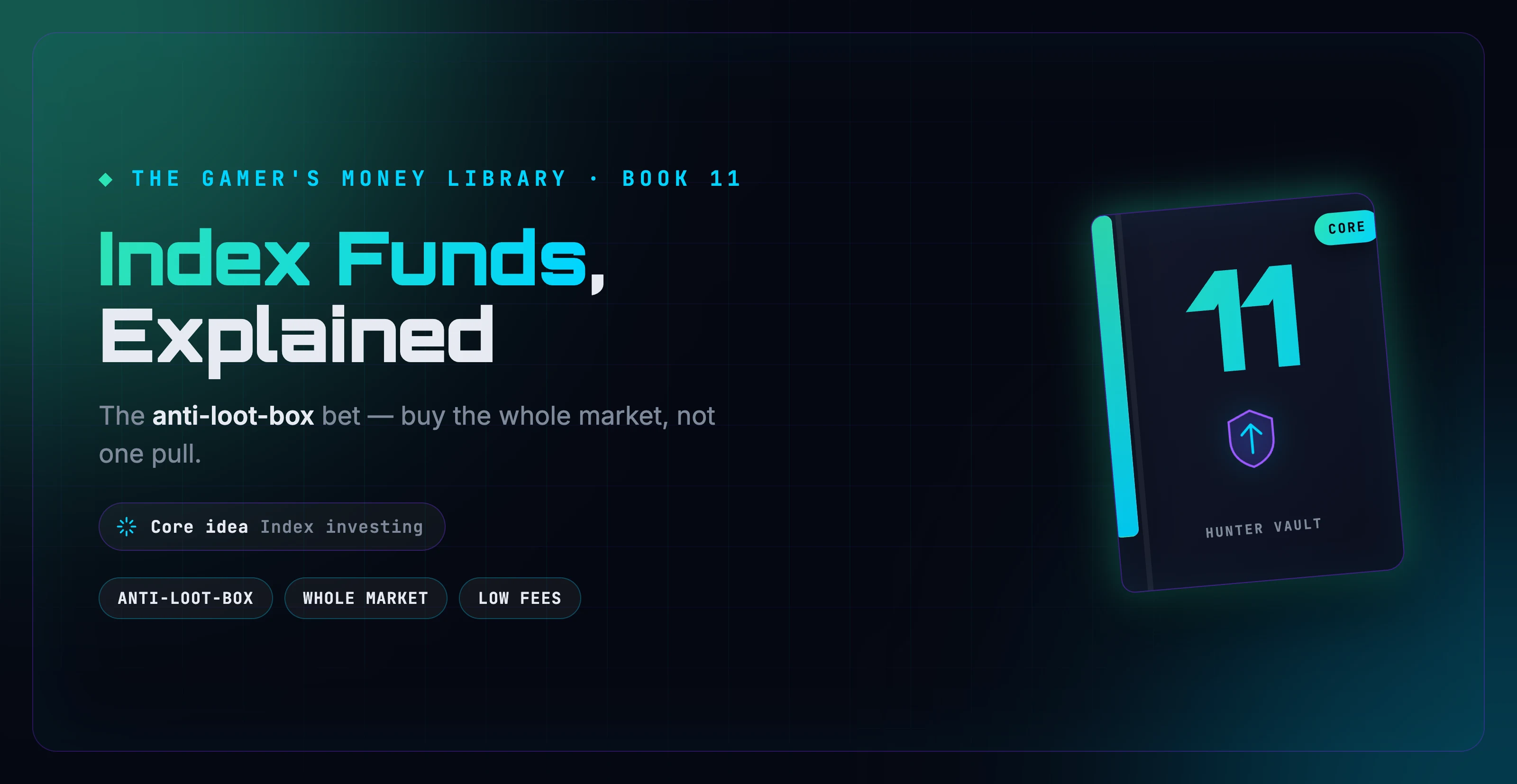
- An index fund buys a tiny slice of a whole basket of companies instead of gambling on one pick
- That's diversification: no single company can sink you, because you own a little of everything
- A loot box is negative expected value by design; broad markets have historically tended to grow over long periods
- Index funds are 'boring' on purpose — low fees, passive, nothing thrilling to do — and that's the point
- But you can only invest a surplus, so control the spending leaks before any of this applies to you
You already understand index funds better than you think — you’ve just been taught the opposite strategy by every gacha banner and loot box you’ve ever opened. Those systems ask you to bet on a single outcome: this pull, this box, this chase. The house sets the odds so that, on average, you come out behind. That’s the entire business model.
An index fund is the structural mirror image of that bet. Instead of gambling on one pick, you buy a tiny slice of an entire basket of companies at once — and instead of the odds being tilted against you by design, you’re simply along for the growth of the whole group. It’s the most boring investment there is, and that’s exactly why it’s worth understanding. This post explains what an index fund actually is in plain gamer terms, why “boring” is a feature, and the honest catch: none of it matters until you have a surplus to invest, which means controlling your spending comes first.
Hunter Vault is an independent app inspired by RPG and anime progression systems. It is not affiliated with, endorsed by, or sponsored by the creators or rights holders of Solo Leveling, nor by the authors or publishers of the books referenced here. Ideas from the books referenced here are summarized in our own words and credited to their authors.
Quick Answer: What Is an Index Fund?
An index fund is a single investment that holds a small slice of a whole basket of companies — say, a broad market index — instead of one hand-picked stock. Rather than betting everything on one winner, you own a little of everything, so no single company blowing up can sink you. That’s diversification, and it’s the opposite of a loot box, which is engineered so the house wins on average. Index funds are also passive (they track an index rather than pay a manager to guess) and typically low-cost, and both traits matter over time. Historically, broad markets have tended to grow over long periods — often cited around 7% a year after inflation historically, though future returns are never guaranteed. The catch: you can only invest money you don’t spend, so surplus first, always.
Diversification: Don’t Bet Your Whole Roster on One Pull
Imagine a gacha game where, instead of pulling for one character and praying, you could pay once and receive a small copy of every character in the game. A few will be duds. A few will carry your account. Most will be fine. Because you own the whole roster, one terrible unit can’t wreck you, and you don’t need to guess which banner is worth chasing — you already have them all.
That’s diversification, and it’s the core idea behind a broad index fund. When you buy one, you’re not betting on a single company to win; you’re buying a tiny piece of hundreds or thousands of them at once. If a few fail, the others carry the basket. You’ve traded the possibility of picking the one perfect stock for the reliability of owning the whole field — which, for beginners, is almost always the smarter trade, because reliably owning everything beats unreliably guessing one.
This is why “which stock should I buy?” is often the wrong beginner question. A broad index fund lets you sidestep it entirely. You’re not trying to out-pick a market full of professionals; you’re just owning a slice of the whole thing and letting the group’s long-run trend do the work.
Loot Box vs Index Fund: Negative vs Positive Long-Run Expectation
Here’s the contrast that should reframe how you see both. A loot box has negative expected value by design. The odds are set so that, on average, the value you get back is less than what you paid — because the gap is the profit. Open enough of them and the math is not on your side; it was never meant to be. The hidden cost of free-to-play games digs into how those systems are engineered to keep you spending against those odds.
A broad market index fund is the structural opposite. Historically, over long time horizons, broad markets have tended to grow, because you’re owning a slice of the collective output of many companies rather than betting against a house. This is not a promise — markets fall, sometimes hard, and future returns are never guaranteed — but the underlying setup is fundamentally different from a loot box. One is designed so the system extracts value from you; the other lets you own a piece of the system.
Any specific number here has to be hedged heavily. You’ll often see broad long-run stock market returns cited around 7% a year after inflation historically — but that’s a rough, backward-looking average across a very long period, not a rate you’re owed, and future results could be higher, lower, or negative for long stretches. The honest takeaway isn’t a number. It’s the direction of the expectation: one bet is built to lose on average, the other to participate in long-run growth with real risk attached.
Gamers already think in expected value — you just apply it to drop rates and pity counters. Point that same instinct at your money. A loot box is a negative-EV bet you make for fun; a diversified, low-cost investment is a positive-long-run-expectation bet you make for your future, risk included. Neither is ‘wrong,’ but only one is a wealth strategy, and confusing the two is where people get hurt.
Why “Boring” Is the Point
The most common complaint about index funds is that they’re boring. No thrilling pull, no jackpot single stock, no daily decision. You buy a broad slice of the market and then… mostly nothing. You wait.
That boredom is the feature. Excitement in investing almost always means concentrated risk — the big single bet that could double or crater. The calm, passive, nothing-to-do nature of a broad index fund is precisely what makes it easy for a beginner to hold through the scary parts, and holding through the scary parts is where most of the long-run results actually come from. As the sibling post The Psychology of Money for Gamers argues, behavior beats brilliance — and a boring investment you’ll actually stick with beats an exciting one you’ll panic-sell.
Two more traits make broad index funds a common beginner starting point (though not a recommendation to buy any specific one): they’re passive, tracking an index instead of paying a manager to try and beat the market, and they tend to be low-cost. Fees are one of the few things you can control, and even a small annual fee quietly compounds against you every year. Low and passive isn’t glamorous, but glamour was never the goal.
The Catch: You Can Only Invest a Surplus
Now the part every investing explainer skips. Everything above is irrelevant to you until one condition is met: you have money left over to invest. And you can’t have a surplus while your discretionary cash is leaking into passes, pulls, and packs every month.
So the order stands, and it’s not optional. Make your spending visible, plug the leaks, build a reliable surplus and a small buffer — then the index fund conversation applies to you. The full sequence is laid out in how to start investing after you stop overspending, and the reason time matters so much once you start is in compound interest vs compound spending.
Fix the leaks before the fund
An index fund can’t help money you never keep. Track your gaming and hobby spending, cancel the recurring waste, and slow the impulse buys. The surplus that frees up is the only thing you can actually invest — and it’s usually larger than a beginner could earn chasing returns.
Learn the fundamentals before the tickers
Understand diversification, fees, risk, and your own time horizon before touching anything specific. The goal is a simple, low-cost, diversified approach you comprehend and can hold — not a clever pick. No single fund or security is right for everyone, which is exactly why this post names none.
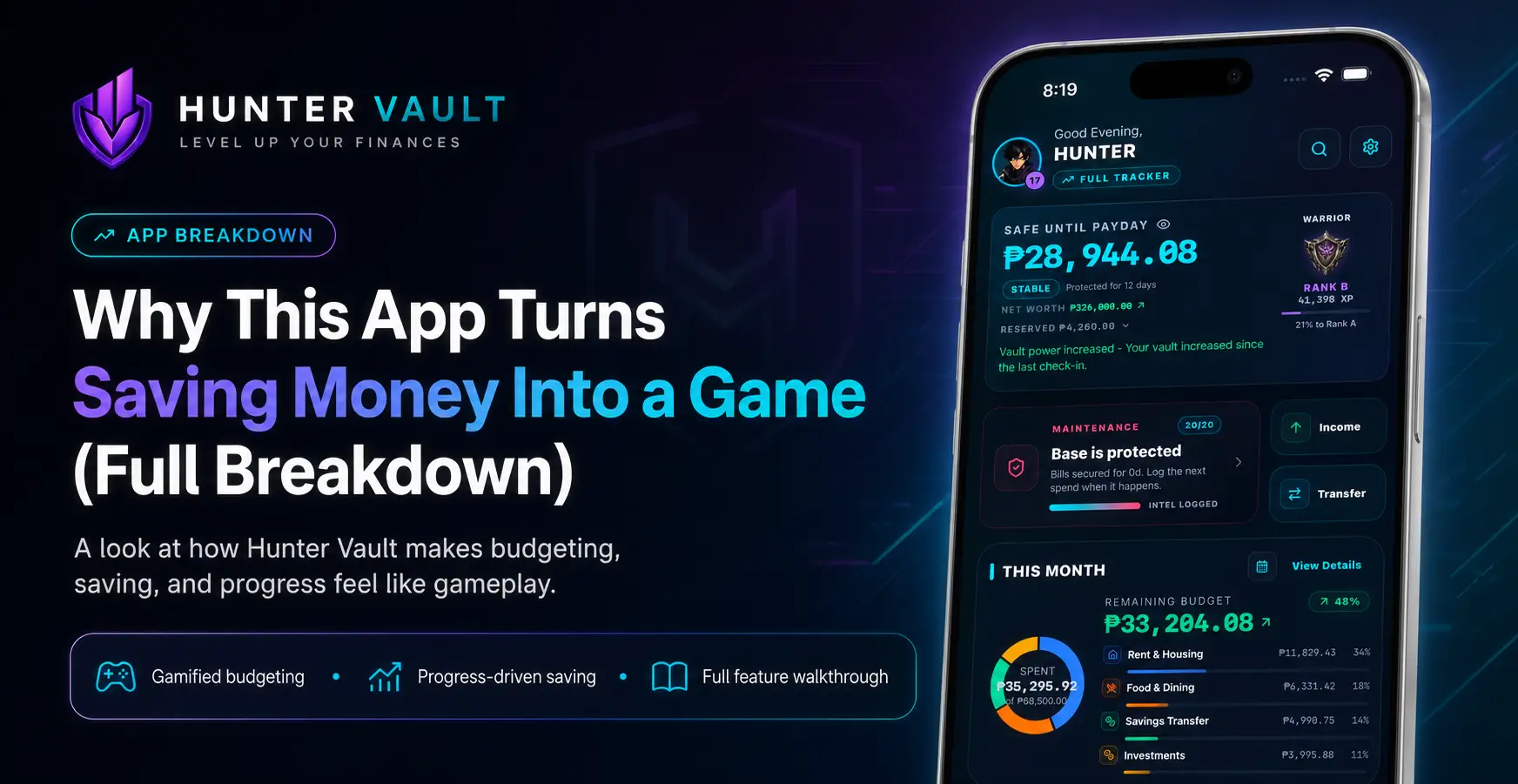
You can’t invest what’s leaking into skins and gacha — Hunter Vault makes your gaming and hobby spending visible so you can plug the leaks and build a surplus worth investing. Download free on iOS or Android. (Premium unlocks unlimited tracking for a one-time $15.99.)
A live safe-to-spend number keeps the surplus intact — it shows you what you can spend today without eating into the money you’re setting aside to invest.
This is general educational content, not financial advice, and nothing here is a recommendation to buy any specific investment or security. Investing carries risk, including loss of principal; past performance doesn’t guarantee future results. Consider a qualified professional for your situation.
Final Takeaway
An index fund is the anti-loot-box: instead of a negative-expected-value bet on one pull, you own a diversified slice of a whole market, passively and cheaply, and participate in its long-run trend — with real risk, and no guarantees. “Boring” is the feature, because boring is what you can actually hold through the rough patches.
But the fund is step three, not step one. You can only invest a surplus, and a surplus only exists once the spending leaks are plugged. Control the spending first, and the boring bet finally has something to work with. This post is part of The Gamer’s Money Library — five classic money books, translated for how you actually spend.
Sources & Further Reading
Authoritative, unbiased sources for the concepts covered here:
- Index fund — full background on how they work.
- Mutual funds & ETFs (Investor.gov) — the SEC’s plain-English explainer.
Frequently Asked Questions
What is an index fund in simple terms?
An index fund is a single investment that holds a tiny slice of a whole basket of companies — for example, a broad market index — instead of one hand-picked stock. Rather than betting on one winner, you own a little of everything in that index, so no single company can sink you. It’s automatic and passive by design: the fund just tracks the index rather than a manager trying to outguess the market.
Why are index funds often called a ‘boring’ investment?
Because nothing exciting happens on purpose. There’s no thrilling pull, no big single-stock jackpot, no daily decision to make — you own a broad slice of the market and mostly leave it alone. That ‘boring’ quality is the feature, not a flaw. Excitement in investing usually means concentrated risk, and the calm, hands-off nature of a broad index fund is exactly what makes it easy for beginners to hold through ups and downs.
How is an index fund different from a loot box?
A loot box has negative expected value by design — on average you’re meant to get back less than you put in, because that’s how the house profits. A broad market index fund is the structural opposite: historically, over long periods, broad markets have tended to grow, though future returns are never guaranteed. One is engineered so the system wins; the other lets you own a slice of the system instead of betting against it.
Do index funds guarantee a return?
No. Nothing in investing is guaranteed, and index funds can and do lose value, sometimes sharply, over short periods. Investing carries real risk, including loss of principal, and past performance never guarantees future results. What broad diversification and low fees do is remove some avoidable risks — single-company blowups and high costs — not eliminate market risk. Anyone promising a guaranteed return is describing something that doesn’t exist.
Why do fees matter so much with index funds?
Because fees are one of the few things you can control, and they compound against you every year you’re invested. A seemingly small annual fee quietly skims a slice of your money whether the market rises or falls, and over decades that drag adds up meaningfully. Broad index funds are popular partly because they tend to be low-cost and passive — you’re not paying a manager to try to beat the market and often fall short.