This post covers collection tracking and valuation methods for informational purposes. Card market values are volatile and unpredictable. Tracking collection value is not a substitute for financial planning or investment advice. Do not rely on trading card collection value as a primary financial asset.
- You can't make good hold or sell decisions without knowing your cost basis, current market value, and realized gains from past sales
- Market value means completed sales — not listed prices. Listed prices overstate realistic collection value.
- Paper gains are not real until you sell; don't spend or plan around unrealized gains
- Monthly updates are practical for active collections; use an automated tracker like TCGplayer's or a spreadsheet with manual price pulls
- Tracking lets you catch declining trends early — untracked collectors often discover value loss months after it happened
Most TCG collectors don’t know what their collection is worth. Not within 20%, not within 50%. They have a rough sense from memory of what they paid for big cards, but no reliable picture of total cost basis, current market value, or how those numbers compare.
That’s fine for a pure hobby collection where money isn’t a consideration. For anyone who thinks about their collection as having financial value — cards that might be sold, traded, or that represent real money — tracking is not optional.
If you need a one-time snapshot of what your cards are worth right now, start with how to value your card collection. This guide covers the next step: keeping three numbers current so you can see how the collection changes over time.
The Three Numbers That Matter
Every useful collection tracking setup captures three numbers:
1. Cost basis — What you paid to acquire everything in the collection. This includes purchase prices, platform fees, shipping paid as a buyer, and grading fees if applicable. Cost basis is your break-even point: it’s the floor that determines whether a sale is profitable.
2. Current market value — What your collection could realistically sell for today, based on completed sales data. Not listed prices — completed sales. This is your current position.
3. Realized gains — Profit or loss from cards you’ve already sold. This is the only number that represents actual money earned from the collection. Paper gains are theoretical until a sale happens.
These three numbers tell you: what you’ve spent, what it’s worth now, and what you’ve actually earned. Without all three, collection “value” is a guess.
Why Completed Sales, Not Listed Prices
This is a common valuation mistake. When you look up a card on a marketplace, the listings show what sellers are asking, which is not the same as what buyers are paying. TCGplayer separates the two: its Market Price is based on recent completed sales on the platform, not on current listings (TCGplayer Help). The trap is valuing your cards from the asking prices in the listings instead.
For many mid-range cards, listed prices and completed sales prices can differ a lot:
- A card listed at $85 may have sold repeatedly in the $60–$70 range
- A card listed at $20 may have near-zero recent sales (meaning listed price is aspirational, not actual)
To find real market value:
- On TCGplayer: use the Market Price, or check the latest sales and price history on the product page
- On eBay: search the card, then filter to “Sold Items” so you see what actually sold
- On PriceCharting.com: completed auction prices are the default display
Using listed prices to value your collection creates an inflated sense of what it’s worth. If you’ve told yourself your collection is worth $3,000 based on listed prices, the real number based on what you’d actually sell for might be $2,000–$2,400.
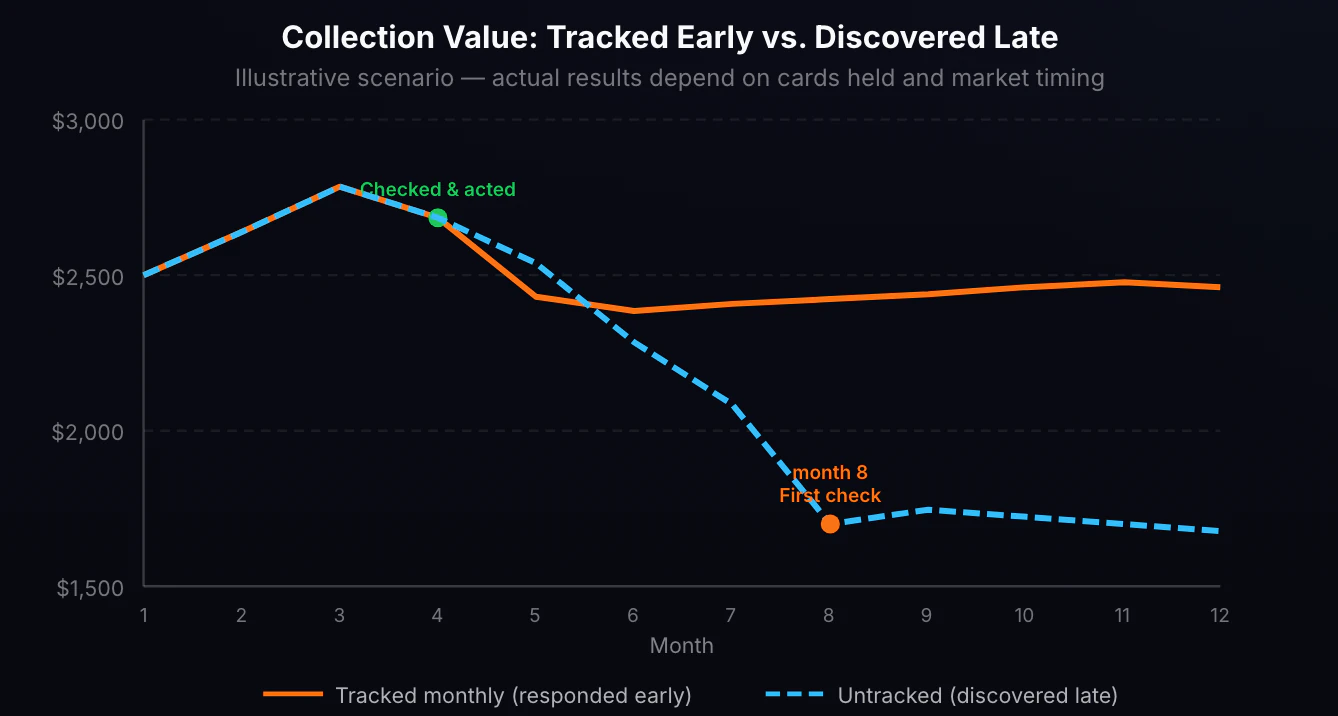
The chart shows what tracking enables. The tracked collector checks their collection at month 4, notices the decline already underway, and makes a decision. The untracked collector discovers the same decline at month 8, when significantly more value has been lost. Both collectors held the same cards — the difference is information and timing.
The Tools
TCGplayer Collection Tracker is the most practical tool for Pokémon, Magic, One Piece, and other games listed on the platform. You add cards to your collection list, and prices update automatically. It values cards using TCGplayer Market Price, which is based on recent sales rather than asking prices. Limitation: Market Price reflects what cards sold for before seller fees and shipping, and it can lag or be thin for low-volume cards, so what you’d actually net from a sale will usually be lower.
PriceCharting.com tracks completed auction prices and is particularly strong for vintage Pokémon and sports cards. Useful as a second set of completed-sale prices to cross-check against TCGplayer.
A personal spreadsheet gives you the most flexibility and is the only way to track cost basis accurately alongside market value. Columns: Card name, Set, Condition/Grade, Date acquired, Purchase price (cost basis), Platform fees paid at acquisition, Current market value (updated periodically), Realized gains (if sold). Takes more work to maintain but gives you numbers no automated tracker provides — particularly your true cost basis.
Hunter Vault covers the cash side, not card prices. Log card purchases as expenses and card sales as income, and its reports show what you’ve spent on the hobby versus what you’ve gotten back. It doesn’t track individual cards, cost basis, or market value, so pair it with a collection tracker or spreadsheet for those.
How Often to Update
Monthly is the practical cadence for an active collection. Set a calendar reminder — first or last Sunday of the month — and update prices for your top holdings. You don’t need to reprice every bulk common; focus on cards worth $20 or more where price changes actually matter.
Before any sell decision. The most critical update is the one that happens before a potential sale. Don’t rely on a price you looked up three months ago. Check the current completed sales data on the day you’re deciding.
After a set release. New sets affect prices of existing cards — new reprints reduce value, new demand for older synergy cards increases it. A post-release check covers both directions.
The Paper Gains Trap
Paper gains feel like real money. They’re not. Until a card is sold, its “value” is the price a buyer is willing to pay on that day, in that market, under those conditions. Market prices move.
Common mistakes driven by treating paper gains as real:
-
Calculating your collection “worth” and treating it like savings. Cards are illiquid. Converting them to cash takes time, fees, and a willing buyer. A collection “worth $4,000” might realistically convert to $2,800 in cash after fees, time, and selling at actual (not listed) prices.
-
Upgrading spending elsewhere based on unrealized collection value. “My collection is up $1,000 this year, I can spend a bit more on packs” — this logic is dangerous because the paper gain can reverse before you spend it.
-
Treating a paper gain as locked in. A $40 paper gain only becomes real money if you sell. Holding a card you love is a fine choice; just know the gain can shrink while you wait.
The hardest part of retroactively starting to track a collection is reconstructing cost basis — what you paid for cards acquired months or years ago. Start tracking now, from this point forward, even if you can’t reconstruct the past accurately. Every card acquired from today gets a purchase price noted. Partial data is better than none.
For context on whether the collection value you’re tracking represents a good investment outcome, Is Collecting Trading Cards a Good Investment? covers the evidence. For how to value a collection from scratch, how to value your card collection covers methodology.
Once you have current values, When to Sell Your Cards covers how to use that data for sell and hold decisions.
Hunter Vault’s reports feature summarizes the expenses and income you log. Record card purchases as expenses and sales as income, and you can see what the hobby has cost you versus what you’ve gotten back in one view, not scattered across receipts and memory. For per-card cost basis and market value, keep using a collection tracker or spreadsheet.
Frequently Asked Questions
Why should I track my trading card collection's value?
Tracking collection value gives you the information needed to make good hold and sell decisions. Without a cost basis and current market value, you're guessing when you ask 'should I sell this?' You also can't see trends — whether your collection is appreciating or declining — without data over time. Most collectors who don't track their collection systematically are surprised when they add it up: either it's worth more than expected, or they've lost more value than they realized.
What is cost basis in a trading card collection?
Cost basis is the total amount you paid to acquire the cards in your collection, including purchase prices, fees, and shipping. It's your break-even number: if you sold everything at cost basis today, you'd recover exactly what you spent. Cost basis is the starting point for calculating whether your collection has appreciated or depreciated, and how much profit or loss you'd realize on a sale.
What is the difference between paper gains and realized gains?
Paper gains (or unrealized gains) are the difference between your cost basis and current market value. They only exist on paper — they're not real money until you sell. Realized gains are from cards you've actually sold at a profit. Many collectors have significant paper gains on cards they love holding — the gain becomes real only when they choose to sell. This distinction matters because market prices fluctuate, and a paper gain today can shrink or disappear before a sale.
What is 'market value' versus 'listed price' for cards?
Market value is what buyers have actually paid for a card recently — the completed sales price. Listed price is what sellers are asking. These often differ: a card listed at $80 on TCGplayer may be selling at $55–$65 based on completed transactions. Using listed prices to value a collection overestimates its real value. Always use completed sales data, not active listings, to get a realistic current value.
How often should I update my card collection tracking?
For an active collection with regular buying and selling, monthly updates are practical. For a passive collection you're not actively trading, quarterly is sufficient. The most important time to update is before any significant sell decision — you want current data, not data from three months ago. Most TCGplayer collection trackers update prices automatically if you keep the list current.