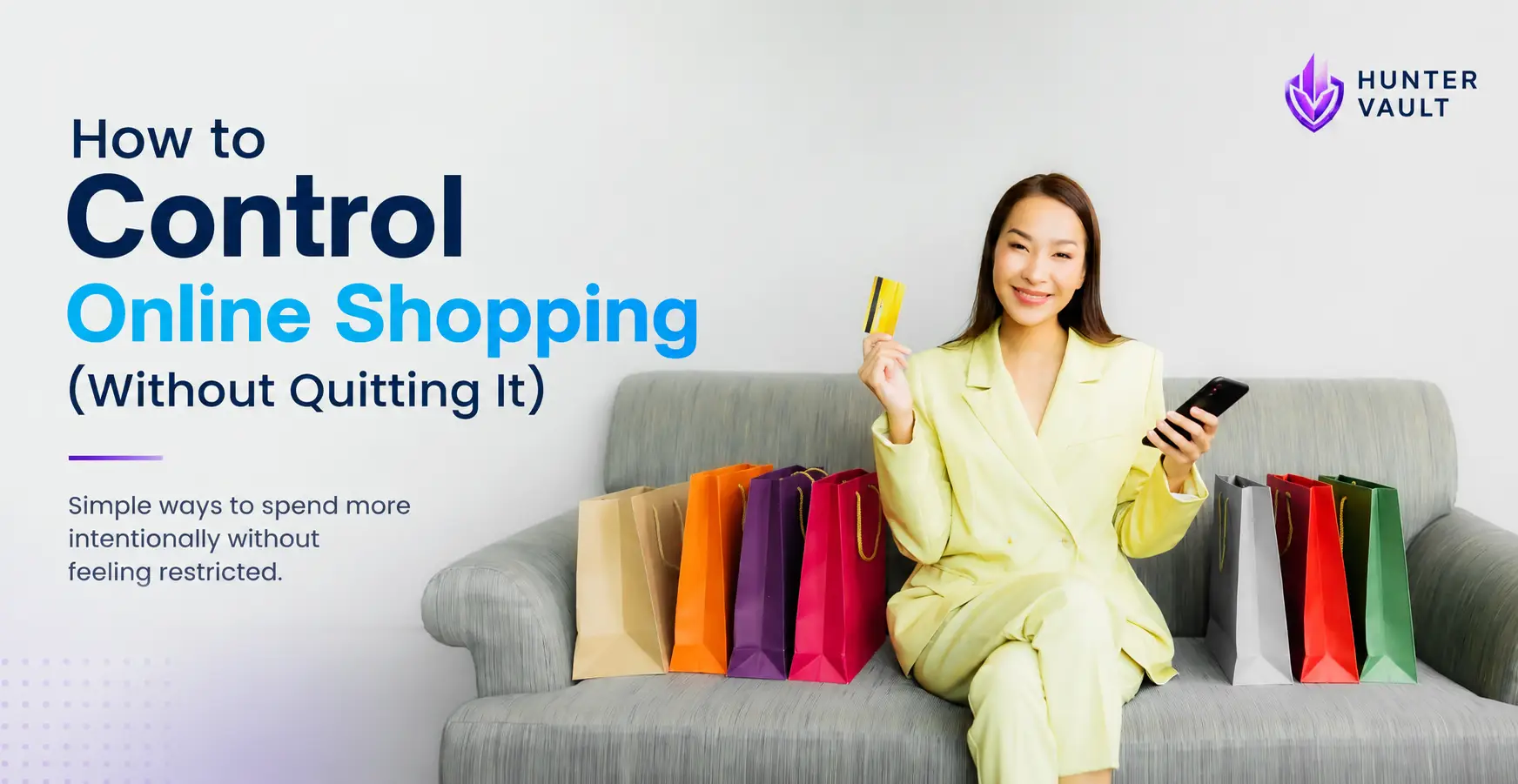
Online shopping is designed to separate you from your money with as little friction as possible. Saved cards, one-tap checkout, next-day delivery, personalized recommendations, midnight scrolling — every part of it is engineered to turn a passing want into a completed purchase before you have time to think.
So if you find yourself spending more than you mean to online, it is not a personal weakness. You are up against a system built by people whose job is to make buying effortless. The way to win is not more willpower — it is to put some of the friction back, and to give your real wants a planned place to go.
This guide is about controlling online shopping without swearing it off entirely.
Quick Answer: How Do You Control Online Shopping?
To control online shopping, slow the path to purchase: remove saved cards so checkout is not instant, use a waiting rule before buying, unsubscribe from the marketing emails that prompt you, and give yourself a planned amount for online buys so you can shop within a limit instead of relying on restraint. The aim is to stop unplanned, autopilot purchases — not to ban online shopping, which is fine when it is intentional.
Why Online Shopping Is So Hard to Control
Online shopping is uniquely difficult because it removes almost every natural barrier that used to slow spending.
In a physical shop, you have to go there, carry the item, queue, hand over payment — friction at every step, and time to reconsider. Online, all of that collapses into a single tap. The gap between “I want this” and “I bought this” can be seconds, far too short for second thoughts.
On top of that, it is everywhere and always open. You can shop from your bed at midnight, prompted by an email or an ad, with your card already saved. And the recommendations are tuned to show you exactly the things you are most likely to buy. The whole environment is built to convert impulses instantly.
This is why willpower struggles here. The system is specifically designed to act faster than your better judgment. So instead of fighting it with discipline, you change the setup.
Step 1: Remove Saved Cards and Checkout Shortcuts
The single most effective change: make paying require effort again. Take your card details out of shopping sites, apps, and your browser, and switch off one-tap and stored-checkout options.
When buying means getting up to find your wallet and typing in a card number, a surprising amount of impulse shopping simply stops. That small pause — having to actively retrieve your payment details — is often enough for the urge to pass. You are reintroducing the friction the system removed.
Step 2: Use a Waiting Rule
Give anything non-essential a waiting period before you are allowed to buy it. Put it in the cart or on a wishlist and leave it — a day for smaller things, longer for bigger ones.
The wait separates genuine wants from passing urges. Most online impulse buys are momentary; come back a day later and the urge has usually evaporated, and you are slightly puzzled you wanted it. The things you still want after waiting are the ones worth buying — and now you are buying them deliberately, not on a whim.
Step 3: Cut Off the Prompts
This is the step that is specific to online shopping, and it is the one generic advice misses. A lot of online shopping is not something you set out to do — it is triggered. A sale email, an app notification, an ad. You were not planning to shop; something prompted you, and the frictionless path did the rest.
So cut the prompts. Unsubscribe from store marketing emails. Turn off shopping app notifications. Mute or unfollow the accounts that constantly make you want to buy. Removing the triggers means far fewer moments where you are nudged toward a purchase you were not looking for. You cannot impulse-buy from an email you never received.
Step 4: Give Yourself a Planned Online Shopping Budget
Here is the part that makes this sustainable rather than miserable. The goal is not to never shop online — it is to do it on purpose, within a limit you set.
Decide on an amount for online shopping that fits your budget, and treat that as yours to spend freely. If you’re not sure how much breathing room you have, a subscription audit is worth running first — forgotten recurring charges are exactly the same autopilot problem as impulse shopping, and cutting them often frees up room immediately. When a purchase fits within your planned amount, you can buy it without guilt, because you already decided this money was for that. When the amount is used up, you are done for the period.
This reframes the whole thing. Instead of resisting every purchase through willpower (which fails), you shop happily within a boundary you chose. Planned online shopping is not the problem; unplanned, unlimited online shopping is.
A Simple Example
Jordan shops online late at night, prompted by sale emails, with his card saved for one-tap checkout. The purchases are small but constant, and they add up.
He makes four changes: removes his saved card so checkout takes effort, adds a waiting period for anything non-essential, unsubscribes from the store emails that kept prompting him, and sets a planned monthly amount for online shopping.
The late-night impulse buys drop off almost immediately — no prompting emails, no instant checkout, and a day’s wait that most urges do not survive. He still shops online for things he actually wants, within his planned amount, guilt-free. He did not quit; he just stopped doing it on autopilot.
Common Mistakes to Avoid
- Relying on willpower against a system specifically built to beat it.
- Keeping saved cards and one-tap checkout, so buying stays instant.
- Leaving marketing emails and app notifications on, so you keep getting prompted.
- Trying to quit online shopping entirely, which builds pressure until you binge.
- Shopping with no planned limit, so there is nothing to tell you when to stop.
How Hunter Vault Can Help
Controlling online shopping is easier when you can see it — both the pattern and your planned limit. Hunter Vault helps by letting you track your online spending so the habit becomes visible instead of vanishing into dozens of small orders, and you can set up a vault for your planned online shopping budget so your guilt-free amount has a clear, visible limit. Seeing how much of your budget is left makes the boundary real.
It does not connect to your bank or block purchases — it is a manual tracker, so the control comes from your setup and your awareness, not from automation. It is not a bank or a financial advisor. It is a way to turn online shopping from an invisible autopilot habit into something you can see and keep within a limit you chose.
Final Takeaway
You do not control online shopping with willpower, because it is built to outpace willpower. You control it by putting the friction back — no saved cards, a waiting rule, no prompting emails — and by giving yourself a planned amount so you can still shop, just on purpose. Stop the autopilot, keep the intentional, and the habit stops running your budget.
Start with one small action: remove your saved card from the site or app you shop on most, and unsubscribe from its marketing emails. That kills both the instant checkout and the prompt in one move. For the broader habit behind it, see how to stop impulse spending.
Frequently Asked Questions
How do I stop shopping online so much?
Make buying require effort again: remove saved cards and one-tap checkout, use a waiting rule before purchases, and unsubscribe from the marketing emails and notifications that prompt you. Then give yourself a planned amount so you can still shop intentionally within a limit.
Why can’t I stop buying things online?
Because online shopping is engineered to be frictionless — saved cards, instant checkout, constant prompts — so it acts faster than your better judgment. It is not a willpower failure; the system is built to beat willpower. Adding friction back is what actually works.
Is it bad to shop online?
Not at all, when it is intentional and within a budget you set. The problem is unplanned, autopilot online shopping with no limit. Planned online shopping you decided on is just normal spending.
Does a waiting rule really work for online shopping?
For many people, yes. Most online impulse buys are momentary, so putting an item in the cart and waiting a day lets the urge pass. What you still want after the wait is usually worth buying — and you are buying it deliberately rather than on impulse.
How do I shop online without overspending?
Set a planned amount for online shopping that fits your budget, and treat it as the limit. Buy freely within it, guilt-free, and stop when it is used up. Combined with removing saved cards and prompts, this keeps online shopping intentional instead of runaway.