- A no-spend challenge pauses all non-essential spending for a set period and redirects the money to savings or debt
- Framed as a Solo Leveling grind: each no-spend day is a cleared quest, the month is a rank-up
- Define essentials vs non-essentials in writing before you start — no in-the-moment negotiating
- The lasting win isn't just the cash saved; it's revealing how much spending was automatic, not intentional
- Make progress visible and tie the savings to a real goal — that reward loop is what carries you through
In Solo Leveling, Jinwoo doesn’t get stronger by wishing — he enters a period of intense, focused grinding and comes out transformed. A no-spend challenge is your version of that arc: a set stretch of time where you pause every non-essential expense, redirect the money to your goals, and come out with more savings and sharper habits than you went in with.
The problem with most no-spend challenges is that they feel like deprivation, so people quit. The fix is to run it like a game — with ranks, daily quests, and a growing shadow army of savings — so the discipline feels like leveling up. Here’s how to run a Solo Leveling-style no-spend challenge that you actually finish.
Hunter Vault is an independent budgeting app inspired by RPG and anime-style progression. It is not affiliated with, endorsed by, or associated with Solo Leveling or its rights holders. References to the series are commentary and inspiration only.
Quick Answer: A No-Spend Grind, Gamified
A no-spend challenge is simple: for a set period (30 days is classic), you spend only on true essentials and pause everything else, sending the saved money to a goal. To make it stick, run it like a Solo Leveling grind:
- Set your rules — essentials vs. non-essentials, in writing.
- Pick your reward — the goal your saved money feeds.
- Clear daily quests — each no-spend day is a win you track.
- Rank up — watch your savings army grow toward the finish.
Framing turns willpower into a game. Everything below is how to run it well. It pairs with the broader gaming no-spend challenge if games are your main spend.
Step 1: Set the Rules of the Dungeon
Every gate has rules; so does your challenge. Decide, in writing and before you start, exactly what counts as essential versus non-essential. Ambiguity is what kills no-spend challenges — the in-the-moment “well, this kind of counts” negotiation.
List your essentials
Rent and bills, groceries (not restaurant meals), transport to work, medicine, genuine emergencies. These continue as normal — the challenge isn’t about endangering yourself.
List your non-essentials
Everything discretionary: eating out, anime merch, gacha, impulse buys, pausable subscriptions, that “treat” purchase. These are what you’re clearing the dungeon without.
Write the line down
Put both lists somewhere you’ll see them. A rule you wrote in advance beats a decision you make while tempted, every time.
Clear rules set before the challenge are your gear check. Enter prepared, and there’s no arguing with yourself at checkout.
Step 2: Choose Your Reward (The Quest Objective)
A grind without a purpose fizzles. Before you start, decide where the saved money goes — a specific goal you actually want. An emergency fund, debt paydown, a grail figure, a con fund. The money you don’t spend should visibly feed something you care about.
This is what separates a no-spend challenge from mere deprivation: you’re not losing the ability to spend, you’re transferring it toward something better. Tie the challenge to a savings goal or a fund in your shadow army of savings, so every skipped purchase is a deposit toward a win you can see.
The reason no-spend challenges feel like deprivation is that people focus on what they’re not buying. Flip it: the money you don’t spend is loot you’re collecting. Point it at a goal and watch the total climb, and each skipped purchase becomes a reward you gave yourself rather than a pleasure you denied. Same action, opposite feeling.
Step 3: Clear the Daily Quest
A 30-day challenge is really 30 daily quests. Each day you spend only on essentials is a cleared gate — a small, concrete win. Track them.
The tracking is what makes it work. A visible streak of cleared days builds momentum you won’t want to break, exactly the way a game’s daily-login streak keeps you coming back. Mark each no-spend day, watch the run grow, and let the not-wanting-to-break-it feeling do the heavy lifting. This is the same consistency-over-willpower principle that carries every good money habit, and the full playbook for turning saving into a game loop is in gamified savings challenges.
Print the free tracker below and tick a box for every cleared day.
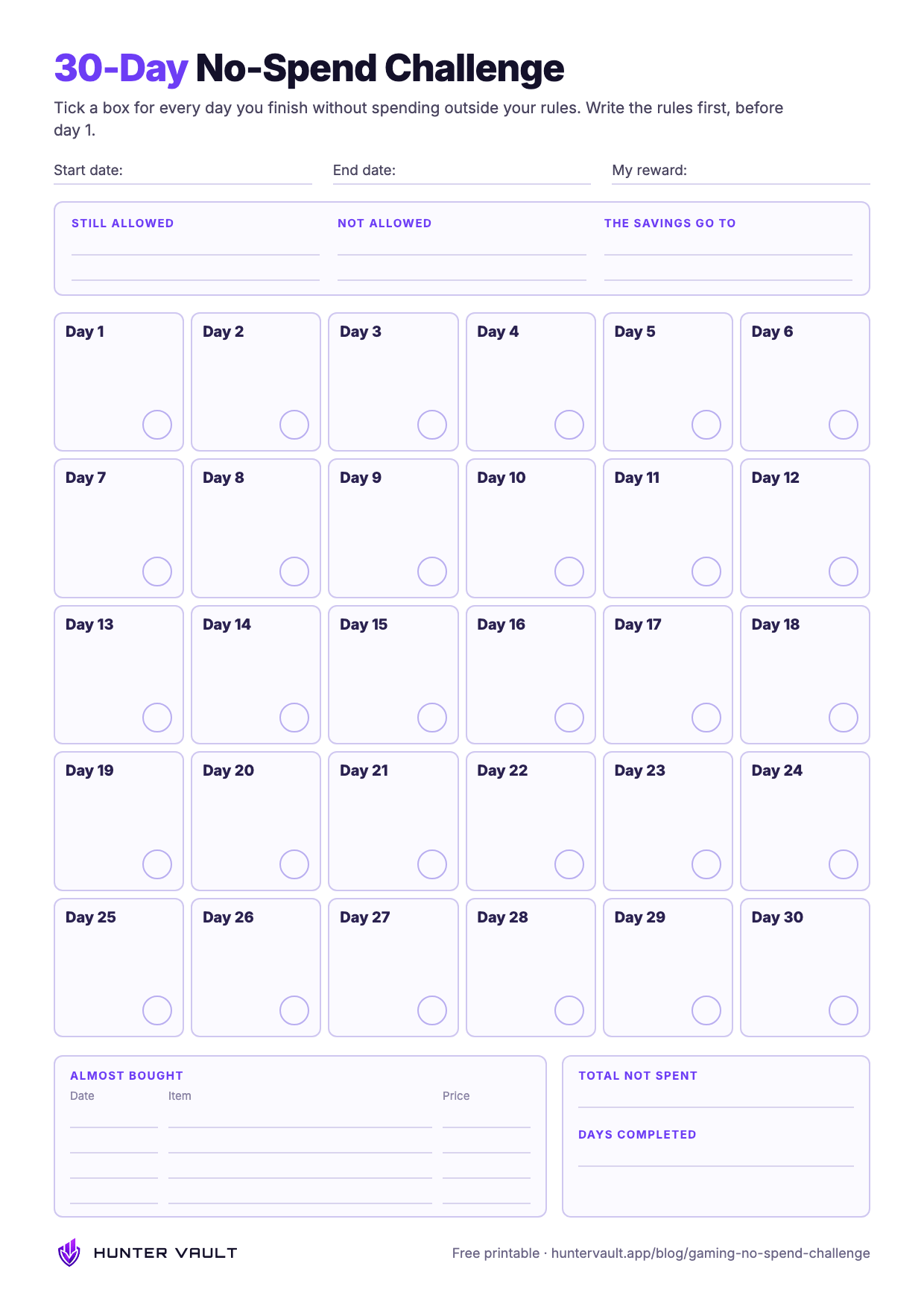
Missed a day and spent on something non-essential? Don’t rage-quit the whole challenge — that’s the real failure. Log it, and clear the next day’s quest. A single slip is a scratch; abandoning the grind is a wipe.
Step 4: Rank Up to the Finish
As the days accumulate and your savings army grows, you’re ranking up. Check your progress often — both the streak of cleared days and the total saved. Seeing both climb is the reward loop that carries you through the middle stretch where motivation usually dips.
When you clear the full period, take the win seriously: you completed the grind, you have the loot to show for it, and — often more valuable — you’ve seen how much of your old spending was automatic rather than chosen. Many people spend less even after the challenge ends, because a no-spend month resets your sense of what’s normal. That awareness is the real S-rank reward, beyond the cash. It’s the same engine behind the whole Hunter’s guide to your money.
This is general educational content, not financial advice. Adapt the challenge to your situation, and never skip genuine essentials or health needs to “win.”
Final Takeaway
A no-spend challenge is a grind arc for your money: a focused stretch of discipline that leaves you stronger — with more savings and clearer habits — than you started. Run it like Solo Leveling, with written rules, a reward objective, daily quests you clear, and a savings army you watch grow, and the discipline stops feeling like deprivation and starts feeling like leveling up.
Set your rules and pick your reward today, then start the grind tomorrow. Thirty cleared quests from now, you’ll have the loot and the awareness to show for it. Back to the Hunter’s guide to your money for the full progression.
Frequently Asked Questions
What is a no-spend challenge?
A no-spend challenge is a set period — often 30 days — where you cut all non-essential spending and only pay for true necessities like bills, groceries, and transport. Everything you’d normally spend on wants, from anime merch to takeout, is paused, and the money you don’t spend goes to savings or debt. Framing it as a Solo Leveling-style grind, with ranks and daily quests, makes the discipline feel like leveling up instead of depriving yourself.
How do I do a no-spend month?
Define your rules first: list what counts as essential (bills, food, transport) versus non-essential (eating out, merch, subscriptions you can pause). Set the money you save aside toward a specific goal, add friction to your usual spending triggers, and track each day you clear. Treat every no-spend day as a cleared quest and the whole month as a rank-up, and the challenge becomes a game you’re winning rather than a punishment.
Does a no-spend challenge actually save money?
Yes — it both saves the direct money you don’t spend and resets your spending habits. The immediate win is the cash redirected to savings or debt. The lasting win is that a no-spend month reveals how much of your spending was automatic rather than intentional, so many people spend less even after the challenge ends. It’s a reset button for awareness as much as a savings sprint.
What can I still buy during a no-spend challenge?
True essentials: rent and bills, groceries (not restaurant meals), transport to work, medicine, and genuine emergencies. The point isn’t to endanger yourself — it’s to pause discretionary wants. You decide the exact line in advance and write it down, so there’s no in-the-moment negotiating. Clear rules set before you start are what make the challenge work.
How do I stay motivated during a no-spend challenge?
Make progress visible and frame it as leveling up. Track each cleared day like a quest, watch your savings ‘shadow army’ grow, and tie the saved money to a goal you actually want. Sharing the challenge with a friend or doing it alongside a gamified tracker adds accountability and a reward loop, which is what carries you through the days willpower alone would fail.