Budgeting Is Broken (And You Already Know It)
Let’s be honest: most budgeting apps feel like a chore.
You download one with good intentions, track expenses for a few days, then slowly stop opening it. Not because you don’t care about your money, but because the experience feels like work.
No momentum. No progress you can feel. No reason to come back. (We broke down exactly why this happens in why most budgeting apps don’t work.)
It isn’t just you. By one set of industry benchmarks, the median finance app keeps only about 7% of its users 30 days after install, down from roughly 28% on day one (UXCam retention benchmarks, 2025; directional aggregate).
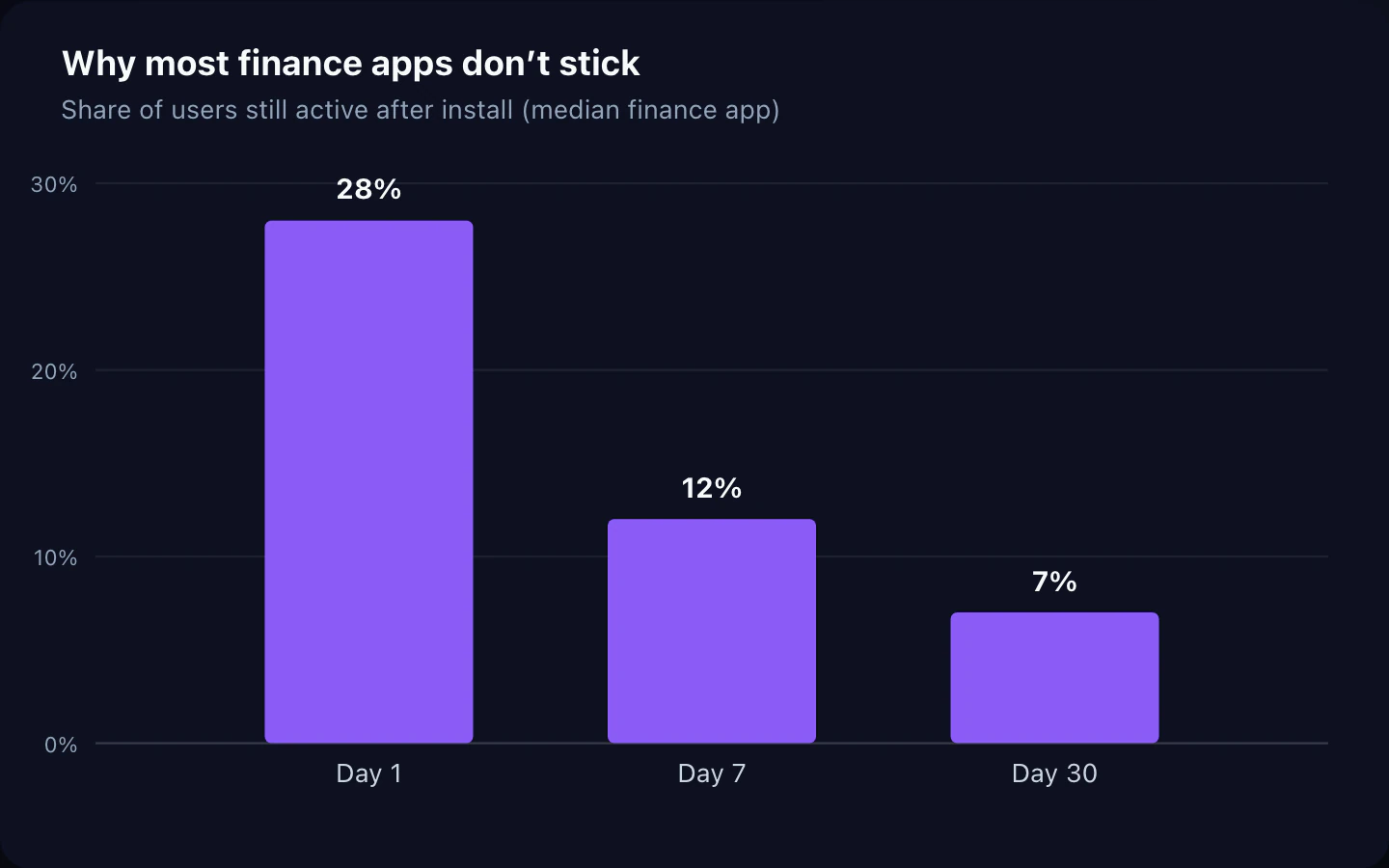
That’s the gap a gamified finance tracker is built to close.
- A gamified finance app turns budgeting, saving, and debt payoff into quests, XP, streaks, and ranks so the habit actually sticks
- It works because visible progress and small, immediate rewards make a behavior easier to repeat, a pattern backed by behavior-design research
- Hunter Vault builds the progression into the core loop, and its budgeting works fully offline with no bank connection required
- Best fit: anyone who keeps abandoning traditional budgeting apps and whose real struggle is staying consistent, not knowing what to do
Quick Answer: What Is a Gamified Finance App?
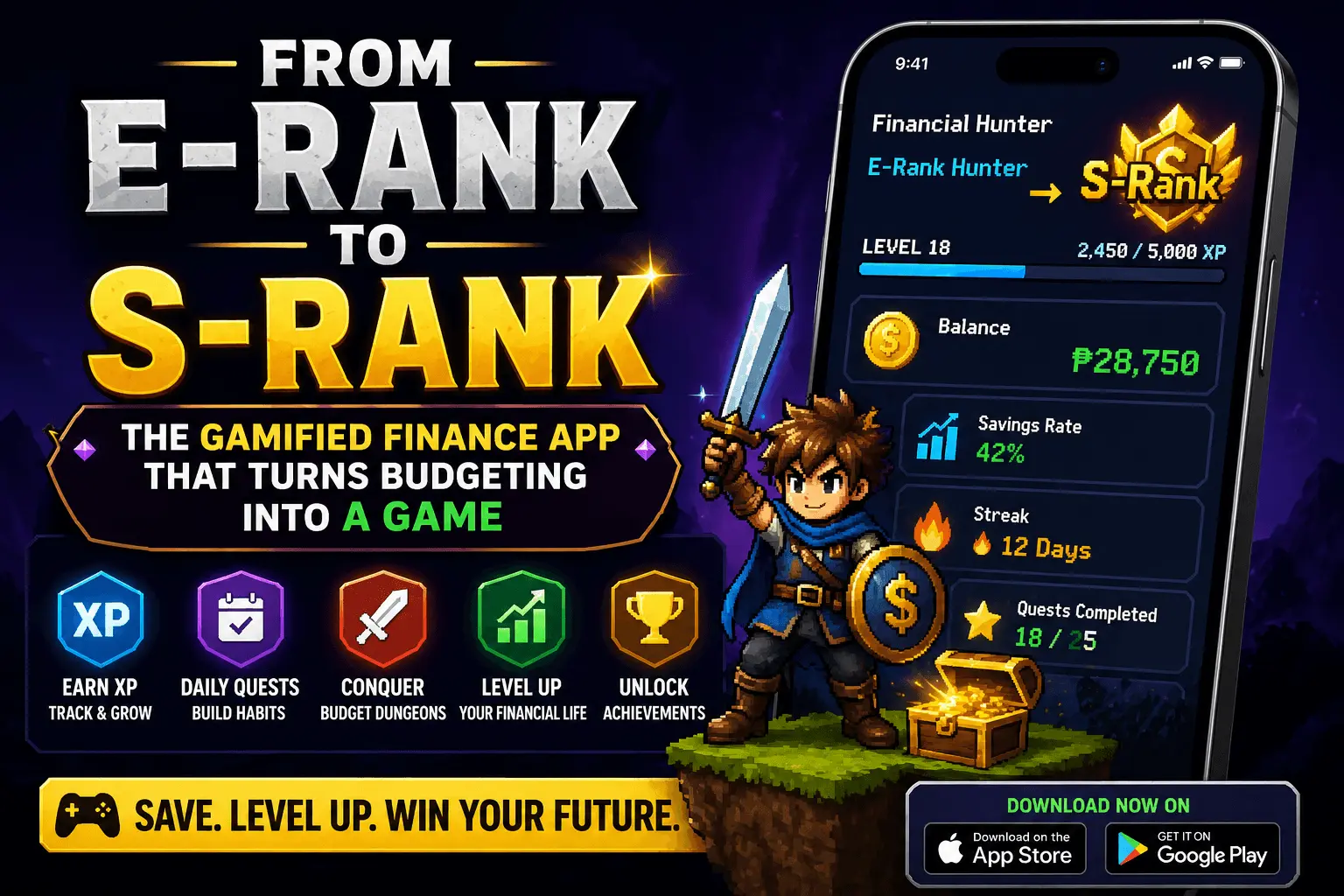
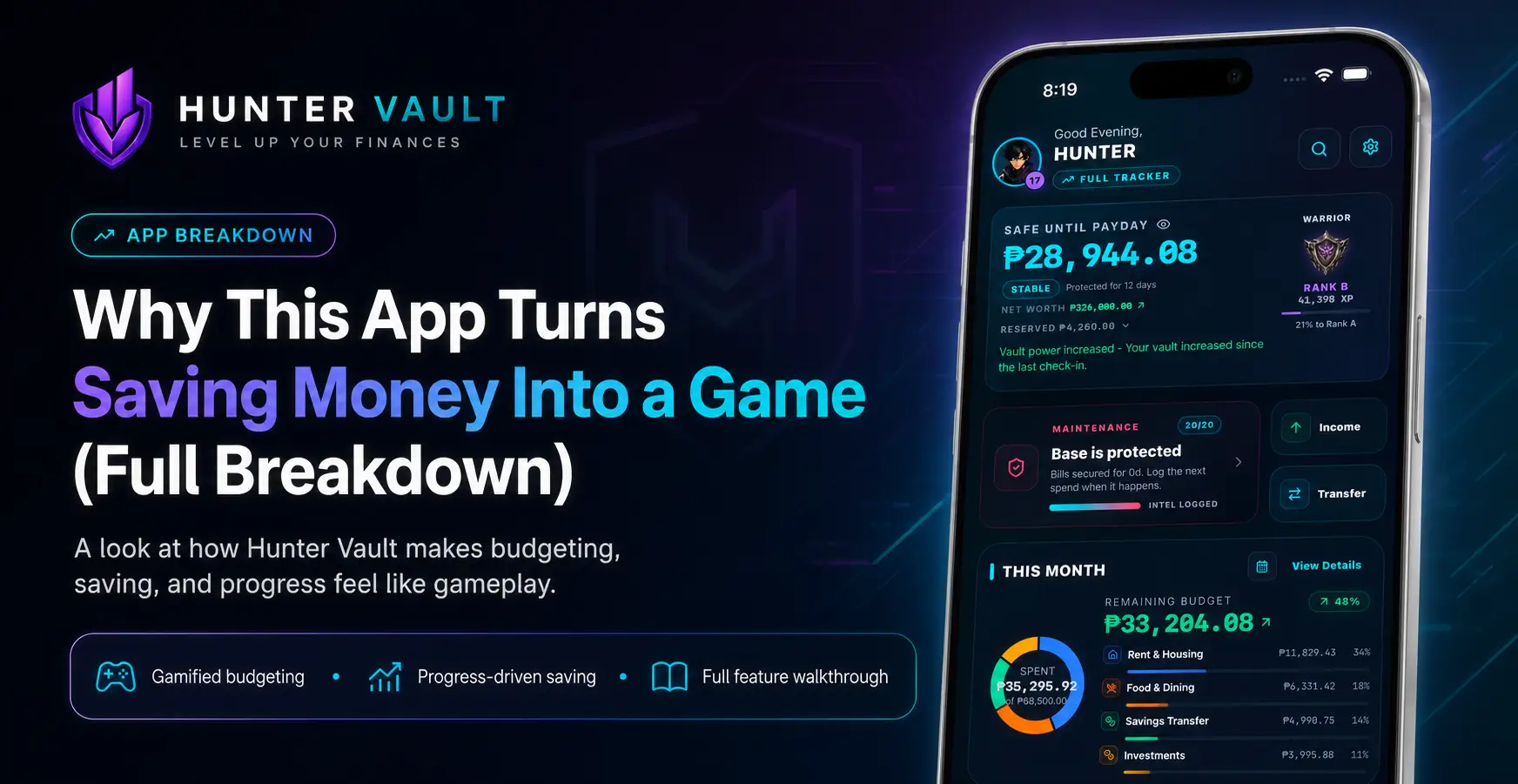
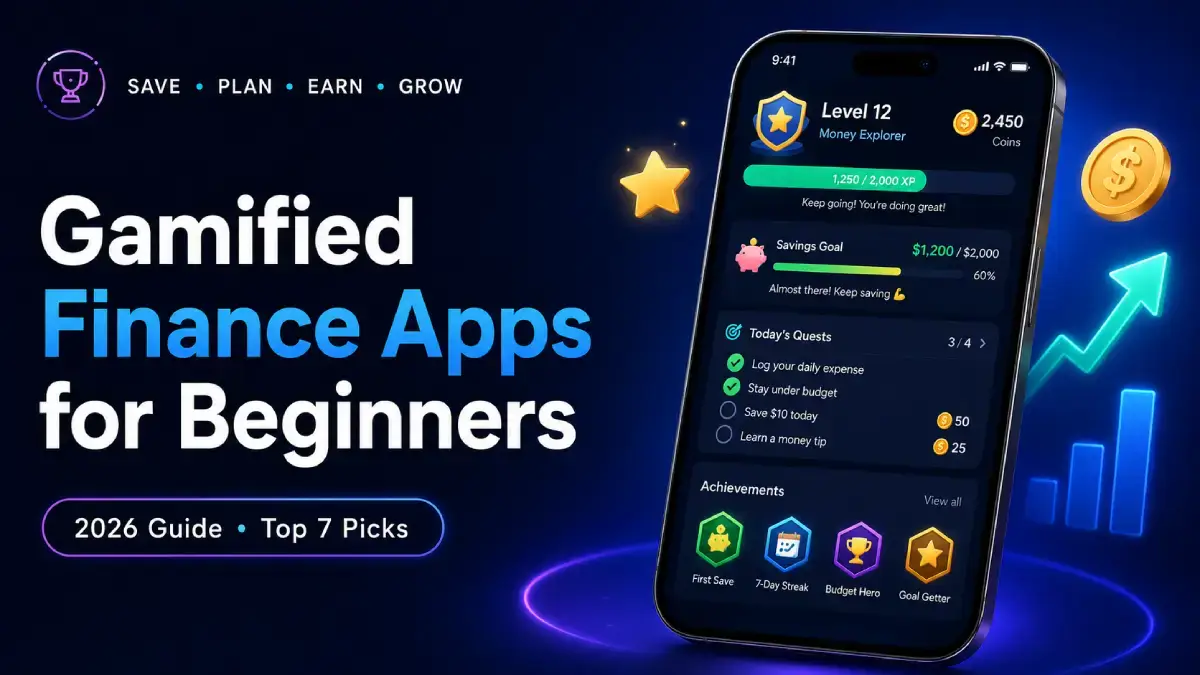
A gamified personal finance app uses game mechanics (XP, levels, streaks, and quests) to make everyday money habits more engaging, so the habit actually sticks. Hunter Vault is a gamified personal finance tracker that turns budgeting, expense tracking, saving, and debt payoff into RPG-style progress using quests, XP, ranks, streaks, vaults, and goals. The point isn’t to make money “fun” for the sake of it. It’s to give you a reason to show up tomorrow.
What If Managing Money Felt Like an RPG?
Picture the same boring habits, reframed:
- Every expense you log moves a quest forward, and quests pay XP
- Paying off debt is the boss fight
- Your overall progress raises your Rank, from E to S
Instead of a spreadsheet that judges you at the end of the month, you get small, visible wins for doing the right thing today. The detailed version is below.
How a Gamified Finance App Works
At its core it works like a game, but the progress is real.
Earn XP for Real Money Actions
Logging expenses and income moves your quests forward, and quests, savings deposits and debt payments pay out experience. Consistency becomes the thing you’re rewarded for, not perfection.
Complete Daily Quests
Small, repeatable tasks like:
- “No-spend day”
- “Log all of today’s transactions”
- “Add to your savings goal this week”
Finish them to keep your streak alive and build momentum.
Clear Your Budget Categories
Think of each category (food, transport, entertainment) like a stage to clear. Each one shows what’s left this month and flags when you’re near the limit, so if it slips you see exactly where, instead of finding out at the end of the month.
Level Up Your Rank
Start near the bottom and climb through ranks like E up to S. Your rank reflects the habit you’ve actually built over time: a streak of small actions, not a single good month.
Earn Titles and Milestones
Hitting milestones turns into identity markers, the kind of thing that quietly reinforces “I’m someone who’s getting better at this.”
Watch Your Stats Grow
Your profile keeps the numbers that matter in one place, things like your savings progress, consistency streaks, and where your spending actually goes. Over time, you’re not just recording money; you have something to show for the effort.
What a Week Actually Looks Like
To make it concrete:
- Monday: you grab lunch and log it in ten seconds. That clears today’s tracking quest: small XP, streak continues.
- Wednesday: you log a no-spend day. Streak is now three days.
- Friday: an impulse buy nudges your “fun” category near its limit, and you can see it before payday, not after.
- Sunday: a five-minute review shows where the week went. The logging streak and quests behind it are what slowly move your rank.
None of these take real effort on their own. The point is that the small actions add up into something visible, which is the part a plain tracker never gives you.
Why Gamified Finance Actually Works
This isn’t only about making things fun. It leans on a few well-studied patterns in how people build and keep habits:
- Progress you can see keeps people going far longer than a number on a statement.
- Small rewards make it easier to come back the next day.
- Identity matters. Once you start seeing yourself as “good with money,” the behavior tends to follow.
- Fast feedback beats the delayed, abstract feedback of a traditional budget.
There’s research behind this. A widely cited review of empirical gamification studies by Hamari, Koivisto, and Sarsa found that gamification generally does produce positive effects on motivation and behavior, though how well it works depends heavily on the context and the person using it (Hamari, Koivisto & Sarsa, 2014, HICSS). In other words, points bolted onto a boring app won’t save it, but game mechanics tied to real actions can genuinely move behavior.
It also lines up with how behavior change works in practice. BJ Fogg’s Behavior Model, developed at Stanford, describes a behavior as motivation, ability, and a prompt arriving at the same moment. Make the action easy and cue it at the right time, and you stop depending on motivation being high (Fogg Behavior Model). A ten-second expense log that clears a quest on the spot is exactly that kind of easy, prompted action.
The timing of the reward matters too. Research on long-term goals found that immediate rewards, like actually enjoying the activity in the moment, predict sticking with a goal better than the delayed payoff does (Woolley & Fishbach, 2017). Clearing a quest the second you log is that immediate reward. A lower number on next month’s statement is the delayed one, and on its own it rarely gets people to come back.
The underlying idea is the one Hunter Vault is built on: budgeting should feel like progress, not punishment. Most apps are good at flagging what went wrong. Far fewer are designed to make the next right action feel rewarding.
What Makes Hunter Vault Different
Most finance apps land in one of two camps: too boring (a spreadsheet with a nicer interface) or too shallow (a points gimmick with no depth). This one is built around the part most apps ignore: staying consistent.
Here’s the practical difference between the two approaches:
| Dimension | Traditional budgeting app | Gamified finance app |
|---|---|---|
| Core motivation | Willpower and guilt | Visible progress and small rewards |
| Feedback timing | Monthly summary, after the fact | Instant, the moment you log |
| What gets rewarded | Perfection (an unbroken budget) | Consistency (showing up daily) |
| Progress you can feel | A number on a statement | XP, streaks, ranks, and goal bars |
| Common failure mode | Quiet abandonment after a few weeks | Streaks and quests pull you back |
Where most gamified apps stop at cosmetic points, the goal here is to tie every mechanic to a real financial action.
A Real Progression System
It’s not a sticker chart bolted onto a tracker. Quests, ranks, streaks, and goals connect to each other, so logging an expense today ladders up to something you can see over weeks and months. See the full gamified finance system.
Private by Design
No bank connection required. Your data stays on your device by default (only optional cloud sync, Huntee and Smart Import send data off-device), a good fit if you’d rather not hand a third-party app your bank login. (Always review what any app stores and asks for.)
Built for Consistency, Not Just Tracking
Plenty of apps can record a transaction. The harder problem is getting you to come back tomorrow, and that’s the problem this one is actually designed to solve.
To be straight with you: it’s still a tracker, and you still log your spending. The difference is that the logging earns you something. If spreadsheets already work for you, you may not need this.
Who This Is Built For
Here’s the honest version: this is built for the people who keep quitting. If you’ve downloaded budgeting apps before and abandoned them within a couple of weeks, you’re exactly who it’s for. It fits:
- People tired of boring budgeting apps
- Gamers who already understand progression systems
- Beginners who want a simple but engaging way to start
- Anyone whose real weak spot is staying consistent
If discipline has always felt like the hard part, a system that rewards small actions can make showing up easier. (New to the idea entirely? Start with what gamified budgeting actually means, or if apps in general have burned you, how to start budgeting when you hate budgeting.)
Engagement Over Willpower
The old way of managing money leans on willpower, and willpower runs out. A better approach is to design the habit so the right behavior is easy to repeat, even on a low-motivation day. That’s the Fogg model in action: lower the effort, add a prompt, and the behavior stops depending on how motivated you feel.
Gamified finance turns:
- Saving into a visible goal you’re feeding
- Budgeting into a series of small wins
- Discipline into progress you can watch add up
No system makes good money habits automatic. But the right one makes the small actions easy enough to repeat that they add up on their own.
This is general educational content, not financial advice. Choose an approach that fits your own income, responsibilities, and situation. If you’re dealing with serious debt or hardship, consider speaking with a qualified financial professional.
Keep Leveling: Related Reads
If the rank-up mindset clicks for you, go deeper with the Hunter’s guide to personal finance for the full E→S progression, budget like a hunter to treat each month like a dungeon run, and what leveling-up anime teaches about money for the mindset behind the grind. Comparing your options? See the best gamified personal finance apps for beginners and our roundup of RPG budgeting apps.
Start at E-Rank
You don’t need another budgeting app that collects dust. You need one that gives you a reason to come back.
Your rank starts at E. The first quest is simple: log one expense today and watch the XP land. Download free on the App Store or Google Play.
Frequently Asked Questions
What is a gamified personal finance app?
A gamified finance app uses game mechanics (XP, levels, streaks, and quests) to make budgeting and saving more engaging, so you’re more likely to keep doing it day to day.
Do gamified budgeting apps actually work?
They can help, mainly with consistency. By rewarding small actions and making progress visible, they give you a reason to return, which is exactly where most traditional apps lose people after a couple of weeks. A widely cited review of gamification studies (Hamari, Koivisto & Sarsa, 2014) found positive effects overall, though results depend on the context and the user.
Is it safe to use an offline finance tracker?
An offline tracker can be more private, since it doesn’t need a bank connection and keeps your data on your device. As with any app, it’s worth checking what it stores and what permissions it requests.
How does gamification help with saving money?
It turns saving into a series of small wins (quests, streaks, and a goal bar you can watch fill), so a habit that usually relies on willpower gets some built-in motivation instead.
Who should use a gamified finance tracker?
Anyone who keeps abandoning traditional budgeting apps, especially gamers, beginners, and people whose real struggle is staying consistent rather than knowing what to do.