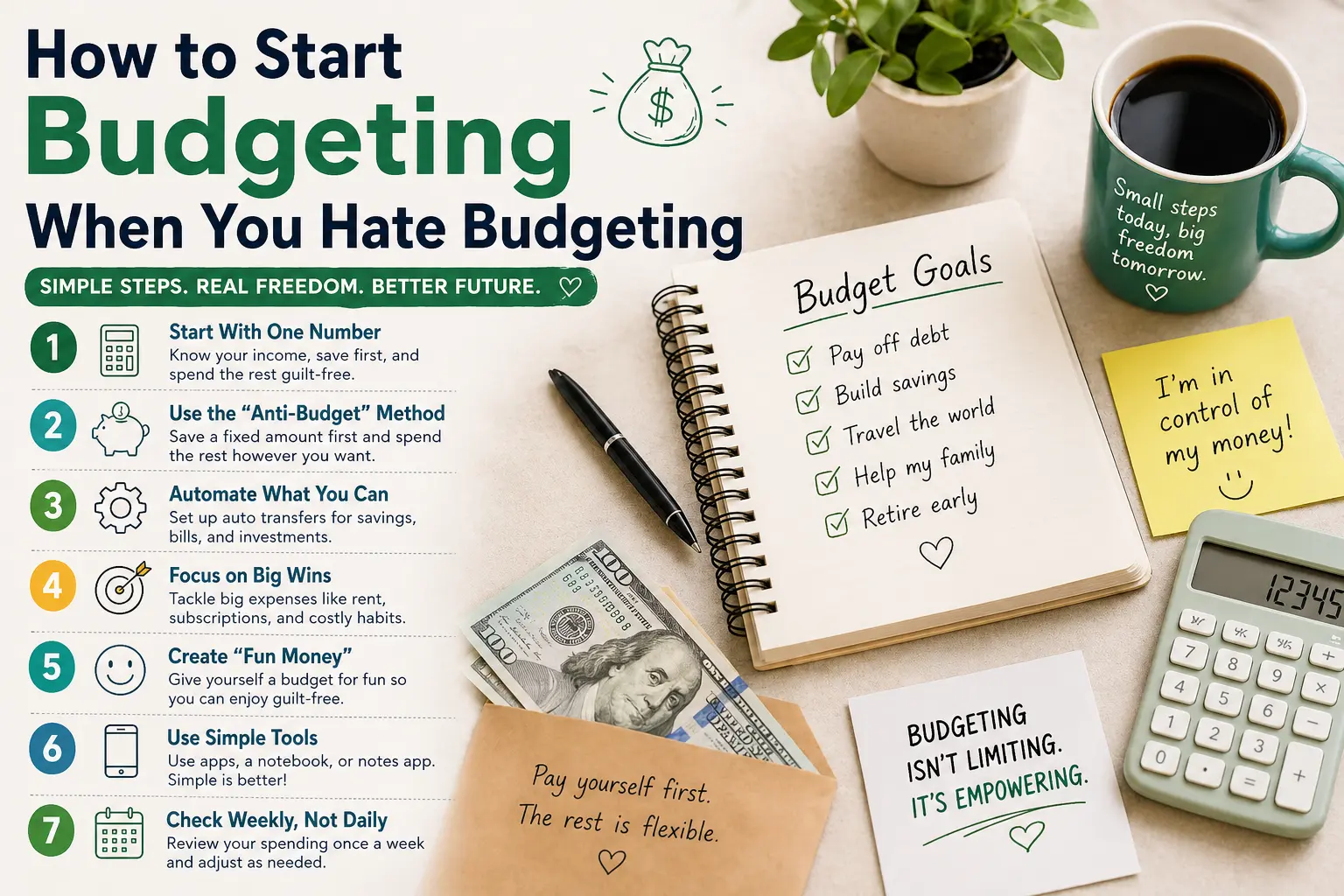
Let’s be honest — budgeting has a bad reputation. It feels restrictive, boring, and a little like being told off. Most people try it once, track expenses for a few days, then quietly give up. If that’s you, you are not lazy and you are not bad with money.
You probably just used a system that did not fit your life. Most people don’t fail at budgeting because they lack discipline. They fail because the method asked for more effort than anyone can keep up with. The good news: starting a budget when you hate budgeting doesn’t require strict rules or spreadsheets. It requires a system simple enough that you’ll still be using it after a bad week.
Quick Answer: How Do You Start Budgeting When You Hate It?
The easiest way to start budgeting when you hate budgeting is to strip it down to almost nothing: save a small fixed amount first, skip the detailed categories, and watch only your two or three biggest spending areas. You don’t need a perfect budget. You need one simple enough to keep after a bad week.
Why You Hate Budgeting (It’s the System, Not You)
Most “classic” budgeting advice was built for a different era of spending, and it breaks down for three predictable reasons.
It Feels Like a Diet
Restrictive systems lean almost entirely on willpower, and willpower runs out. Like a crash diet, an overly strict budget works for a few weeks until one stressful day unravels the whole thing.
Too Much Tracking Creates Friction
The more effort a routine takes, the faster people drop it. Logging your third coffee of the week into a spreadsheet feels pointless — because for most people, it is. Every extra bit of effort is one more reason to skip it tomorrow.
All-or-Nothing Thinking
One overspend — a birthday dinner, an impulse buy — often makes people abandon the budget entirely. There’s a well-known name for this: the “what-the-hell effect.” Once you break a rule, your brain decides the whole system is ruined, so you might as well keep going. A good budget is built to survive this. A bad one isn’t.
A budget you’ll keep using after a messy month beats a perfect budget that needs a perfect month to work. Sustainable systems are designed to tolerate imperfection, not punish it.
Shift Your Mindset: A Budget Is a Map, Not a Cage
The single most useful thing you can do before starting any system is reframe what a budget actually is.
Instead of: “I can’t spend money.” Try: “I’m deciding where my money goes.”
A budget isn’t restriction — it’s visibility. And visibility almost always comes before control. When you can actually see your money, a few things change:
- Less financial anxiety, because nothing surprises you anymore
- Better decisions, because you’re choosing instead of reacting
- Real progress, because small consistent actions start to stack up
You’re not trying to become perfect with money overnight. You’re trying to notice the pattern. That’s the whole first quest.
Before the 7 Ways: Start With One Number
For most beginners, the best starting point isn’t a full system — it’s a single number: your monthly spending limit.
- Calculate your total monthly income (after tax)
- Set aside savings first — start with just 5–10%, even a small fixed amount counts
- Whatever’s left is what you can spend without guilt
No categories. No sub-tracking. Just one number that tells you whether you’re on track. Once that feels natural after a few weeks, adding detail becomes easy instead of overwhelming. (Want a smarter version of this number? See our guide on setting a safe-to-spend amount.)
A Quick Example (Real Numbers)
Say your take-home pay is 2,000 a month (use your own currency — the math works the same anywhere).
- Savings first: move 10% — that’s 200 — into a separate account on payday.
- Fixed bills: rent, utilities, phone, and subscriptions come to 1,200.
- Your spending number: 2,000 − 200 − 1,200 = 600 for the rest of the month.
That 600 is the only number you have to watch. Roughly 150 a week. You don’t track what you bought, only whether you’re still inside the line. The first time you see your money laid out this plainly, the panic usually drops — because nothing is hidden anymore. If you want the full version of this approach, start with our beginner’s guide to budgeting.
Way 1: Use the “Anti-Budget” Method
The anti-budget is one of the best frameworks for people who’ve failed at traditional budgeting. The idea: do the one thing that matters most, then stop worrying about the rest.
- On payday, immediately move your savings amount to a separate account
- Pay your fixed bills (rent, utilities, subscriptions)
- Spend the remainder however you want — no tracking required
You’re not ignoring your spending — you’re trusting that if savings come first, the rest sorts itself out. It eliminates decision fatigue for everything except the one decision that matters.
Way 2: Automate Your Finances
Automation removes the biggest obstacle to saving: forgetting, or choosing not to. When money moves on its own, budgeting becomes something that happens to you instead of something you have to remember to do.
- Savings transfer — scheduled the same day your paycheck lands
- Bill payments — scheduled 1–2 days after payday to avoid overdrafts
- Investment or extra-savings contributions — even small recurring amounts add up
Automation is one of the simplest high-impact money habits there is: fewer missed payments, savings that grow without willpower, and less emotional spending — you can’t spend what you never see.
Way 3: Focus on High-Impact Expenses
A common mistake is obsessing over tiny purchases — the daily coffee — while ignoring the categories that actually move the needle.
- Housing — usually 30–50% of spending. Even a small change here is transformative.
- Transportation — payments, fuel, ride-shares. Does your current setup still make sense?
- Subscriptions — most people pay for 3–5 services they barely use. Cancel two today.
Fixing these three categories usually has a bigger long-term impact than cutting every small treat combined. Small purchases still matter — but start where the real money is. The hard part is usually seeing which categories are quietly draining you; a spending-mix view that breaks your month into needs, wants, and bills makes that obvious at a glance.
Way 4: Create a “Fun Money” Category
This is the step most beginners skip, and it’s exactly why they quit. A sustainable budget must include money you’re allowed to spend on things you enjoy — guilt-free, no tracking required.
Remove all fun and you’ve built a system nobody maintains. Keep a clear fun-money boundary and you’re far more likely to stick with it.
Pick a realistic weekly amount for anything you want — food trips, online shopping, games, hobbies. Once it’s gone, it’s gone for the week. But while you have it, spend it without second-guessing.
The amount matters less than the boundary. Knowing you have guilt-free money is what stops the “I’ve already ruined it” spiral.
If your fun spending tends to be hobbies, gaming, or collectibles, you can plan for it on purpose instead of feeling bad about it later — here’s how to budget for hobbies without guilt.
Way 5: Use Simple Tools That Fit Your Lifestyle
The best budgeting tool is the one you’ll actually open. If a tool takes more effort than the habit it’s supposed to support, you’ll quit it — so you don’t need premium software or elaborate spreadsheets.
- A notes app with a running total
- A simple mobile budgeting app with minimal setup
- A basic spreadsheet with 3–4 columns
- Pen and a notebook — still works perfectly
But here’s the honest catch: if spreadsheets and plain trackers have never worked for you, the problem usually isn’t the tool — it’s that nothing about it feels rewarding. Logging an expense gives you no signal that you did something good. So you stop.
Hunter Vault is a gamified personal finance tracker that turns budgeting, expense tracking, saving, and debt payoff into RPG-style progress using quests, XP, ranks, streaks, vaults, and goals. Instead of staring at numbers, logging an expense completes a quest and earns XP toward your next rank — small actions that finally feel like progress. If spreadsheets never stuck for you, that reward loop is worth a look. See how Hunter Vault works →
If you’ve bounced off spreadsheets before, our guide on tracking expenses without a spreadsheet walks through a few alternatives.
Way 6: Review Weekly, Not Daily
Daily tracking is the fastest route to burnout. It turns every purchase into a stressful event and makes budgeting feel like a second job.
- Pick a consistent day — Sunday morning works well for most people
- Compare the week’s total spending against your limit
- Note one pattern, good or bad
- Adjust next week if needed — five minutes, done
Lower-frequency routines are far easier to keep than daily ones. Weekly awareness catches problems early without the constant friction. Treat the review as a recurring weekly quest: show up for five minutes, keep the streak alive, and let the small wins stack. A streak you can actually maintain beats a perfect daily system you abandon by Thursday.
Way 7: Build Consistency Before Complexity
The most common reason people quit their second or third attempt is optimizing too early. They build an elaborate system before the basic habit exists, and the moment life interrupts, the whole thing collapses. Think of it like ranking up: you don’t fight the boss at level one. You unlock the next stage only after the last one feels automatic.
- Weeks 1–4 (starter rank): Anti-budget only. One number. No categories.
- Month 2–3 (next rank): Add 2–3 categories for your highest-impact areas. Keep weekly reviews.
- Month 4+ (advanced rank): Add bigger goals — debt payoff timelines, savings targets, contributions.
Consistency beats accuracy in the early stages. A messy budget you maintain beats a perfect one you quit. Start imperfectly. Refine later. You’re leveling up a habit, not passing an exam.
Common Budgeting Mistakes to Avoid
Even with the right methods, a few patterns reliably derail beginners:
- Overcomplicating from day one — more categories and rules than you can sustain
- Cutting all fun spending — a budget with no enjoyment is a budget you’ll quit
- Treating one slip as failure — overspending is data, not a reason to stop
- Comparing your budget to someone else’s — the one that works is the one that fits your life
Small purchases feel harmless until they team up like a final boss. The fix isn’t guilt — it’s visibility. Progress matters more than perfection.
This is general educational content, not financial advice. Choose a budgeting method that fits your own income, responsibilities, and situation. If you’re dealing with serious debt or financial hardship, consider speaking with a qualified financial professional.
Frequently Asked Questions
What is the easiest budgeting method for beginners?
The anti-budget method — save a fixed amount first, then spend the rest freely — is the lowest-friction starting point. It skips detailed tracking while still building the habit that matters most: saving consistently.
How much should I save each month?
Begin wherever you can. Five to ten percent of your take-home pay is a common target, but if that feels out of reach, save whatever amount you genuinely won’t miss. Consistency does the heavy lifting here — a small sum saved every month for years quietly adds up, and the habit becomes the base for bigger saving later.
How do I budget when my income changes every month?
Build your baseline around your lowest expected monthly income. When you earn more — a good freelance month, a bonus — treat the extra as a windfall and split it between savings and any debt, rather than expanding your regular spending.
Is budgeting time-consuming?
Not with a simplified system. A five-minute weekly review is genuinely enough for most people at the start. Daily tracking is rarely necessary and usually leads to burnout faster than it builds awareness.
Do budgeting apps actually help if I hate budgeting?
They can — if they lower friction instead of adding it. The best app for someone who hates budgeting is one that makes logging quick and even a little satisfying, so the habit forms before you talk yourself out of it.
How long before budgeting feels natural?
Most people feel comfortable with a simple routine within three to four weeks of consistent practice. Keep the system low-friction — the habit has to form before you can optimize it.
Final Takeaway: A Smarter, More Realistic Way to Budget
If you’ve struggled with budgeting before, it’s not a personal failure — it’s almost always a system problem. The version you were taught was probably too strict, too detailed, and too dependent on willpower.
- Start with one number, not twenty categories
- Automate everything you can
- Watch your biggest expenses, not your smallest
- Give yourself guilt-free fun money every week
- Review weekly, not daily
- Build consistency first, then optimize
You don’t need to fix everything today. Start with one small action — set up a single auto-transfer, or just write down your spending limit. That’s enough for day one. Do it again next week, and the week after, and money slowly stops being a source of dread and starts being something you’re actually getting better at.
Hunter Vault turns these exact habits — logging expenses, completing weekly reviews, hitting savings goals — into quests that earn XP and raise your Hunter rank. If spreadsheets never stuck, a system that feels like an RPG might be the thing that finally does. Your first quest is simple: log one expense today. Download Hunter Vault free →
For more beginner-friendly personal finance reading, NerdWallet maintains a large library of free guides.