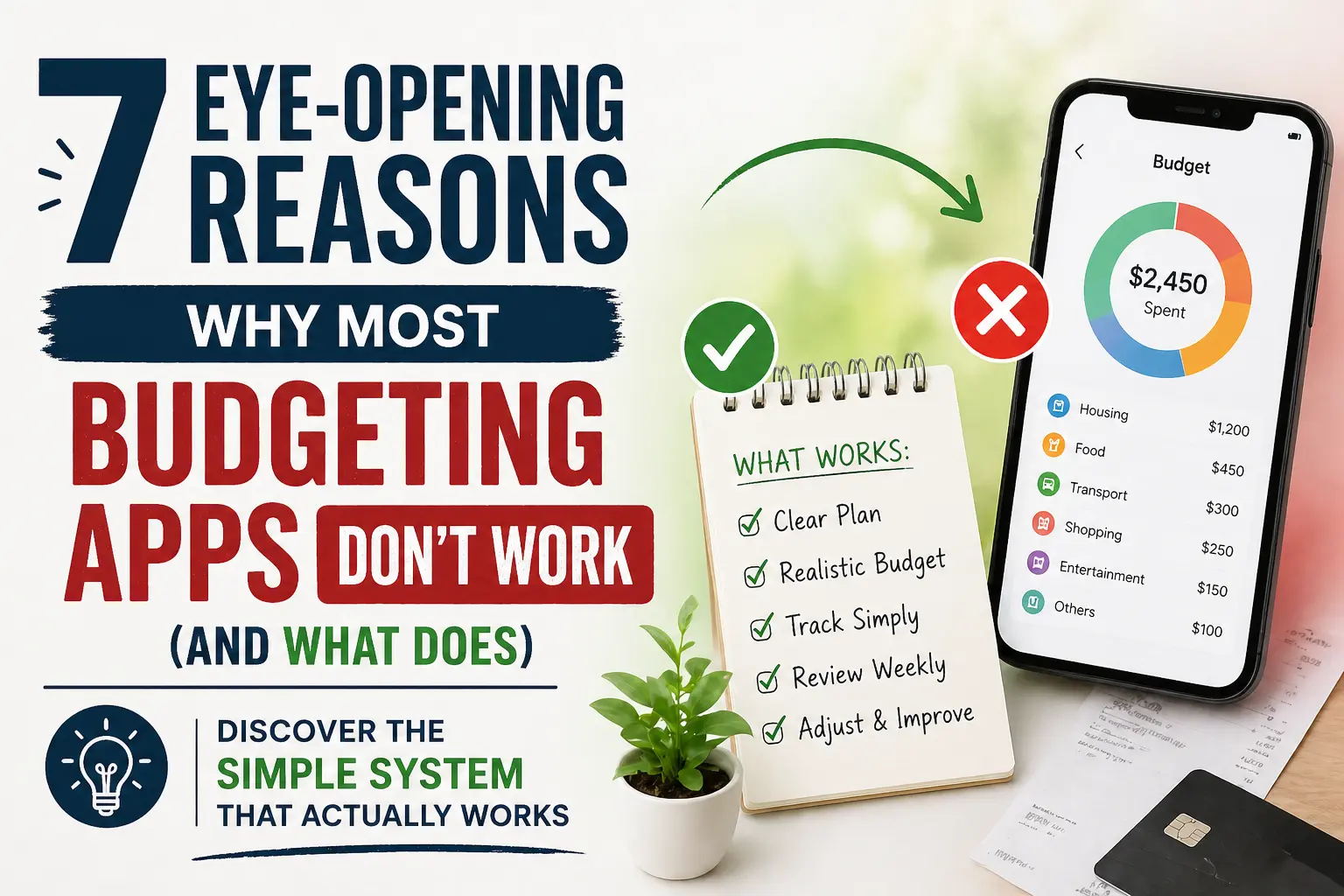
Budgeting apps promise to make managing money easy. Download, connect your bank account, set some category limits, and suddenly you’re in control — at least, that’s the idea.
Here’s the reality: most people try a budgeting app, use it for a few days or weeks, then quietly stop. The app collects dust in a folder. The bank account stays confusing. Nothing actually changed. It’s not unique to budgeting, either — analysis of mobile app usage found the average app loses around 90% of its daily active users within 30 days of install.
If that’s happened to you, you’re not alone — and it’s not a discipline problem. The issue usually isn’t that budgeting apps are bad. It’s that most of them don’t match how people actually manage money in real life.
Quick Answer: Why Don’t Budgeting Apps Work?
Most budgeting apps don’t work because they demand daily effort right when your motivation naturally dips, assume you’ll behave perfectly, and track the past instead of changing what you do next. They’re good dashboards but poor systems. What actually works is the opposite: automate your savings and bills, keep one simple spending number, review weekly instead of daily, and treat any app as a support tool — not your whole plan.
The Honest Truth About Budgeting Apps
Before diagnosing the problems, it helps to see the pattern. Most people don’t quit because they’re careless about money. They quit because the app demands consistent effort at exactly the moment when the early excitement has worn off.
If you’ve ever abandoned a budgeting app, you probably hit the wall around the two-week mark — once the novelty fades but before the habit has become automatic. Most apps offer nothing to get you through that gap: no reward for showing up, no grace when you miss a day, no way to recover from a bad week without feeling like you failed.
Motivation fades — but the app’s demands stay constant. That mismatch is the core design flaw in most budgeting apps, and it’s why short-term users far outnumber long-term ones.
7 Reasons Most Budgeting Apps Don’t Work
Even apps that auto-import transactions need daily upkeep — reviewing imports, fixing wrong categories, splitting transactions. The more steps a routine demands, the faster the habit erodes.
Small tasks repeated daily are much harder to maintain than one larger weekly task. Most apps run on a daily-engagement model that suits social media, not money management.
Most apps are designed as though you never forget, always check in, and never overspend. Real life includes busy weeks, impulse buys, irregular income, and surprise bills. A system that assumes ideal conditions breaks under real ones.
Pie charts and category breakdowns look useful, but information without a next step creates anxiety instead of clarity. Most people open the dashboard, feel vaguely stressed by the numbers, and close it again without changing anything.
A good money tool should reduce the number of decisions you have to make — not hand you more things to analyze.
Knowing you overspent on dining last month doesn’t automatically change how you spend this month. Tracking is passive — it builds awareness, not action. Without nudges, automation, or systems that move money before you can spend it, tracking alone rarely improves anything.
Apps are purely logical systems in a world where spending is largely emotional. People spend when they’re stressed, bored, celebrating, or socializing. Flagging a purchase as “over budget” doesn’t address why it happened — and without the trigger, the pattern repeats.
Strict category limits don’t bend when an unexpected expense hits. A medical bill doesn’t care that you’ve already used your “miscellaneous” budget. When the system breaks and there’s no graceful way to recover, most people abandon it rather than adjust.
Traditional apps track failure well — overspending triggers red bars and warnings. But they rarely celebrate wins. Saved more this month? Hit your goal three weeks running? Most apps show you the same neutral dashboard either way.
It’s a lot easier to keep doing something that rewards you than something that only scolds you. Penalty-only systems quit on you the moment the habit gets hard. This is the whole reason the idea that budgeting should feel like progress, not punishment exists — an app that only flags failures is built on the wrong half of that sentence.
Most budgeting apps are excellent at telling you what happened with your money. Almost none are designed to change what happens next — and that’s the gap that causes failure.
What Actually Works (7 Proven Alternatives)
The fixes below have one thing in common: they reduce the effort and decisions needed to stay on track. For a fuller walkthrough, see our guide on how to start budgeting when you hate budgeting.
1. Simplicity Over Features
The best system isn’t the most advanced one — it’s the one you’ll still be using under real-life conditions. One spending number, basic weekly check-ins, and minimal categories beat a comprehensive tracker you abandon in two weeks.
2. Automation Over Manual Tracking
Instead of tracking every transaction, automate the behaviors that matter most. Scheduled savings transfers on payday, automatic bill payments, and recurring contributions keep your finances moving even during busy or unmotivated stretches.
3. The “Pay Yourself First” Method
Save a fixed amount the moment you’re paid, then spend the rest freely. You don’t track anything beyond confirming the transfer happened — the most important action is handled before any spending decision arrives.
Here’s what it looks like with numbers (use your own currency — the math holds anywhere): you’re paid 3,000. On payday you move 300 (10%) straight into savings. Fixed bills come to 1,800. That leaves 900 as your spend-it-however number for the month — roughly 225 a week, no transaction-by-transaction tracking required. The saving already happened; everything after that is just staying inside the line. (More on building this in our guide to how to start saving money.)
Pay yourself first removes the need for willpower. The money is gone before temptation arrives. Consistent savers aren’t necessarily more disciplined — they’ve just removed the decision entirely.
4. Weekly Check-Ins Instead of Daily Tracking
A single five-minute weekly review — checking total spending against your limit and noting one pattern — keeps you aware without the daily friction. A once-a-week routine is far easier to keep than a daily one.
5. Build a Flexible Spending System
Flexible systems include a buffer, expect the occasional overspend, and adjust monthly rather than demanding daily perfection. A practical way to do this is to give money a “job” before you spend it — separate containers for bills, savings, and a no-guilt fun pot (in Hunter Vault these are called vaults). When the surprise expense hits, it comes out of a buffer you planned for, not out of your entire month.
6. Focus on High-Impact Categories
Optimizing small purchases rarely moves the needle. Housing, transportation, unused subscriptions, and debt payments carry outsized weight. The hard part is seeing which categories quietly take the most, which is exactly what tracking your expenses is for — a spending-mix view that splits your month into needs, wants, and bills makes the heavy hitters obvious in seconds, so you fix the three or four that matter instead of agonizing over coffee.
7. Use Apps as Support Tools, Not the System
Budgeting apps aren’t useless — they’re just misused as the entire strategy. Use one to spot trends, monitor balances, and set reminders. Let automation handle the actual saving. The app is the dashboard, not the engine.
If you’re trying to pick one — especially as a beginner — the label matters less than whether it survives a real, messy month. A budgeting app worth keeping should:
- Keep effort low — a quick action, not a daily chore
- Reward consistency, not just flag failures
- Forgive a bad week instead of making you feel like you blew it
- Support automation rather than fighting it
Hunter Vault is a gamified personal finance tracker that turns budgeting, expense tracking, saving, and debt payoff into RPG-style progress using quests, XP, ranks, streaks, vaults, and goals. It’s built around the gap most apps miss: motivation. Instead of a red over-budget bar, logging an expense completes a quest, earns XP, and keeps your streak alive — so the small daily action feels like progress, not a chore.
To be clear, Hunter Vault doesn’t make the work disappear — you still log your spending. If you already happily maintain a spreadsheet, you may not need it. It’s built for the people who keep quitting. Download Hunter Vault free →
Curious what “gamified budgeting” actually means before you commit? Here’s a plain explanation of how it works.
Budgeting Apps vs. Real-Life Systems
Here’s how traditional apps, a simple self-managed system, and a gamified approach compare on the things that actually decide whether you’ll stick with them:
| Factor | Typical Budgeting Apps | Simple Self-System | Hunter Vault |
|---|---|---|---|
| Complexity | ● High | ● Low | ● Low |
| Effort Required | ● Daily review | ● Weekly | ● ~2 min/day logging |
| Flexibility | ● Limited | ● High | ● High |
| Sticking Power | ● Low–Medium | ● High* | ● High |
| Primary Focus | Tracking past spending | Behavior & habits | Gamified habit-building |
| Built-In Motivation | ● None | ● Self-driven | ● XP, streaks, ranks |
| Handles a Bad Week | ● Poorly | ● Up to you | ● Streaks restart, no shame |
| Best For | Data lovers who want detail | Minimalists who self-motivate | People who keep quitting and need momentum |
*A simple self-managed system sticks well — but only if you’re the kind of person who keeps showing up without external reminders. If that’s been your weak spot, a motivation layer matters more than another spreadsheet column.
The honest takeaway: there’s no universal winner. A simple automated system is genuinely hard to beat if you’re self-motivated. A gamified app like Hunter Vault earns its place specifically when your problem is staying consistent, not knowing what to do. For a concrete head-to-head against the best-known subscription budgeting app, see Hunter Vault vs YNAB — and if you’re weighing options more broadly, our roundup of the best budgeting apps for beginners.
This is general educational content, not financial advice. Choose a method that fits your own income, responsibilities, and situation. If you’re dealing with serious debt or financial hardship, consider speaking with a qualified financial professional.
Frequently Asked Questions
Are budgeting apps completely useless?
No — they’re genuinely useful when used correctly. The problem is treating one as a complete system rather than a support layer. An app that surfaces your spending trends is valuable; an app expected to replace your entire strategy is asking too much of itself.
Why do I keep stopping using budgeting apps?
Because they require daily engagement at the exact point when motivation naturally dips. The app doesn’t adapt to your reduced effort — it just stops reflecting your spending accurately, which feels like failure even when it’s a normal low-motivation stretch.
What works better than a budgeting app?
Simple automated systems. Set a fixed savings transfer on payday, automate your bills, and do one brief weekly review. This takes less daily effort than any app while producing better long-term outcomes, because the key behaviors happen on their own.
Should I still use a budgeting app?
Yes — but as a support tool, not your primary strategy. Use it to review trends, monitor balances, and set payment reminders. Let automation handle the saving and bill payment.
What is the easiest budgeting method for beginners?
Pay yourself first: save a fixed percentage the moment you’re paid, cover fixed bills, then spend the rest without detailed tracking. It’s the lowest-friction option and the most likely to create a lasting habit, because it removes daily decisions.
How do I stay consistent without an app?
Three habits: automate your savings transfer, review spending once a week instead of daily, and build in a flexible buffer so one overspend doesn’t break the whole system.
Conclusion: It’s Not the App — It’s the System
If budgeting apps have repeatedly failed you, it’s almost certainly a design problem, not a discipline problem. These apps were built to track financial behavior. They weren’t built to change it.
The shift that actually produces results is moving from passive tracking to automated action — from logging what happened to building systems that make the right behaviors happen regardless of your motivation on a given day.
- Automate savings and bills — remove the decision entirely
- Simplify ruthlessly — fewer categories, weekly reviews, one core number
- Build flexibility in from the start — expect imperfect months, not perfect ones
- Focus on behavior change, not data collection
- Use apps as tools within a system — not as the system itself
Pick a system that’s forgiving and mostly automatic, then give it a few months. That matters far more than which app you download — and if “staying consistent” is the part that keeps tripping you up, solve that first. Everything else is easier once the habit survives a bad week.
Hunter Vault turns the boring-but-important habits — logging an expense, a weekly review, a savings contribution — into quests that earn XP and raise your rank. Your first quest is simple: log one expense today. Download Hunter Vault free →
For more beginner-friendly personal finance reading, NerdWallet maintains a large library of free guides.