- If you can't save, it's usually visibility — not discipline — that's broken
- Saving fails when you can't see where money goes and can't feel progress
- Fix it with a small, repeatable system: track, save first, automate, see progress
- Start smaller than feels meaningful — the habit matters more than the amount
- An app like Hunter Vault makes spending visible and turns saving into progress bars and streaks
You promise yourself this is the month you finally save something. Then payday comes, the money spreads out across bills and small purchases, and by the end of the month there is nothing left to move into savings. Again.
If that loop feels familiar, you are not bad with money and you are not the only one. Most of the time you can’t save money because you can’t see where it goes and you never feel like saving is working, so willpower runs out before the habit forms. The fix is not trying harder. It is making your money visible and making saving small, automatic, and rewarding.
Amounts below are in USD as examples — use whatever currency you actually budget in.
Quick Answer: Why Can’t You Save Money?
You usually can’t save money for one or more of these reasons: you don’t have clear visibility into where your money goes, you try to save whatever is “left over” instead of saving first, saving gives you no reward while spending does, your income is genuinely stretched thin, or you are relying on discipline instead of a system. The good news is that most of these are fixable with a small, repeatable setup rather than a personality change.
Why Saving Feels So Hard
Before fixing it, it helps to know what is actually working against you. It is rarely just one thing.
You Can’t See Where Your Money Goes
You can feel like you barely spent anything, then check your balance and wonder what happened. That gap is a visibility problem. Small purchases, subscriptions, and “just this once” buys are easy to forget individually, but they add up fast. You can’t change a pattern you can’t see.
You Save Whatever Is Left (And There’s Never Anything Left)
If your plan is to spend first and save the leftovers, saving almost always loses. There is always something to spend on, so “later” never arrives. Money tends to find a use unless you give it one on purpose.
Saving Has No Reward, But Spending Does
When you spend, you get something right away. When you save, you get nothing you can feel for months. Your brain keeps choosing the instant reward, and that is not a character flaw. It is just how rewards work. Saving needs a feedback loop to compete.
The Math Might Genuinely Be Tight
Sometimes the problem is not your habits at all. If your income barely covers your bills, no amount of motivation creates money that isn’t there. If that is your situation, the goal shifts: start with tiny amounts and focus on visibility, and be kind to yourself about the pace.
You’re Running on Willpower, Not a System
Willpower is great for a few days and unreliable after that. Without a system that keeps going when motivation dips, you end up restarting from zero every few weeks and feeling worse each time.
The Real Problem Is Usually Visibility
Here is the pattern under almost all of these: you can’t see your money clearly, and you can’t feel your progress.
When spending is invisible, leaks go unnoticed. When saving is invisible, it feels pointless. Fix the seeing, and the doing gets much easier. That is why the system below starts with visibility before it asks you to change anything.
How to Actually Start Saving
You do not need a perfect budget. You need a few small changes you can repeat.
Do not change anything yet. Just write down what you spend for seven days, every coffee and every subscription. This is the single most useful step, because it turns vague guilt into a clear picture. You will almost always spot one or two leaks you did not expect.
Move a small amount to savings the day you get paid, before it has a chance to disappear. Start with an amount so small it feels almost silly, even a dollar or two. The habit matters more than the size right now, and you can grow it later.
Set up an automatic transfer or a fixed daily habit so saving doesn’t depend on remembering or feeling motivated. The less you have to decide, the more likely it sticks.
Once your bills and a small savings amount are set aside, whatever is left is your safe-to-spend money. Spending from that number instead of your whole balance protects the money that already has a job, so saving stops competing with everyday life.
Give your savings something to climb toward, like a small goal with a progress bar. Watching a number move is what keeps you going when the amounts are still small. Seeing progress is the reward that spending normally has and saving normally doesn’t.
A Simple Example
Say money disappears every month and you have never managed to save.
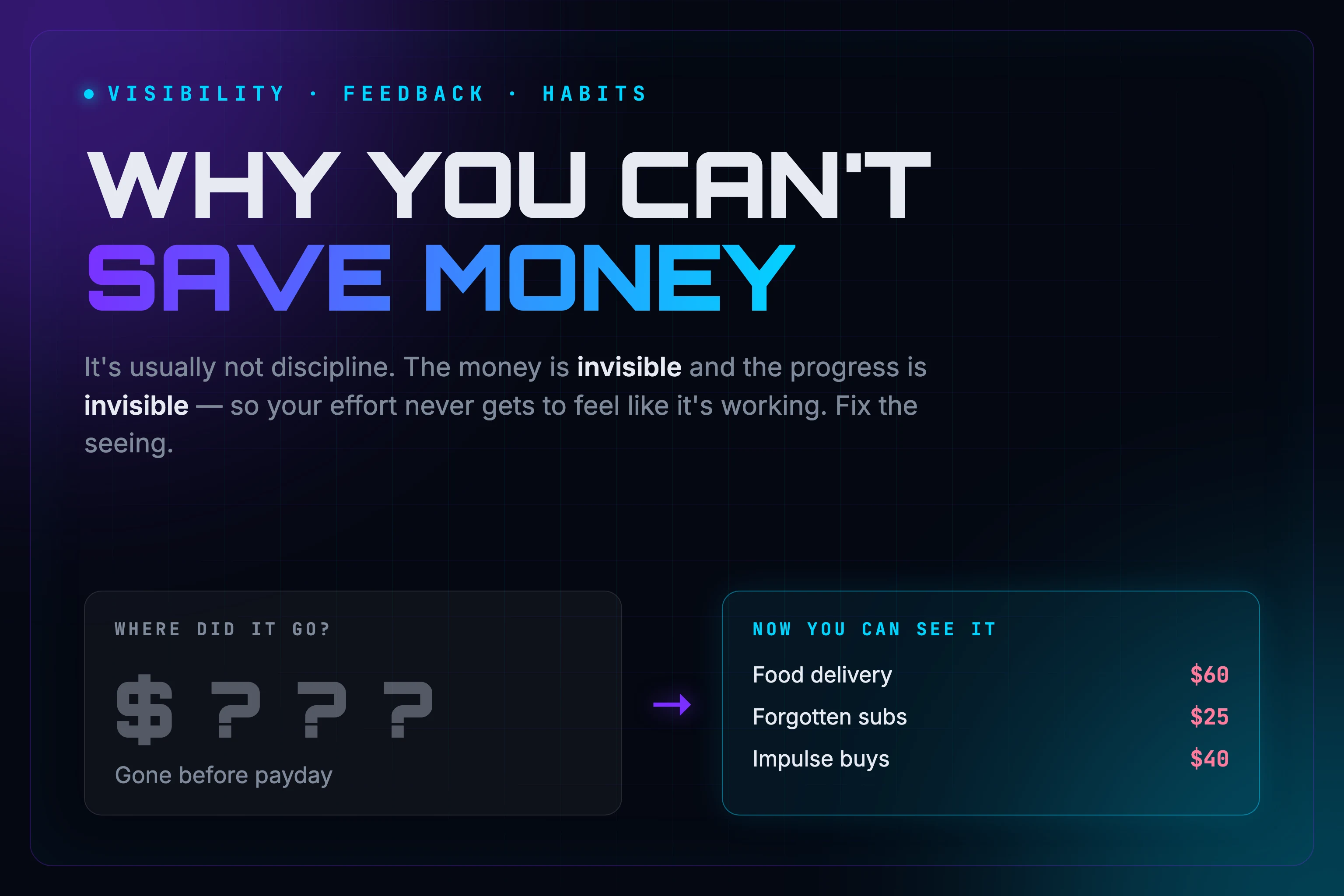
- Week 1: track everything, no changes. You notice $60 went to food delivery and $25 to forgotten subscriptions.
- Cancel one subscription and set an automatic $10 transfer on payday.
- Set a small goal: a $100 starter buffer, with a progress bar you check weekly.
- Each week the bar moves a little. The small win keeps you going, and you slowly raise the amount.
Nothing dramatic happened. You just made your money visible and gave saving a reward you can see. (For a fuller version of this loop, see how to save money using a game system.)
Where Hunter Vault Fits
You can do all of this with a notebook, a bank app, and a spreadsheet. The hard part is usually staying consistent once the novelty wears off, and that is the gap a gamified tracker is built for.
Hunter Vault is a gamified personal finance tracker that turns budgeting, expense tracking, saving, and debt payoff into RPG-style progress using quests, XP, ranks, streaks, vaults, and goals. For saving specifically, it helps with the two things that usually break: it makes spending visible so you can spot leaks, and it turns saving into goals with progress bars and streaks so every small contribution feels like progress instead of a sacrifice. Logging a saving action becomes a quick quest rather than another chore.
It will not make you rich and it will not save the money for you. What it can do is make the habit easier to see, repeat, and stick with, which is exactly where most saving attempts fall apart.
This is general educational content, not professional financial advice. Choose a saving method that fits your income, responsibilities, and situation. If you are dealing with serious debt or financial hardship, consider speaking with a qualified financial professional.
Final Takeaway
If you can’t save money, it is probably not because you lack discipline. It is because the money is invisible and the progress is invisible, so your effort never gets to feel like it is working. Make both visible, start smaller than feels meaningful, and let the habit grow from there.
Your first step is the easiest one. Track your spending for one day, or move one small amount into savings today. That is Level 1. Consistency beats perfection, and small money actions count more than you think. For the full step-by-step on building that first saving habit, see how to start saving money.
If you’d rather not track all of this by hand, try Hunter Vault and let the app keep score for you. It’s available on iOS and Android.