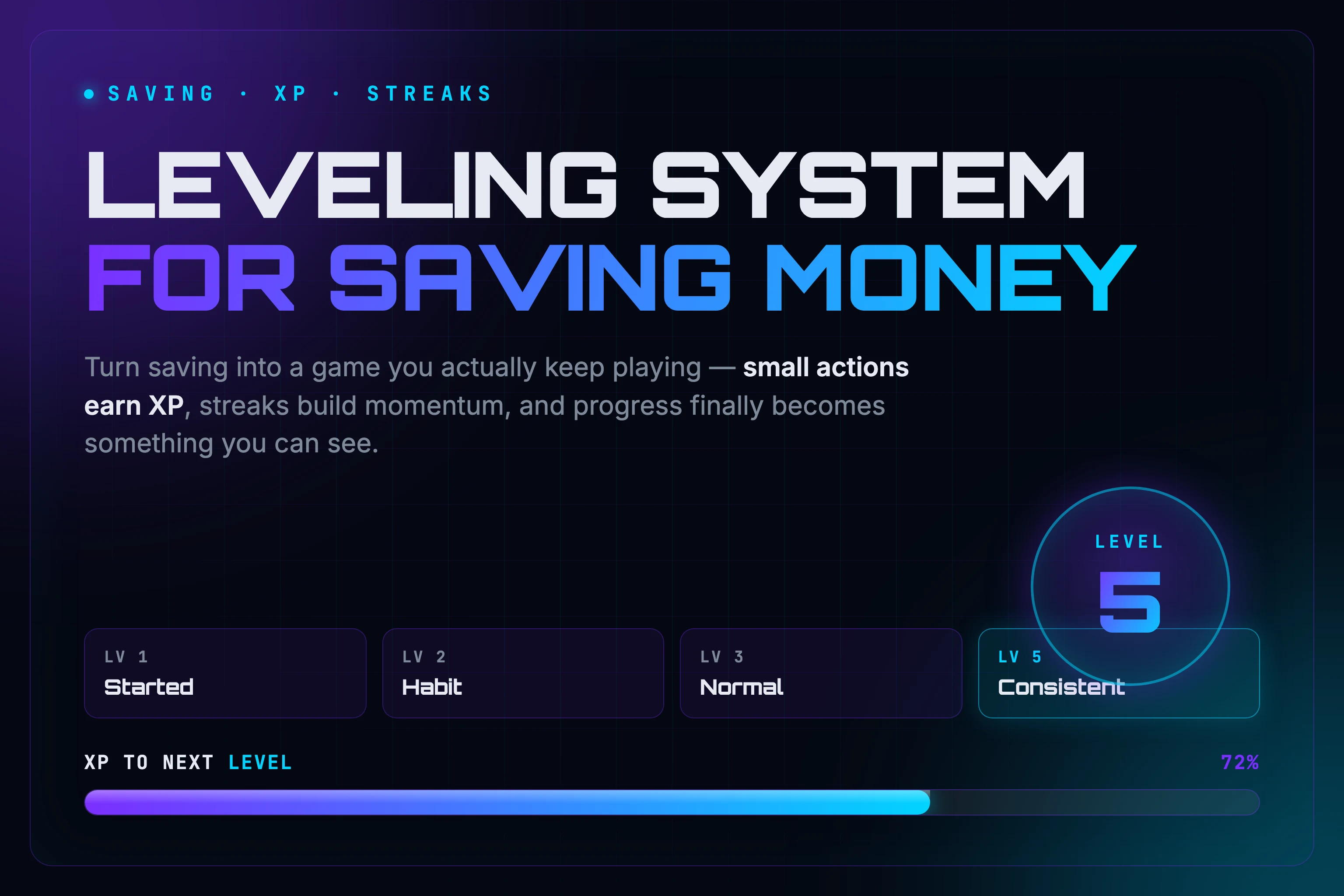
- Saving fails because progress is invisible and the reward feels too far away — not because you lack discipline
- A leveling system adds XP, levels, and streaks so every small action gives instant feedback
- 9 steps: start at Level 1, define XP, set milestones, build quests, add rewards, track visually, fight bosses
- Keep early levels easy — the first job is getting you to Level 2 before motivation fades
- Works with a notebook or spreadsheet; an app like Hunter Vault just runs the scorekeeping for you
Saving money is simple in theory and hard in practice.
You tell yourself you will save more this month and stop overspending. Then a few days pass, motivation fades, and you are back where you started. That is not a discipline problem. Traditional saving asks you to give something up now for a reward you cannot see or feel for months, and that kind of delayed payoff is hard for almost everyone to stick with.
A leveling system for saving money fixes the part that actually breaks: the missing feedback. Instead of relying on willpower, you turn saving into a progress system where small actions earn points, push you toward the next level, and give you something to see right away. In this guide you will learn how to build one in nine simple steps, with examples you can copy today.
Amounts below are in USD as examples — use whatever currency you actually budget in.
Quick Answer: What Is a Leveling System for Saving Money?
A leveling system for saving money applies game mechanics to your saving habit. You start at Level 1, assign XP to small money actions like saving a few dollars or having a no-spend day, and level up as you earn points. The goal is not to force discipline. It is to add visible progress and instant feedback so saving feels rewarding instead of restrictive.
You can build one with a notebook, a spreadsheet, or an app. The steps below work the same way no matter which you choose. (For the wider version of this idea, see what gamified budgeting actually means or 13 ways to level up your money habits.)
Why Most People Struggle to Save
Before the system, it helps to understand why the usual approach quietly fails.
Saving has no instant reward. When you spend, you get something now. When you save, you get nothing you can feel, so your brain keeps choosing the purchase. There is no shame in this. It is just how rewards work.
You cannot see progress. A balance that creeps up slowly does not feel like movement. Without feedback, it is easy to assume nothing is happening and give up. Visibility usually matters more than effort.
A leveling system attacks both problems directly. It adds a reward to every small action, and it makes progress something you can actually watch.
The 9-Step Leveling System for Saving Money
You cannot level up if you do not know where you are starting. Write down your current numbers with no judgment.
| Stat | Example |
|---|---|
| Current savings | $50 |
| Monthly income | $1,500 |
| Monthly spending | $1,300 |
Use whole, rough numbers in your own currency. This is just your starting screen, not a test you can fail.
Assign XP to the actions you want to repeat. The point is to reward the behavior, not just the result.
| Action | XP |
|---|---|
| Save $1 | 5 XP |
| Log your spending for the day | 10 XP |
| Save $5 | 20 XP |
| No-spend day | 30 XP |
| Stay under budget for the day | 40 XP |
Tune the numbers so the actions that are hardest for you give the most XP.
Levels turn a vague goal into a clear path. Set XP thresholds you can actually reach.
| Level | XP Needed | What It Represents |
|---|---|---|
| Level 1 | 0 | You started |
| Level 2 | 200 | Habit is forming |
| Level 3 | 500 | Saving feels normal |
| Level 4 | 900 | You are in control |
| Level 5 | 1,500 | Consistent saver |
Keep the early levels easy. The first job of a leveling system is to get you to Level 2, because that early win is what keeps you going.
Daily quests are small, repeatable actions that earn XP. A few good ones:
- Save a small fixed amount.
- Log your spending for the day.
- Skip one impulse purchase you would normally make.
Small and repeatable beats big and rare. A quest you can do every day builds the habit faster than one heroic saving day a month. (For ready-made challenges to slot in, see these gamified savings challenges like no-spend and 52-week.)
Rewards keep motivation high, as long as they do not undo your progress.
- Level 2: a small, low-cost treat.
- Level 3: a free or cheap fun activity.
- Level 5: something more meaningful you have been wanting.
Match the reward to the level so celebrating does not cancel out the saving. The reward is feedback, not a spending spree.
Pick a way to see your XP grow:
- A progress bar toward your next level.
- A simple chart of savings over time.
- A dashboard that shows your level and current XP.
Watching the bar fill is the part that hooks people. If you cannot see it, you will not feel it.
Track consecutive days you take a saving action or stay under budget. Streaks turn “saving once” into “saving consistently,” and once a streak gets long, you start protecting it on its own.
If you break a streak, just start a new one. A leveling system is about restarting without guilt, not punishing yourself for missing a day. (Streaks are one of the money habits that reinforce themselves the longer they run.)
Turn your biggest spending leaks into named challenges so they feel like something you can beat.
| Boss | Strategy |
|---|---|
| Overspending | Set a daily limit |
| Food delivery | Plan a few meals in advance |
| Impulse buying | Wait 24 hours before any non-essential purchase |
Beating a boss can be worth a big XP bonus. It reframes a frustrating habit as a level to clear instead of a personal flaw.
A notebook works, but the tracking, XP math, and streaks are exactly the kind of thing an app can handle automatically so you do not lose momentum.
This is where a gamified tracker like Hunter Vault fits naturally. Instead of doing the math yourself, you log a small saving action and it turns into XP, streaks, and visible progress, with savings goals acting as the progress bars in this system and quests handling the daily actions. It is built for people who want saving to feel like leveling up rather than another spreadsheet to maintain. For a full breakdown of how each feature maps to a specific motivation mechanic, see how Hunter Vault turns saving into a game.
This is general educational content, not financial advice. Choose a saving method that fits your income, responsibilities, and situation. If you are dealing with serious debt or financial hardship, consider speaking with a qualified financial professional.
A Simple Example You Can Copy
Here is the whole mechanic in one snapshot, built around XP thresholds rather than a dollar deadline.
- Goal framed as a level: reach Level 3 (500 XP) on the way to a $500 buffer
- Daily quests: save a small amount (20 XP), log expenses (10 XP)
- Level checkpoint: Level 2 lands at 200 XP — roughly ten days in — and unlocks a small treat
- Streak rule: keep the daily-action streak alive; the climb from Level 2 to Level 3 is mostly just protecting it
That is enough to start. You do not need a perfect setup. You need a system you can repeat.
Benefits of a Leveling System for Saving
When the system is working, it helps you:
- Stay consistent because every action gives feedback.
- Build the habit faster through small daily wins.
- Reduce overspending by naming and beating “bosses.”
- See progress clearly instead of guessing.
- Actually enjoy saving instead of dreading it.
Common Mistakes to Avoid
A giant XP spreadsheet you stop updating helps no one. Keep it simple enough to do daily.
Skipping rewards. With no payoff, you are back to pure willpower. Small rewards are part of the system, not a cheat.
Ignoring small wins. Saving $1 and earning 5 XP still counts. Small steps are the whole point.
Quitting after a broken streak. One missed day is not failure. Start a new streak and keep going.
Final Takeaway
A leveling system for saving money works because it fixes the real problem. Saving usually fails not because you lack discipline, but because the progress is invisible and the reward feels too far away. Add XP, levels, and streaks, and saving turns into something you can see and repeat.
You do not have to build the perfect system today. Start with one quest: save a small amount, log it, and watch your first bit of XP land. That is Level 1. Everything else is just showing up again tomorrow.
If you’d rather not track all of this by hand, try Hunter Vault and let the app keep score for you. It’s available on iOS and Android.